How cells change gears
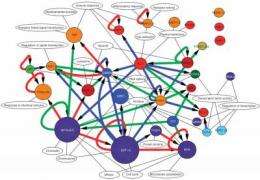
Bioinformatics researchers from UC San Diego just moved closer to unlocking the mystery of how human cells switch from "proliferation mode" to "specialization mode." This computational biology work from the Jacobs School of Engineering's bioengineering department could lead to new ideas for curbing unwanted cell proliferation—including some cancers. This research, published in Nature Genetics, could also improve our understanding of how organs and other complex tissues develop.
The UC San Diego bioengineers are part of a Japan-based global research consortium, the Genome Network Project, which generated one of the first close-to-comprehensive looks at a human cell's entire network of proteins called "transcription factors." Each human cell contains approximately 2,000 transcription factors, which are proteins that bind to specific locations on the cell's DNA. Once bound to DNA, transcription factors work to either encourage or prevent "transcription"—the process by which messenger RNA is generated from DNA. These messenger RNA strands then travel to cellular factories called ribosomes which churn out proteins based on the specifications of the mRNA.
"Transcription is one of the most important events in the cell…it determines cell morphology and cell function," said Timothy Ravasi, a UC San Diego research scientist from the bioengineering department and author on the new Nature Genetics paper.
Researchers have long understood that most transcription factors in human cells do not work alone, but studying the entire network of transcription factors within a cell has been difficult until now. In the new study, the researchers used a series of computational and integrative biology approaches in order to look at how the activity of the network of transcription factors in a myeloid leukemia cell line changes over time.
"Leukemia" refers to a variety of pathologies involving uncontrolled proliferation of white blood cells. Understanding the role of the transcriptional network during differentiation in leukemia cells could offer a glimpse into the cause of leukemia, or offer possible approaches for treating leukemia, according to Ravasi.
During the laboratory phase of the project, researchers introduced a compound that stopped cell proliferation in the myeloid leukemia cell line. Next, they collected as much information as possible regarding the activity of the transcription factor network during the processes of differentiation and maturation into immune cells known as monocytes and macrophages. Computational work performed at UC San Diego after all the laboratory data had been collected allowed the researchers to identify specific subnetworks of transcription factors that were activated at particular time points.
Integrative Biology
The UCSD researchers were challenged to integrate different but related data sets in order to tease out real signals from noise. This is known as "integrative biology."
"We take lots of measurements of the same thing…we integrate them together," which leads to higher confidence in experimental results, Ravasi explained. Measuring both messenger RNA and protein levels, is one example. Detection of both signals provides two independent data points indicating the presence of the same protein.
"Getting to be the first to analyze and make sense of this large and fascinating data set was a huge opportunity," said Ravasi. The UC San Diego bioinformatics team working on this project included Ravasi and two post-doctoral researchers from Trey Ideker's bioengineering laboratory, Ariel Schwartz, now at Synthetic Genomics, and Kai Tan, now an assistant professor of internal medicine and biomedical engineering at the University of Iowa.
By monitoring the activity of the transcriptional network one hour after the onset of differentiation, the researchers identified a gene that appears to play an important role in cell differentiation in white blood cells. "It's a long shot, but if you found a compound that inhibits this gene, you could make the cells begin to differentiate towards a normal monoblast line rather than continue unchecked cell proliferation," said Ravasi.
Resilient and Redundant
Based on the new research, it appears that the network of transcription factors from the human myeloid leukemia cell line is redundant and resilient, explained Ravasi.
The researchers turned-off or "knocked down" 52 transcription factors, one at a time, in order to study their individual role within the network. Most of the single knock-downs did not result in changes to cell differentiation or cell shape.
"The transcriptional network for this cell type appears quite redundant which likely makes the network resilient to mutations or environmental agents that could interfere with transcription factor function," said Ravasi. "My guess is that we will find similar redundancy in the transcription networks of other cell lines, and in the transcription networks that regulate other aspects of cell function, but we can't say that from these data."
Source: University of California - San Diego (news : web)


