Scientists monitor developing Mars dust storm
April 20, 2009 Scientists monitor developing Mars dust storm

Enlarge

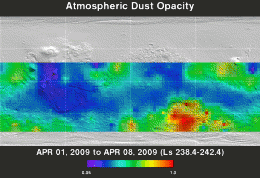
Greens, yellows, and reds map the growing density of dust in the Martian atmosphere, as seen during the first week of April 2009 by ASU's Thermal Emission Imaging Spectrometer on NASA's Mars Odyssey orbiter. The storm originated in the Hellas impact basin, the red patch at lower right. (Image credit: NASA/JPL/Arizona State University)

(PhysOrg.com) -- Scientists at Arizona State University's Mars Space Flight Facility are using the Thermal Emission Imaging System (THEMIS) on NASA's Mars Odyssey orbiter to monitor a new dust storm that has erupted on the Red Planet.

The dust storm began in mid-March 2009, in the large Southern Hemisphere impact basin named Hellas. It has since grown as it spread northward in a patchy fashion. How large the storm will become is unknown, but previous storms have grown to envelop the whole planet for weeks at a time.

"This storm is coming at a time in the Martian year — around the planet's closest approach to the Sun — when are common," says Philip Christensen, of the Space Flight Facility on the Tempe campus. Christensen, a Regents' Professor of geological sciences in the School of Earth and Space Exploration, is the designer and principal investigator for the THEMIS camera.

"But so far," he says, "this storm has not reached the severity of the big dust storm of 2001, or even the more modest one in 2007."

Mars' closest approach to the sun comes April 21, and summer begins in the planet's southern hemisphere a month later. Both effects combine to produce the atmospheric heating that drives the dust activity.

Dust in the eyes

Dust storms affect operations for all five spacecraft working at Mars. The fleet includes two NASA rovers on the ground (Spirit and Opprtunity), plus three orbiters, two of which belong to NASA ( and ) and one from the European Space Agency (Mars Express).

"If the dust causes a lot of obscuration, we lose the ability to image the ground," explains Christensen. "In big dust storms, the rover teams are strongly affected as dust in the air reduces sunlight which provides power for driving and science operations. And when the dust finally settles out, it coats the solar panels, diminishing their capability."

"We've noticed increasing opacity over the last several days," says Steve Ruff, of the Mars Space Flight Facility. "This has produced roughly a 20 percent drop in power for Spirit." Ruff is in charge of day-to-day operations for the Miniature Thermal Emission Spectrometers, a mineral-scouting instrument each rover carries.

In the 2007 storm, dust blocked more than 99 percent of the sunlight for both rovers.

"When kicks up," Ruff says, "it hurts."

Provided by Arizona State University (news : web)


print this article email this article download pdf blog this article bookmark this article     Stumble it Digg this share on Facebook retweet share on Reddit add to delicious
Rate this story - 4.3 /5 (4 votes)


April 20, 2009 all stories

Comments: 0

4.3 /5 (4 votes)
  • Stumble this up

  • Digg this

  • share this

  • hide
  • Related Stories

  • Arizona State scientists keep an eye on Martian dust storm
    created Jul 11, 2007 | popularity not rated yet | comments 0
  • Mars Spacecraft Teams on Alert for Dust-Storm Season
    created Apr 16, 2009 | popularity not rated yet | comments 0
  • HiRISE Catches a Dust Devil on Mars
    created Jul 20, 2007 | popularity not rated yet | comments 0
  • Mars Kicks Up the Dust as It Makes Closest Approach to Earth
    created Nov 03, 2005 | popularity not rated yet | comments 0
  • Mars Rover Team Sets Low-Power Plan for NASA's Spirit
    created Nov 17, 2008 | popularity not rated yet | comments 0


  • hide
  • Relevant PhysicsForums posts

  • Supernova's Gamma Rays and Comets
    created 49 minutes ago
  • Our Moon
    created 4 hours ago
  • Question about a Carl Zeiss lens
    created 17 hours ago
  • Origin of planets
    created 23 hours ago
  • More from Physics Forums - General Astronomy

Other News

States call on EPA for tougher air pollution regulations

Space & Earth / Environment

created 2 hours ago | popularity not rated yet | comments 0

Twelve states and the District of Columbia urged the Environmental Protection Agency Thursday to adopt more rigorous national policies so they can meet federal air pollution reduction requirements for the region.


Willis Tower

The greening of Willis Tower: Rooftop gardens part of plan to improve efficiency

Space & Earth / Environment

created 3 hours ago | popularity 4.3 / 5 (3) | comments 0

Growing up in the southwest suburbs, Sara Beardsley had a view of the Chicago skyline from her house. Today, she is transforming that skyline, but you won't find her work glorified on a $6 mug or gracing postcards.


Caribbean, Gulf spared widespread coral damage

Space & Earth / Environment

created 4 hours ago | popularity not rated yet | comments 0

(AP) -- Lower-than-feared sea temperatures this summer gave a break to fragile coral reefs across the Caribbean and the central Gulf of Mexico that were damaged in recent years, scientists said Thursday.


Space hotel taking bookings for 2012 opening

Space hotel taking bookings for 2012 opening

Space & Earth / Space Exploration

created 22 hours ago | popularity 4.5 / 5 (17) | comments 10

(PhysOrg.com) -- The first orbiting space hotel is on track to open for its first customers in 2012, but hurry, as bookings are filling fast.


Rapid supernova could be new class of exploding star

Rapid supernova could be new class of exploding star

Space & Earth / Astronomy

created 18 hours ago | popularity 4.6 / 5 (14) | comments 2

(PhysOrg.com) -- An unusual supernova rediscovered in seven-year-old data may be the first example of a new type of exploding star, possibly from a binary star system where helium flows from one white dwarf ...