Scientists discover a nearly Earth-sized planet (Update)
April 21, 2009 Lightest exoplanet yet discovered

Enlarge

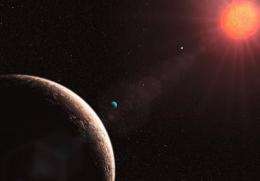
After more than four years of observations using the most successful low-mass-exoplanet hunter in the world, the HARPS spectrograph attached to the 3.6m ESO telescope at La Silla, Chile, astronomers have discovered in this system the lightest exoplanet found so far: Gliese 581-e (foreground) is only about twice the mass of our Earth. The Gliese 581 planetary system now has four known planets, with masses of about 1.9 (planet e, left in the foreground), 16 (planet b, nearest to the star), 5 (planet c, center), and 7 Earth-masses (planet d, with the bluish color). The planet furthest out, Gliese 581 d, orbits its host star in 66.8 days, while Gliese 581 e completes its orbit in 3.15 days. Credit: ESO/L. Calçada

(PhysOrg.com) -- Exoplanet researcher Michel Mayor announces the discovery of the lightest exoplanet found so far. The planet, "e," in the system Gliese 581, is only about twice the mass of our Earth. The team also refined the orbit of the planet Gliese 581-d, first discovered in 2007, placing it well within the habitable zone, where liquid water oceans could exist. These amazing discoveries are the outcome of observations using the HARPS spectrograph attached to the 3.6m ESO telescope at La Silla, Chile.

"The holy grail of current exoplanet research is the detection of a rocky, Earth-like planet in the 'habitable zone' — a region around the host star with the right conditions for water to be liquid on a planet's surface", says Michel Mayor from the Geneva Observatory, who led the European team to this stunning breakthrough.

Planet Gliese 581 e orbits its host star - located only 20.5 light-years away in the constellation Libra ("the Scales") — in just 3.15 days. "With only 1.9 Earth-masses, it is the least massive exoplanet ever detected and is, very likely, a rocky planet", says co-author Xavier Bonfils from Grenoble Observatory.

Being so close to its host star, the planet is not in the habitable zone. But another planet in this system appears to be. From previous observations — also obtained with the HARPS spectrograph at ESO's La Silla Observatory and announced two years ago — this star was known to harbour a system with a Neptune-sized planet (ESO 30/05) and two super-Earths (ESO 22/07). With the discovery of Gliese 581 e, the planetary system now has four known planets, with masses of about 1.9 (planet e), 16 (planet b), 5 (planet c), and 7 Earth-masses (planet d).

The planet furthest out, Gliese 581 d, orbits its host star in 66.8 days. "Gliese 581 d is probably too massive to be made only of rocky material, but we can speculate that it is an icy planet that has migrated closer to the star," says team member Stephane Udry. The new observations have revealed that this planet is in the habitable zone, where liquid water could exist. "'d' could even be covered by a large and deep ocean — it is the first serious 'water world' candidate," continued Udry.

The gentle pull of an exoplanet as it orbits the host star introduces a tiny wobble in the star's motion — only about 7 km/hour, corresponding to brisk walking speed — that can just be detected on Earth with today's most sophisticated technology. Low-mass red dwarf stars such as Gliese 581 are potentially fruitful hunting grounds for low-mass exoplanets in the habitable zone. Such cool stars are relatively faint and their habitable zones lie close in, where the gravitational tug of any orbiting planet found there would be stronger, making the telltale wobble more pronounced. Even so, detecting these tiny signals is still a challenge, and the discovery of Gliese 581 e and the refinement of Gliese 581 d's orbit were only possible due to HARPS's unique precision and stability.

"It is amazing to see how far we have come since we discovered the first exoplanet around a normal star in 1995 — the one around 51 Pegasi," says Mayor. "The mass of Gliese 581 e is 80 times less than that of 51 Pegasi b. This is tremendous progress in just 14 years."

The astronomers are confident that they can still do better. "With similar observing conditions an Earth-like planet located in the middle of the habitable zone of a red dwarf star could be detectable," says Bonfils. "The hunt continues."

More information: This discovery was announced today at the JENAM conference during the European Week of Astronomy & Space Science, which is taking place at the University of Hertfordshire, UK. The results have also been submitted for publication in the research journal Astronomy & Astrophysics ("The HARPS search for southern extra-solar planets: XVIII. An Earth-mass planet in the GJ 581 planetary system", by Mayor et al., 2009).

Provided by ESO


print this article email this article download pdf blog this article bookmark this article     Stumble it Digg this share on Facebook retweet share on Reddit add to delicious
Rate this story - 4.2 /5 (19 votes)

Rank Filter

Move the slider to adjust rank threshold, so that you can hide some of the comments.


Display comments: newest first

  • QubitTamer - Apr 21, 2009
    • Rank: 5 / 5 (6)
    Science news from the AP... gotta love it... Re-read the first sentence of the story: "Scientists...twice the size of Earth...located in a GALAXY outside our solar system."

    Really? We suddenly skipped several orders of magnitude of imaging capability and said you know what, our galaxy is a great big bore. Screw this galaxy, lets go find earth sized planets in a whole OTHER galaxy...

  • El_Nose - Apr 21, 2009
    • Rank: 4 / 5 (2)
    i thought i would be the only one to catch that -- funny we are imaging planets in other galaxies --
  • LuckyBrandon - Apr 21, 2009
    • Rank: not rated yet
    yea now that you mention it.....that is kinda jacked up....

    BUT, its an outstanding discovery :)
  • am_Unition - Apr 21, 2009
    • Rank: 4.5 / 5 (2)
    Also, they mention that "most" exoplanets are larger than Earth. If this is the smallest exoplanet found to date and is two times as massive as Earth... "all" exoplanets are larger than Earth.

    Yeah, AP pumps out some real quality stuff.
  • Bob_B - Apr 21, 2009
    • Rank: 5 / 5 (2)
    Please, do not cut and paste the AP story here, or Physorg could get sued by them. AP is now trying to stop people from reading their news unless you PAY for it.
  • am_Unition - Apr 21, 2009
    • Rank: 5 / 5 (2)
    Please, do not cut and paste the AP story here, or Physorg could get sued by them. AP is now trying to stop people from reading their news unless you PAY for it.


    Excellent! They'll be bankrupt shortly.
  • Suzu - Apr 21, 2009
    • Rank: 5 / 5 (2)
    That's an AP story? No wonder no one wants to subscribe.
  • am_Unition - Apr 21, 2009
    • Rank: 4 / 5 (2)
    Physorg, you did this up quite nicely.

    Thank you.
  • gopher65 - Apr 21, 2009
    • Rank: 4 / 5 (4)
    am_Unition: A long time ago they found some planets orbiting a neutron star. At least one of them is much smaller than Earth (Mars sized more or less). However, these are not standard planets. The star they orbit went supernova long ago. The planets are either the irradiated cores of gas giants (with all the gas blown away), new planets that formed out of the debris and gas that the exploding star flung out, or, maybe, they are rocky worlds that somehow survived the explosion.

    But in any case they aren't normal, and they aren't really in orbit around a "star", assuming that the definition of a star is "an object currently undergoing nuclear fusion via a mechanism of gravitation compression of the core".

    That's why they always say "this is the smallest planet found around a normal star" in these types of articles.
  • Fazer - Apr 21, 2009
    • Rank: 5 / 5 (3)
    From the About Physorg section:

    "Licensed sci-tech news from all major news agencies is published on Physrg."

    So they probably are paying AP, although the credit is from ESO.
  • omatumr - Apr 22, 2009
    • Rank: not rated yet
    EARTH-LIKE PLANETS WERE DISCOVERED IN 1992

    The first planetary system beyond our own was discovered by Alexander Wolszczan and Dale A. Frail [See: "A planetary system around the millisecond pulsar PSR1257 12," Nature, 255, 145 (1992)].

    That planetary system consists of three small, Earth-like planets orbiting the collapsed core of a supernova - a pulsating neutron star - a pulsar!

    There is a lesson on the birth of planetary systems there for those willing to learn.

    With kind regards,
    Oliver K. Manuel
    http://www.omatumr.com


  • jc123 - Apr 22, 2009
    • Rank: not rated yet
    the smallest pulsar planet Alex has found is around a moon mass
  • omatumr - Apr 22, 2009
    • Rank: 1 / 5 (1)
    jc123,

    There is a pulsar planet that is exactly the size of Earth. We ride on it!

    Circular polarized light from the pulsar separated chiral molecules like the d- and l-amino acids discovered in meteorites like Murchison.

    That is probably why amino acids in you and me are not racimic mixtures of amino acids.

    See: "The sun's origin, composition and source of energy", in Lunar and Planetary Science XXIX, Abstract 1041] The paper is available as 1041-pdf from Lunar and Planetary Institute, Houston, TX (CD-ROM, 2001) or contact me at omatumr@yahoo.com for a pdf file.

    With kind regards,
    Oliver K. Manuel
    http://www.omatumr.com
  • omatumr - Apr 26, 2009
    • Rank: 1 / 5 (1)
    jc123,

    The paper, "The sun's origin, composition and source of energy", is also available from arXiv: http://arxiv.org/.../0411255

    With kind regards,
    Oliver K. Manuel
    http://www.omatumr.com
  • gopher65 - Apr 26, 2009
    • Rank: not rated yet
    yeah... that's a giant load of woo if I've ever seen woo before:P. Are you in the Richard Hoagland Fan Club by any chance "professor"?

April 21, 2009 all stories

Comments: 15

4.2 /5 (19 votes)
  • Stumble this up

  • Digg this

  • share this

  • hide
  • Related Stories

  • A trio of super-Earths
    created Jun 16, 2008 | popularity not rated yet | comments 0
  • Astronomers find potentially habitable Earth-like planet
    created Apr 25, 2007 | popularity not rated yet | comments 0
  • Scientists discover new planet orbiting dangerously close to giant star
    created Nov 18, 2008 | popularity not rated yet | comments 0
  • Trio of Neptunes and their belt
    created May 17, 2006 | popularity not rated yet | comments 0
  • New rocky planet found in constellation Leo
    created Apr 09, 2008 | popularity not rated yet | comments 0


  • hide
  • Relevant PhysicsForums posts

  • The shape of our solar system's orbits.
    created Nov 07, 2009
  • Above or Below the Line of Nodes
    created Nov 07, 2009
  • Supernova vs. Nova?
    created Nov 07, 2009
  • Supernova's Gamma Rays and Comets
    created Nov 06, 2009
  • More from Physics Forums - General Astronomy

Other News

Deep creep means milder, more frequent earthquakes along Southern California's San Jacinto fault

Deep creep means milder, more frequent earthquakes along Southern California's San Jacinto fault

Space & Earth / Earth Sciences

created 15 hours ago | popularity 4.5 / 5 (4) | comments 0

With an average of four mini-earthquakes per day, Southern California's San Jacinto fault constantly adjusts to make it a less likely candidate for a major earthquake than its quiet neighbor to the east, the ...


Success in 'space elevator' competition (AP)

Success in 'space elevator' competition (Update 3)

Space & Earth / Space Exploration

created Nov 05, 2009 | popularity 4.3 / 5 (33) | comments 50

(AP) -- A robot powered by a ground-based laser beam climbed a long cable dangling from a helicopter on Wednesday to qualify for prize money in a $2 million competition to test the potential reality of the ...


In a Galaxy Far, Far Away...

In a Galaxy Far, Far Away...

Space & Earth / Astronomy

created Nov 06, 2009 | popularity 4.8 / 5 (5) | comments 17

(PhysOrg.com) -- Astronomers have published the discovery of the farthest known object in the cosmos: a star that exploded when the universe was only 630 million years old -- only 4.6% of its current age. ...


'Dropouts' pinpoint earliest galaxies

'Dropouts' pinpoint earliest galaxies

Space & Earth / Astronomy

created Nov 06, 2009 | popularity 4.2 / 5 (10) | comments 13

Astronomers, conducting the broadest survey to date of galaxies from about 800 million years after the Big Bang, have found 22 early galaxies and confirmed the age of one by its characteristic hydrogen signature ...


Space hotel taking bookings for 2012 opening

Space hotel taking bookings for 2012 opening

Space & Earth / Space Exploration

created Nov 05, 2009 | popularity 4.4 / 5 (21) | comments 11

(PhysOrg.com) -- The first orbiting space hotel is on track to open for its first customers in 2012, but hurry, as bookings are filling fast.