China says planning more dams on troubled Yangtze
April 21, 2009
China is planning to build more dams and reservoirs on the troubled Yangtze river

Enlarge

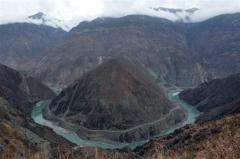
China's longest river, the Yangtze, seen from the remote mountains in Deqen Tibetan Autonomous Prefecture of southwest China's Yunnan province. China will build at least 20 more reservoirs or hydroelectric projects on the Yangtze river system by 2020, the government has said, despite growing concerns over dam construction there.

China will build at least 20 more reservoirs or hydroelectric projects in the Yangtze river system by 2020, the government said Tuesday, despite growing concerns over dam construction there.

The figure was contained in comments by a top water resources ministry official on plans for the Yangtze, China's longest river, and its upper reaches that were posted on the ministry's website.

"At least 20 (new) reservoirs will be put into operation by 2020," vice minister Hu Siyi was quoted as saying in a report on the website.

The increase was aimed primarily at further harnessing the hydropower resources of the Yangtze, the report said.

A proliferation of dams in the Yangtze drainage basin has drawn heavy criticism from domestic and overseas experts who have warned of a range of environmental and seismic risks.

Much of the criticism has been centred on the massive Three Gorges project in Hubei province.

Government reports in recent years have warned that the dam's huge reservoir had trapped massive amounts of pollution dumped into the river system and that the reservoir's weight on surrounding terrain was triggering landslides.

The state-run Daily newspaper said Tuesday the government's plans were aimed at tapping 60 percent of the river's hydroelectric potential by 2030.

It quoted Yangtze Water Resources Committee director Cai Qihua as telling a water conference in Shanghai on Monday that currently just 36 percent of that potential was now being harnessed.

But it also noted the proliferating dams and reservoirs -- aimed at meeting China's skyrocketing electricity needs and flood control -- were "posing threats to the ecology of the Yangtze River."

Chinese experts have warned that one of the many dams along the Yangtze river system may have triggered the massive earthquake last May that left 87,000 people dead or missing.

However government officials have rejected those assertions.

(c) 2009 AFP

4.5 /5 (2 votes)  

Rank 4.5 /5 (2 votes)
Related Stories
Relevant PhysicsForums posts
  • Do some geologists actually act a lot like Randy Marsh?
    createdFeb 11, 2012
  • Discrepancy between oxygen and carbon-dioxide levels
    createdFeb 09, 2012
  • where gems are found in the world
    createdFeb 09, 2012
  • Wind Waves in Reservoir ~ Wind run-up and Wind set-up
    createdFeb 08, 2012
  • Balance of oxygen in the atmosphere
    createdFeb 01, 2012
  • The case for a methanol-based economy
    createdJan 30, 2012
  • More from Physics Forums - Earth

More news stories

Salvage workers begin pumping fuel from Italian shipwreck

Salvage workers Sunday began pumping fuel from the shipwrecked Italian cruise liner Costa Concordia, a day ahead of schedule, officials said.

Space & Earth / Environment

created 10 hours ago | popularity 5 / 5 (2) | comments 0

Latin America mining boom clashes with conservation

Latin America is experiencing a mining boom as prices rise fuelled by a hike in global demand, but the region is also being hit by a wave of violent protests, strikes and rallies by environmentalists.

Space & Earth / Environment

created 18 hours ago | popularity 5 / 5 (1) | comments 1

Political leaders play key role in how worried Americans are by climate change: study

More than extreme weather events and the work of scientists, it is national political leaders who influence how much Americans worry about the threat of climate change, new research finds.

Space & Earth / Environment

created Feb 06, 2012 | popularity 5 / 5 (8) | comments 75

NASA budget will axe Mars deal with Europe: scientists

US President Barack Obama's budget proposal to be submitted next week for 2013 will cut NASA's budget by 20 percent and eliminate a major partnership with Europe on Mars exploration, scientists said Thursday.

Space & Earth / Space Exploration

created Feb 10, 2012 | popularity 5 / 5 (3) | comments 58

Humans may have helped the decline of African rainforests 3000 years ago

(PhysOrg.com) -- Large areas of rainforests in Central Africa mysteriously disappeared over three thousand years ago, to be replaced by savannas. The prevailing theory has been that the cause was a change ...

Space & Earth / Environment

created Feb 10, 2012 | popularity 4.1 / 5 (14) | comments 21 | with audio podcast report


Scientists discover molecular secrets of 2,000-year-old Chinese herbal remedy

For roughly two thousand years, Chinese herbalists have treated Malaria using a root extract, commonly known as Chang Shan, from a type of hydrangea that grows in Tibet and Nepal. More recent studies suggest that halofuginone, ...

New method to examine batteries -- MRI from the inside

There is an ever-increasing need for advanced batteries for portable electronics, such as phones, cameras, and music players, but also to power electric vehicles and to facilitate the distribution and storage of energy derived ...

Google might launch Drive for cloud storage soon

(PhysOrg.com) -- Google's next big move, according to the Wall Street Journal, is a cloud storage service called Drive. Hardly first to the plate, Google is simply catching up to introducing its cloud reposi ...

A mitosis mystery solved: How chromosomes align perfectly in a dividing cell

Although the process of mitotic cell division has been studied intensely for more than 50 years, Whitehead Institute researchers have only now solved the mystery of how cells correctly align their chromosomes during symmetric ...

Lab study raises questions over nano-particle impact

Tests involving chickens have raised questions about the impact on health from engineered nano-particles, the ultra-fine grains commonly used in drugs and processed foods, scientists said on Sunday.

Starve a virus, feed a cure? Findings show how some cells protect themselves against HIV

A protein that protects some of our immune cells from the most common and virulent form of HIV works by starving the virus of the molecular building blocks that it needs to replicate, according to research published online ...