Increasing Antarctic sea ice extent linked to the ozone hole
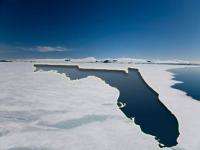
Increased growth in Antarctic sea ice during the past 30 years is a result of changing weather patterns caused by the ozone hole according to new research published this week (Thurs 23 April 2009).
Reporting in the journal Geophysical Research Letters scientists from British Antarctic Survey (BAS) and NASA say that while there has been a dramatic loss of Arctic sea ice, Antarctic sea ice has increased by a small amount as a result of the ozone hole delaying the impact of greenhouse gas increases on the climate of the continent.
Sea ice plays a key role in the global environment - reflecting heat from the sun and providing a habitat for marine life. At both poles sea ice cover is at its minimum during summer. However, during the winter freeze in Antarctica this ice cover expands to an area roughly twice the size of Europe. Ranging in thickness from less than a metre to several metres, the ice insulates the warm ocean from the frigid atmosphere above. Satellite images show that since the 1970s the extent of Antarctic sea ice has increased at a rate of 100,000 square kilometres a decade.
The new research helps explain why observed changes in the amount of sea-ice cover are so different in both polar regions.
Lead author Professor John Turner of BAS says,
"Our results show the complexity of climate change across the Earth. While there is increasing evidence that the loss of sea ice in the Arctic has occurred due to human activity, in the Antarctic human influence through the ozone hole has had the reverse effect and resulted in more ice. Although the ozone hole is in many ways holding back the effects of greenhouse gas increases on the Antarctic, this will not last, as we expect ozone levels to recover by the end of the 21st Century. By then there is likely to be around one third less Antarctic sea ice."
Using satellite images of sea ice and computer models the scientists discovered that the ozone hole has strengthened surface winds around Antarctica and deepened the storms in the South Pacific area of the Southern Ocean that surrounds the continent. This resulted in greater flow of cold air over the Ross Sea (West Antarctica) leading to more ice production in this region.
The satellite data reveal the variation in sea ice cover around the entire Antarctic continent. Whilst there has been a small increase of sea ice during the autumn around the coast of East Antarctica, the largest changes are observed in West Antarctica. Sea ice has been lost to the west of the Antarctic Peninsula - a region that has warmed by almost 3ºC in the past 50 years. Further west sea ice cover over the Ross Sea has increased.
Turner continues,
"Understanding how polar sea ice responds to global change - whether human induced or as part of a natural process - is really important if we are to make accurate predictions about the Earth's future climate. This new research helps us solve some of the puzzle of why sea-ice is shrinking is some areas and growing in others."
More information: The paper 'Non-annular atmospheric circulation change induced by stratospheric ozone depletion and its role in the recent increase of Antarctic sea ice extent' by J Turner, JC Comiso, G J Marshall, T A Lachlan-Cope, T Bracegirdle, T Maksym, MP Meredith, Z Wang, and A Orr (2009), is published in Geophysical Research Letters doi:10.1029/2009GL037524, [23 April 2009].
Source: British Antarctic Survey (news : web)


