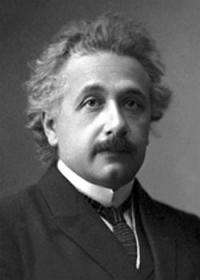
New Features Found in Einstein's Brain
April 21, 2009 by Miranda Marquit
Albert Einstein had a brain different from the "average" person.
(PhysOrg.com) -- When one thinks of Einstein, it is natural to assume that obviously his brain differed from that of the average person. And, ever since Thomas Harvey, a pathologist in Princeton, removed Einstein's brain upon his 1955 death and documented it, scientists have been studying it. Currently, Einstein's brain is in 240 pieces, mounted on slides. However, measurements and photographs were taken of the brain prior to its dis-assembly, and these photos are pored over every few years by those wishing to unravel the secrets of the brain belonging to one of the geniuses of the 20th Century.
In 1999, an anatomical study of Einstein's brain was made. Interestingly, reports Science Now, his brain was smaller than average:
"One parameter that did not explain Einstein's mental prowess, however, was the size of his brain: At 1230 grams, it fell at the low end of average for modern humans."
This meant that it was necessary to study the other intricacies of his brain. If Einstein's overall brain were at the smaller end, perhaps there were other things to find. The 1999 study by a team in Canada found that Einstein's parietal lobes were 15% wider than average. Science Now points out that these lobes are usually connected to spatial and visual cognition, as well as mathematics.
A new study has found even more differences in Einstein's brain. Dean Falk works at Florida State University and has studied the photographs of Einstein's brain in detail. In addition to the parietal lobes, Falk claims to have discovered a pattern of ridges and grooves in those wider lobes that is rare. This rare pattern is thought to have contributed to Einstein's visual thinking when it came to physics.
Another difference Falk found is related to a knob found in the motor cortex. Science Now describes the implications of this knob in the brain:
"[ I ]n other studies, similar "knobs" have been associated with musical ability. (Einstein had played the violin avidly since childhood.)"
The idea is that what made Einstein a genius has more to do with the structure of his brain, than its size. However, it is important to keep in mind that Einstein's brain in its totality can only be studied via photograph and compared to other photographs. And, of course, the brain is a complex and still-mysterious organ. But it may be that we can glean some additional insight from studying the structure of Einstein's brain.
© 2009 PhysOrg.com
-
Einstein’s brain
Jan 21, 2005 |
not rated yet |
0
-
Einstein papers to go on sale in London
May 22, 2006 |
not rated yet |
0
-
Bigger brain size matters for intellectual ability
Dec 22, 2005 |
not rated yet |
0
-
Focusing: Brain, not age, important
Oct 27, 2005 |
not rated yet |
0
-
Study: How the brain masks alcohol impact
Apr 26, 2006 |
not rated yet |
0
-
Engineers build first sub-10-nm carbon nanotube transistor
Feb 01, 2012 |
4.9 / 5 (30) |
30
-
Something old, something new: Evolution and the structural divergence of duplicate genes
Jan 31, 2012 |
4.6 / 5 (7) |
1
-
The hidden nanoworld of ice crystals: Revealing the dynamic behavior of quasi-liquid layers
Jan 30, 2012 |
5 / 5 (3) |
1
-
Stock market network reveals investor clustering
Jan 27, 2012 |
3.9 / 5 (23) |
8
-
Of microchemistry and molecules: Electronic microfluidic device synthesizes biocompatible probes
Jan 26, 2012 |
5 / 5 (1) |
0
-
Is Everyday Technology Killing Us?
Feb 08, 2012
-
Exercise and weight loss
Feb 08, 2012
-
Why do we have head aches? Our brains can't feel anything.
Feb 07, 2012
-
"The end of diseases" by David Agus, interview from Daily Show with Jon Stewart
Feb 04, 2012
-
Oncolytic adenovirus
Feb 04, 2012
-
Nutrition label stuffs and diets
Feb 02, 2012
- More from Physics Forums - Medical Sciences
More news stories
Curry spice component may help slow prostate tumor growth
Curcumin, an active component of the Indian curry spice turmeric, may help slow down tumor growth in castration-resistant prostate cancer patients on androgen deprivation therapy (ADT), a study from researchers ...
14 minutes ago |
not rated yet |
0
|
Arthritic knees, but not hips, have robust repair response
Researchers at Duke University Medical Center used new tools they developed to analyze knees and hips and discovered that osteoarthritic knee joints are in a constant state of repair, while hip joints are not.
24 minutes ago |
not rated yet |
0
|
To avoid early labor and delivery, weight and diet changes not the answer
One of the strongest known risk factors for spontaneous or unexpected preterm birth any birth that occurs before the 37th week of pregnancy, most often without a known cause is already having had one. For women ...
34 minutes ago |
not rated yet |
0
|
Joint patent for using the BRCA1 gene as a therapy for cardiovascular disease
St. Michael's Hospital and King Saud University have received their first joint U.S. patent to use the BRCA1 gene as a therapy for cardiovascular disease.
50 minutes ago |
not rated yet |
0
Orthopaedic surgery report provides transparency on patient safety, quality initiatives
At NYU Langone Medical Center the focus on quality, patient safety and patient experience are not just broad stroke initiatives but measureable, quantifiable and concrete. Patients and health care professionals can ...
49 minutes ago |
not rated yet |
0
Experts reveal how plants don't get sunburn
(PhysOrg.com) -- Experts at the University of Glasgow have discovered how plants survive the harmful rays of the sun.
Fool's gold may prove an unlikely alternative to overexploited catalytic materials
Catalytic materials, which lower the energy barriers for chemical reactions, are used in everything from the commercial production of chemicals to catalytic converters in car engines. However, with current catalytic materials ...
Unpicking HIV’s invisibility cloak
Drug researchers hunting for alternative ways to treat human immunodeficiency virus (HIV) infections may soon have a novel targetits camouflage coat. HIV hides inside a cloak unusually rich in a sugar ...
What lies beneath: Mapping hidden nanostructures
The ability to diagnose and predict the properties of materials is vital, particularly in the expanding field of nanotechnology. Electron and atom-probe microscopy can categorize atoms in thin sheets of material, ...
Netflix light on flicks as viewers soak up TV shows
Like most fresh faces that arrive in Hollywood, Netflix wanted to be a movie star. But now it's learning what many in Tinseltown have known for decades: Movies are sexy, but the real money is in television.
Sony's Hirai refuses to abandon dire TV business
Struggling Japanese entertainment giant Sony will not abandon its cash-bleeding television business, its incoming CEO says, but he acknowledges tough decisions lie ahead including over redundancies.
Apr 21, 2009
Rank: 3 / 5 (2)
Apr 21, 2009
Rank: 5 / 5 (3)
Is it really that difficult to use 'its' correctly?
Apr 21, 2009
Rank: 4 / 5 (5)
I think some people try to look for some physical gift because they can't comprehend what hard work is let alone how to do it.
I knew a physics student at college who memorized every single page of lecture notes. He did not have a photographic memory. This dedication of 100% of his time both astonished and humbled me. Almost every second of his time was spent revising pages in his head. Once he had them dialed in, he could revise the pages purely using thought. Waiting for a bus, doing the laundry were all revision opportunities as the data was all in his head.
If I had never met anyone like this I would probably never realize that there are regular people 100% dedicated to a goal.
Apr 21, 2009
Rank: 1 / 5 (1)
Apr 21, 2009
Rank: 1.3 / 5 (12)
Apr 21, 2009
Rank: 5 / 5 (1)
Seriously though, it could be a combination of things: Unique brain structures, hard work and dedication to a task, being in the right place at the right time. It's all adds up. Maybe one day we will know where genius comes from. In the mean time, let's just hope there are plenty of geniuses out there. Will the real T.O.E. please stand up?
Apr 22, 2009
Rank: 5 / 5 (5)
Apr 22, 2009
Rank: 1 / 5 (5)
To what extent are you influenced by Christianity?
"As a child I received instruction both in the Bible and in the Talmud. I am a Jew, but I am enthralled by the luminous figure of the Nazarene."
Have you read Emil Ludwig's book on Jesus?
"Emil Ludwig's Jesus is shallow. Jesus is too colossal for the pen of phrasemongers, however artful. No man can dispose of Christianity with a bon mot."
You accept the historical Jesus?
"Unquestionably! No one can read the Gospels without feeling the actual presence of Jesus. His personality pulsates in every word. No myth is filled with such life."
George Sylvester Viereck, "What Life Means to Einstein", The Saturday Evening Post, 26 October 1929.
Apr 22, 2009
Rank: 5 / 5 (3)
Apr 22, 2009
Rank: 4.2 / 5 (5)
Kinda like a cave man trying to understand a computer by breaking it into smaller pieces.
But I guess it is still fun to do anyway. Now where did I put my club?
Apr 22, 2009
Rank: 5 / 5 (9)
"The word god is for me nothing more than the expression and product of human weaknesses, the Bible a collection of honourable, but still primitive legends which are nevertheless pretty childish. No interpretation no matter how subtle can (for me) change this."
Apr 22, 2009
Rank: 5 / 5 (12)
"It was, of course, a lie what you read about my religious convictions, a lie which is being systematically repeated. I do not believe in a personal God and I have never denied this but have expressed it clearly. If something is in me which can be called religious then it is the unbounded admiration for the structure of the world so far as our science can reveal it."
Can we put the god crap to rest now?
Apr 22, 2009
Rank: not rated yet
Apr 22, 2009
Rank: 5 / 5 (3)
Apr 22, 2009
Rank: 2 / 5 (1)
Apr 22, 2009
Rank: not rated yet
I do agree that his brain should have been Cryo frozen. Circa 2045 we will be regretting that mistake (Kurzweil et al). Although ultimately it won't matter as computerized human level thought will become so cheap in the next 50 years. I only hope that it happens in the US. However it is more likely to happen in China or India. The US is in a massive trade,financial and education deficit. We need thought automation to spur the next tech revolution and claw us out of the caveman dark ages.
Apr 22, 2009
Rank: not rated yet
The fact that people are still researching his brain after all this time should reflect poorly on the individuals doing so. There are SO many other more important matters to attend to.
I protest funding for wasteful efforts such as this!
Apr 22, 2009
Rank: not rated yet
Einstein claimed that the reason he worked on his Unified Field Theory (even though the work was going nowhere for so long) was because he wanted to show that it was a dead end and so no one else would have to go down that barren road.
Apr 22, 2009
Rank: not rated yet
Why do people immediately go to cryo as a way to save people? Cryo-statis results in total cellular damage. Water, main component of the human body, and all cells found in nature, expands drastically when frozen. Everyone of those people frozen are long gone, permanently.
Apr 25, 2009
Rank: 2.5 / 5 (2)
Cause: Big brain =>
result: Intelligence.
Deception: Small brain.
result: Huuu must be ehh. the big frontlobes then.
There are so many other options.
Cause: Big effort in spatial science =>
Result: Front lobes increased size. We have seen the brain adapting.
Maybe the intelligence was in the use of his hairstyle. With all those antennas in the free Fresnel zone he must have picked up the thoughts of God. Huh. :)
Apr 25, 2009
Rank: 2 / 5 (4)
He was not that smart.
Apr 26, 2009
Rank: 5 / 5 (1)
And of course you would be judging Einstein comparing to your own contributions, which must be immeasurable.
Apr 26, 2009
Rank: not rated yet
While, ice crystals which form certainly do significant damage, it's still by far the best method of preserving life, there are substances which can be used to substitute for some cellular water and reduce damage during freezing, trehalose (a kind of sugar) is one example.
Human cells are routinely being frozen and thawed in lab practice and while many do die in the process the vast majority is able to survive.
Freezing animals is way more challenging but it should eventually be possible to freeze a human and then bring him back to life. Still the process will likely result in some permanent damage to the individual.
Apr 26, 2009
Rank: not rated yet
Synaptic weights and inter-cellular connections as far as I know are more or less preserved, even though cell membranes are ruptured and molecular processes potentially unresumable as they are.
I suspect that if they have the pieces, even if poorly preserved, his chances for recovery are decent.
Apr 29, 2009
Rank: not rated yet
IMHO the primary goal of cryo is not resuscitation or saving people. It is to enable future scan and upload of their minds into a simulator. This virtual restore of the brain should be available c. 2050. Although the exact date doesn't really matter :).
Apr 29, 2009
Rank: 1 / 5 (1)
Apr 29, 2009
Rank: not rated yet