Ultrasound imaging now possible with a smartphone
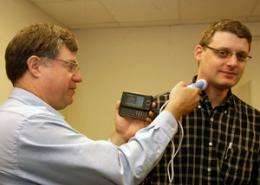
Computer engineers at Washington University in St. Louis are bringing the minimalist approach to medical care and computing by coupling USB-based ultrasound probe technology with a smartphone, enabling a compact, mobile computational platform and a medical imaging device that fits in the palm of a hand.
William D. Richard, Ph.D., Washington University Associate Professor of Computer Science and Engineering, and David Zar, Washington University Research Associate in Computer Science and Engineering, have made commercial USB ultrasound probes compatible with Microsoft Windows Mobile-based smartphones, thanks to a $100,000 grant Microsoft awarded the two in 2008.
In order to make commercial USB ultrasound probes work with smartphones, the researchers had to optimize every aspect of probe design and operation, from power consumption and data transfer rate to image formation algorithms. As a result, it is now possible to build smartphone-compatible USB ultrasound probes for imaging the kidney, liver, bladder, and eyes, endocavity probes for prostate and uterine screenings and biopsies, and vascular probes for imaging veins and arteries for starting IVs and central lines.
Both medicine and global computer use will never be the same.
"You can carry around a probe and cell phone and image on the fly now," said Richard. "Imagine having these smartphones in ambulances and emergency rooms." "On a larger scale, this kind of cell phone is a complete computer that runs Windows. It could become the essential computer of the Developing World, where trained medical personnel are scarce, but most of the population, as much as 90 percent, have access to a cell phone tower." "Twenty-first century medicine is defined by medical imaging," said Zar. "Yet 70 percent of the world's population has no access to medical imaging. It's hard to take an MRI or CT scanner to a rural community without power."
Shrinking the electronics over 25 years
Zar said the vision of the new system is to train people in remote areas of the developing world on the basics of gathering data with the phones and sending it to a centralized unit many miles, or half a world, away where specialists can analyze the image and make a diagnosis. Zar wrote the phone software and firmware for the probes; Richard came up with the low-power probe electronics design. He began working on ultrasound system designs 25 years ago, and in that span he has shrunk the electronics from cabinet-sized to a tiny circuit board one inch by three inches. A typical, portable ultrasound device may cost as much as $30,000. Some of these USB-based probes sell for less than $2,000 with the goal of a price tag as low as $500.
Another promising application is for caregivers of patients with Duchene's Muscular Dystrophy. A degenerative disease that often strikes young boys and robs them of their lives by their late 20s, DMD is a degenerative disease for which there is no cure. The leading treatment to slow its progression is a daily dose of steroids. Patients often experience some side effects to steroids, which are dose related. These side effects include behavioral problems and weight gain. Researchers now know that physical changes in muscle tissue can indicate the efficacy of the steroids. Measuring these changes in muscle can be accomplished with ultrasound and may allow researchers to optimize steroid dosing to maximize efficacy while minimizing side effects. "The idea is that caregivers, who otherwise have to transport a young person often wheelchair bound to a hospital or clinic on a regular basis for examination, can be trained to do ultrasound to track muscle condition," Zar said. "This could lower the dosage to the least effective amount to further increase quality of life of the patient and the caregiver and hopefully extend life. We're really excited about this application. The caregiver would only have to do a one-minute scan, transfer the data captured to the clinic, and the results would come back to the caregiver. A group at the Washington University Medical School studying Duchene's Muscular Dystrophy is very interested in our devices and hope they can incorporate them into their research plans."
Field trials in the Third World
Richard and Zar have discussed a potential collaboration with researchers at the Massachusetts Institute of Technology about integrating their probe-smartphone concept into a suite of field trials for medical applications in developing countries. "We're at the point of wanting to leverage what we've done with this technology and find as many applications as possible,' Richard said.
One such application could find its way to the military. Medics could quickly diagnose wounded soldiers with the small, portable probe and phone to detect quickly the site of shrapnel wounds in order to make the decision of transporting the soldier or treating him elsewhere on the field.
Richard and Zar demonstrated a fully functional smartphone-compatible USB ultrasound probe at Microsoft Research Techfest 2009 in February, and Zar presented the technology at the 2009 World Health Care Congress held in Washington, D.C., from April 14-16.
Source: Washington University in St. Louis (news : web)


