Mars explorer says we'll find life on other planets within 10 years
April 21, 2009 Mars explorer says we'll find life on other planets within 10 years

Enlarge

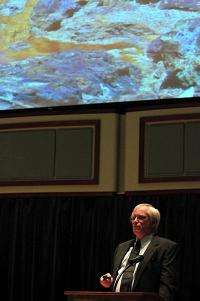
Peter Smith, principal investigator of NASA's Phoenix Mars Mission, predicts that we'll find life outside Earth within 10 years. Credit: Photo by Kathy F. Atkinson/University of Delaware

Within 10 years, we'll find life outside Earth -- that's the prediction of Peter Smith, the University of Arizona professor who led NASA's Phoenix Mars Mission.

While Smith is not predicting we'll encounter the six-legged apes that appeared on Mars in the books by Edgar Rice Burroughs that captured his imagination as a youngster, he does think we'll find microscopic organisms there.

And ultimately, whether it happens this century or a thousand years from now, we're going to be sending humans to the Red Planet, according to Smith.

Smith held the audience spellbound in his lecture, "Journey of the Phoenix," on April 16 at the University of Delaware, as he shared images taken by the Phoenix Mars Lander, which touched down in the Martian arctic on May 25, 2008.

The mission was a collaboration of numerous agencies and academic institutions, including the University of Arizona's Science Operations Center, NASA's in Pasadena, Calif., and Lockheed Martin Space Systems in Denver, along with scientific institutes in Canada, Denmark, Finland, Germany, and Switzerland.

When the spacecraft launched from Cape Canaveral in August 2007, Smith said its nine solid rockets left a vapor trail that was a good omen -- the pattern of a Phoenix bird.

Landing on the Red Planet was the next marvel, with the spacecraft entering Mars' atmosphere at 13,000 miles per hour, withstanding heat up to 2,600 degrees, and then dropping by parachute onto the planet's surface. Then the lander's solar arrays needed to open to begin generating power and the rest of its tools needed to function as planned, among them a robotic arm for digging, a weather station, a series of ovens, a microscope, and cameras.

For the next five months, the stationary probe, controlled by Smith and his crew from the University of Arizona's Science Operations Center, focused on digging and analyzing from an area about the size of a couch on the very cold, dry, volcanic planet where, according to Smith, there has been no rain for at least 100,000 years.

Mars' closest correllary on Earth is the Dry Valleys of Antarctica, Smith said. Although no life was discovered on Mars by Phoenix, tiny organisms inhabit the soils of Antarctica's Dry Valleys, including a predatory nematode about a sixteenth of an inch long.

"Martian soil is really sticky and clumpy," Smith said noting that the probe would get a scoop of soil to pour into its ovens for chemistry experiments, but it would take four days of shaking to get the soil through the screens.

As the weather on Mars started to get cloudy and snowy, the solar power for the spacecraft dwindled, and on Nov. 2, 2008, the entered the "Sleeping Beauty" mode.

By the end of its mission, the Phoenix Mars Mission confirmed the presence of frozen water just below the planet's surface, found minerals that form in liquid water, identified nutrients in the soil that could sustain microbes, and observed snow in the atmosphere. The lander also took lots of photos -- more than 25,000 of them -- ranging from grand landscapes to the tiniest of images using the first atomic force microscope ever used outside Earth.

Smith said the next mission to Mars will include a large rover the size of a MINI-Cooper, with big tires, that would last at least five years and land near an area of high interest, such as the edge of a canyon.

"We're ardently searching for evidence of life on our closest planet," Smith said.

"I think it's coming, I really do," Smith noted. "At some point, we'll turn over a rock, and by gosh there it is."

The evening before, Smith was awarded the American Geographical Society's Cullum Geographical Medal at UD. The awards ceremony and Smith's lecture were among the culminating activities of the University of Delaware's William S. Carlson International Polar Year Events, celebrating UD's president from 1946-1950 who was a polar explorer and the world's fourth International Polar Year.

Source: University of Delaware (news : web)


Rate this story - 4.3 /5 (44 votes)

Rank Filter

Move the slider to adjust rank threshold, so that you can hide some of the comments.


Display comments: newest first

  • paulthebassguy - Apr 21, 2009
    • Rank: 2.8 / 5 (4)
    Alright then, 22nd of April 2019 - I am willing to bet that they will not find martian life by then.

    The only microbes that we will find are those that came from Earth (the spacecraft and tools etc are not sterilized before they are sent to mars).
  • DonR - Apr 21, 2009
    • Rank: 3 / 5 (1)
    I'll take that bet.
  • Bob_Kob - Apr 21, 2009
    • Rank: 3 / 5 (1)
    Why dont we just put life on mars if it doesnt already contain it. Who knows what it will change to over the decades of being on another planet.
  • robbycoats - Apr 22, 2009
    • Rank: 4 / 5 (1)
    I think we know exactly how it might change over decades, I think you mean eons.
  • Modernmystic - Apr 22, 2009
    • Rank: 1 / 5 (1)
    I'll take that bet.


    Done.
  • Rdavid - Apr 22, 2009
    • Rank: not rated yet
    to paulthebassguy:

    How do you think life started here on Earth? Someone else didn't sterilize their visitation equipment.
  • theEXxman - Apr 22, 2009
    • Rank: 2.7 / 5 (3)
    What we really need is humans exploring and not little robots NASA just needs to get off is lazy behind and start sending humans to Mars. That's the only way we can put to rest whether the Face is real or just one big sandbox.
  • livemachine - Apr 22, 2009
    • Rank: 5 / 5 (2)
    its says "life on other planets". not just Mars. i bet between the efforts of the Mars rovers and the new telescope just launched (who's job IS to search for Earthlike planets and signs of life on them) we will find evidence of other life within 10 years. Our technology is advancing very rapidly. A lot can happen in just a decade
  • Modernmystic - Apr 22, 2009
    • Rank: 1 / 5 (2)
    My guess is that we will find evidence of life on extrasolar planets, but I don't think we'll find evidence on Mars.

    One caveat. We wont' find evidence sending another fifteen probes who keep finding nothing.
  • joe2m - Apr 24, 2009
    • Rank: not rated yet
    I will not be surprised at all if life is found on Mars. In fact, it probably does harbor microbes based on the data gathered so far. Microbial life is found in all places it has been looked for on Earth. Even places deemed by the "old school" Stanier type microbiologists as inhospitable. Methane signature, in combination with an apparent methane cycling (methane being oxidized to CO2 and H2--->CO2 being reduced to methane), plus the water findings...strongly suggests life. Geological mechanisms may account for the methane, but the cycling strongly reduces the chances an already fairly unlikely mechanism.
  • thales - Apr 24, 2009
    • Rank: not rated yet
    Those who are betting - care to put your money where your mouth is? Warren Buffett, Ray Kurzweil, and even Freeman Dyson have used the Long Bets website to, well, make long bets. Now you can too.

    http://www.longbets.org/

April 21, 2009 all stories

Comments: 11

4.3 /5 (44 votes)

  • hide
  • Related Stories

  • Phoenix Heads for Mars
    created Aug 04, 2007 | popularity not rated yet | comments 0
  • Phoenix Gets Bonus Soil Sample
    created Oct 20, 2008 | popularity not rated yet | comments 0
  • NASA Hearing Daily From Weak Phoenix Mars Lander
    created Nov 04, 2008 | popularity not rated yet | comments 0
  • Phoenix Mars Lander Working With Sticky Soil
    created Jul 29, 2008 | popularity not rated yet | comments 0
  • Phoenix Lander Winds Up Its Astonishing Summer On Mars
    created Nov 25, 2008 | popularity not rated yet | comments 0


  • hide
  • Relevant PhysicsForums posts

Other News

Orion in a New Ligh

Orion in a New Ligh (w/ Video)

Space & Earth / Astronomy

created 35 minutes ago | popularity not rated yet | comments 0 | with audio podcast

(PhysOrg.com) -- The Orion Nebula reveals many of its hidden secrets in a dramatic image taken by ESO’s new VISTA survey telescope. The telescope’s huge field of view can show the full splendour of the whole ...


India announces long-range nuclear-capable missile test

Space & Earth / Space Exploration

created 1hour ago | popularity 5 / 5 (1) | comments 0

India will test a nuclear-capable missile with a range of over 5,000 kilometres (3,000 miles) within a year, its top military scientist said Wednesday, risking a rise in regional tensions.


Space shuttle Endeavour pulls in at space station (AP)

Space shuttle Endeavour pulls in at space station

Space & Earth / Space Exploration

created 6 hours ago | popularity 5 / 5 (1) | comments 0

(AP) -- Shuttle Endeavour arrived to a warm welcome at the International Space Station early Wednesday, delivering a new room and observation deck that will come close to completing construction 200 miles ...


Climate 'Tipping Points' May Arrive Without Warning, Says Top Forecaster

Space & Earth / Environment

created 16 hours ago | popularity 3.5 / 5 (11) | comments 11 | with audio podcast

(PhysOrg.com) -- A new University of California, Davis, study by a top ecological forecaster says it is harder than experts thought to predict when sudden shifts in Earth's natural systems will occur -- a worrisome finding ...


38 percent of world's surface in danger of desertification

38 percent of world's surface in danger of desertification

Space & Earth / Environment

created 13 hours ago | popularity 2 / 5 (4) | comments 7

A team of Spanish researchers has measured the degradation of the planet's soil using the Life Cycle Assessment (LCA), a scientific methodology that analyses the environmental impact of human activities, and ...