'You will give birth in pain': Neanderthals too
April 21, 2009 'You will give birth in pain': Neanderthals too

Enlarge

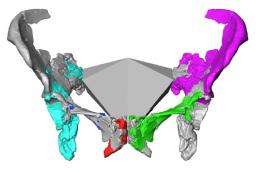
Virtual reconstruction of the pelvis of a female Neanderthal from Tabun (Israel). The colours indicate the individual bone fragments that were fit together. The gray wedge shows the estimated configuration of the sacrum (lower part of the spinal column). Image: Tim Weaver, University of California

(PhysOrg.com) -- Researchers from the University of California at Davis (USA) and the Max Planck Institute for Evolutionary Anthropology in Leipzig (Germany) present a virtual reconstruction of a female Neanderthal pelvis from Tabun (Israel). Although the size of Tabun’s reconstructed birth canal shows that Neanderthal childbirth was about as difficult as in present-day humans, the shape indicates that Neanderthals retained a more primitive birth mechanism than modern humans.

The virtual reconstruction of the pelvis from Tabun is going to be the first of its kind to be available for download on the internet for everyone interested in the evolution of humankind.

in humans is more complicated than in other . Unlike the situation in great apes, human babies are about the same size as the birth canal, making passage difficult. The birth mechanism, a series of rotations the baby must undergo to successfully navigate its mother’s birth canal, distinguishes humans not only from great apes but also from lesser apes and monkeys.

It has been difficult to trace the evolution of human childbirth because the pelvic skeleton, which forms the margins of the birth canal, tends to survive poorly in the fossil record. Only three fossil female individuals preserve fairly complete birth canals, and they all date to earlier phases of human evolution.

Tim Weaver of the University of California (Davis, USA) and Jean-Jacques Hublin, director at the Max Planck Institute for Evolutionary Anthropology in Leipzig (Germany) now present a virtual reconstruction of a female Neanderthal pelvis from Tabun (Israel). The size of Tabun’s reconstructed birth canal shows that Neanderthal childbirth was about as difficult as in present-day humans. However, its shape indicates that Neanderthals retained a more primitive birth mechanism than modern humans, without rotation of the baby’s body.

A significant shift in childbirth apparently happened quite late in human evolution, during the last 400,000 - 300,000 years. Such a late shift underscores the uniqueness of human childbirth and the divergent evolutionary trajectories of and the lineage leading to present-day humans.

The virtual reconstruction of the pelvis from Tabun is going to be the first of its kind to be available for download on the internet for everyone interested in human evolution. The computer files will be available from the websites of University of California at Davis and the Max Planck Institute for Evolutionary Anthropology.

More information: Timothy D. Weaver, Jean-Jacques Hublin, Neandertal birth canal shape and the evolution of human childbirth, Proceedings of the National Academy of Sciences (PNAS), online Early Edition, April 20th, 2009

Provided by Max Planck Institute


print this article email this article download pdf blog this article bookmark this article     Stumble it Digg this share on Facebook retweet share on Reddit add to delicious
Rate this story - 4.5 /5 (11 votes)


April 21, 2009 all stories

Comments: 0

4.5 /5 (11 votes)
  • Stumble this up

  • Digg this

  • share this

  • hide
  • Related Stories

  • Anthropologist's studies of childbirth bring new focus on women in evolution
    created Feb 17, 2009 | popularity not rated yet | comments 0
  • Handsome by Chance
    created Aug 02, 2007 | popularity not rated yet | comments 0
  • Oldest Fossil Protein Sequenced
    created Mar 09, 2005 | popularity not rated yet | comments 0
  • Neanderthal bearing teeth
    created Dec 04, 2007 | popularity not rated yet | comments 0
  • Natural Selection and the Human Skull
    created Mar 18, 2008 | popularity not rated yet | comments 0


  • hide
  • Relevant PhysicsForums posts

  • Human Leukocyte Antigen (HLA) typing
    created 2 hours ago
  • Breeding program
    created Nov 20, 2009
  • How does a concentration gradient provide energy?
    created Nov 20, 2009
  • Eyesight and Neural Damage from Electronics
    created Nov 19, 2009
  • More from Physics Forums - Biology

Other News

Museum: Galileo's fingers, tooth are found (AP)

Museum: Galileo's fingers, tooth are found

Other Sciences / Archaeology & Fossils

created 13 hours ago | popularity not rated yet | comments 5

(AP) -- Two fingers and a tooth removed from Galileo Galilei's corpse in a Florentine basilica in the 18th century and given up for lost have been found again and will soon be put on display, an Italian museum ...


Measure to change U. of Neb. stem-cell rule fails (AP)

Measure to change U. of Neb. stem-cell rule fails (Update 2)

Other Sciences / Other

created 13 hours ago | popularity 5 / 5 (1) | comments 0

(AP) -- The University of Nebraska's governing board on Friday voted not to place tighter restrictions on embryonic stem cell research than those outlined under federal guidelines, which were expanded after ...


Researcher: Faint writing seen on Shroud of Turin (AP)

Researcher: Faint writing seen on Shroud of Turin (Update)

Other Sciences / Archaeology & Fossils

created Nov 20, 2009 | popularity 1.7 / 5 (22) | comments 23

(AP) -- A Vatican researcher has rekindled the age-old debate over the Shroud of Turin, saying that faint writing on the linen proves it was the burial cloth of Jesus. Experts say the historian may be reading ...


Three of a kind

Three of a kind: Revealing language’s universal essence

Other Sciences / Social Sciences

created Nov 20, 2009 | popularity 3.5 / 5 (8) | comments 6

(PhysOrg.com) -- On the surface, English, Japanese, and Kinande, a member of the Bantu family of languages spoken in the Democratic Republic of Congo, have little in common. It is not just that the vocabularies ...


Maya

New insights into the life of the Maya

Other Sciences / Archaeology & Fossils

created Nov 16, 2009 | popularity 4.6 / 5 (15) | comments 7

(PhysOrg.com) -- Ancient artifacts are almost always concerned with rich and powerful religious and political leaders, but new excavations of an ancient Maya site have unearthed a pyramid decorated with murals ...