Researcher discover two highly complex organic molecules detected in space
April 21, 2009
Researcher discover two highly complex organic molecules detected in space

Enlarge

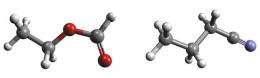
Two new highly complex organic molecules detected in space. Left: Ethyl formate, Right: n-Propyl cyanide. Colour code of the atomic constituents of both molecules: hydogen (H): white, carbon (C): grey, oxygen (O): red and nitrogen (N): blue. Image: Oliver Baum, University of Cologne

(PhysOrg.com) -- Scientists from the Max Planck Institute for Radio Astronomy (MPIfR) in Bonn, Germany, Cornell University, USA, and the University of Cologne, Germany, have detected two of the most complex molecules yet discovered in interstellar space: ethyl formate and n-propyl cyanide.

Their computational models of interstellar chemistry also indicate that even larger organic may be present - including the so-far elusive , which are essential for organic life. The results will be presented at the European Week of Astronomy and Space Science at the University of Hertfordshire on Tuesday 21st April.

The IRAM 30 metre telescope in Spain was used to detect emissions from molecules in the star-forming region Sagittarius B2, close to the centre of our galaxy. The two new molecules were detected in a hot, dense cloud of gas known as the "Large Molecule Heimat", which contains a luminous newly-formed star. Large organic molecules of many different sorts have been detected in this cloud in the past, including alcohols, aldehydes, and acids. The new molecules, ethyl formate (C2H5OCHO) and n-propyl cyanide (C3H7CN), represent two different classes of molecule - esters and alkyl cyanides - and they are the most complex of their kind yet detected in interstellar space.

and molecules emit radiation at very specific frequencies, which appear as characteristic "lines" in the electromagnetic spectrum of an astronomical source. Recognizing the signature of a molecule in that spectrum is rather like identifying a human fingerprint. "The difficulty in searching for complex molecules is that the best astronomical sources contain so many different molecules that their "fingerprints" overlap, and are difficult to disentangle" says Arnaud Belloche, scientist at the Max Planck Institute and first author of the research paper. "Larger molecules are even more difficult to identify because their ‘fingerprints’ are barely visible: their radiation is distributed over many more lines that are much weaker" adds Holger Müller, researcher at the University of Cologne. Out of 3700 spectral lines detected with the IRAM telescope, the team identified 36 lines belonging to the two new molecules.

The researchers then used a computational model to understand the chemical processes that allow these and other molecules to form in space. Chemical reactions can take place as the result of collisions between gaseous particles; but there are also small grains of dust suspended in the interstellar gas, and these grains can be used as landing sites for atoms to meet and react, producing molecules. As a result, the grains build up thick layers of ice, composed mainly of water, but also containing a number of basic organic molecules like methanol, the simplest alcohol.

"But," says Robin Garrod, a researcher in astrochemistry at Cornell University, "the really large molecules don't seem to build up this way, atom by atom." Rather, the computational models suggest that the more complex molecules form section by section, using pre-formed building blocks that are provided by molecules, such as methanol, that are already present on the dust grains. The computational models show that these sections, or "functional groups", can add together efficiently, building up a molecular "chain" in a series of short steps. The two newly-discovered molecules seem to have been produced in this way.

Garrod adds, "There is no apparent limit to the size of molecules that can be formed by this process - so there's good reason to expect even more complex to be there, if we can detect them." Senior MPIfR team member Karl Menten thinks that this will happen in the near future: "What we are doing now is like searching for a needle in a haystack. Future instruments like the Atacama Large Millimeter Array will allow much more efficient studies to discover organic interstellar molecules." These may even include amino acids, which are required for the production of proteins, and are therefore essential to life on Earth.

The simplest amino acid, glycine (NH2CH2COOH), has been searched for in the past, but has as yet not been successfully detected. However, the size and complexity of this molecule is matched by the two new molecules discovered by the team (Astronomy & Astrophysics, in press).

More information: A. Belloche, R. T. Garrod, H. S. P. Müller, K. M. Menten, C. Comito, and P. Schilke
Increased complexity in interstellar chemistry: detection and chemical modeling of ethyl formate and n-propyl cyanide in Sgr B2(N)
Astronomy & Astrophysics (in press), [DOI: 10.1051/0004-6361/200811550]

Provided by Max Planck Institute

4.8 /5 (16 votes)  

Filter


Move the slider to adjust rank threshold, so that you can hide some of the comments.


Display comments: newest first

thales
Apr 21, 2009

Rank: 3.3 / 5 (3)
Makes you wonder if life requires a planet at all.
Bob_Kob
Apr 22, 2009

Rank: not rated yet
Life is like a box of chocolates...
brant
Apr 22, 2009

Rank: 4.5 / 5 (2)
If there is intelligent life in this universe and they got into wars, then blew their planet up, then I would expect to find all molecules in space [that dont break down or degrade].
Thecis
Apr 22, 2009

Rank: not rated yet
pity that almost every organic molecule will break down if there is enough radiation...

Btw, if complex molecules can be formed and life is possible, isnt it very likely that we will find a box of chocolates floating around somewhere in space instead of some kind of lifeform?
Yulia_Rudy
Apr 22, 2009

Rank: not rated yet
You say: "The simplest amino acid, glycine, has been searched for in the past, but has as yet not been successfully detected."

But what can you say about this article: "Amino acid found in deep space" ( http://www.newsci...e/dn2558 )?

Of course not you wrote this phrase (it was in MPI' press-release) But anyway I would like to know if that research was confirmed somehow?

Thank you.
Velanarris
Apr 22, 2009

Rank: not rated yet
Btw, if complex molecules can be formed and life is possible, isnt it very likely that we will find a box of chocolates floating around somewhere in space instead of some kind of lifeform?
If the universe is of sufficient size, by probability, there is a chance, although infinitely slight, that you could find your own corpse in space.
thales
Apr 22, 2009

Rank: not rated yet
If the universe is of sufficient size, by probability, there is a chance, although infinitely slight, that you could find your own corpse in space.

What a relief! Ever since I found my corpse, I've been afraid I'm going crazy.
jselin
Apr 22, 2009

Rank: not rated yet
I think we're all overlooking the obvious source of deep space formates... space ants!!! :)
h0dges
Apr 22, 2009

Rank: not rated yet
Exogenesis people. That's probably how it happened; complex organic molecules self-assembling in space then captured by a comet and delivered to our fertile planet to further evolve to actual life via more abundant activation methods.
jeffsaunders
Jun 08, 2009

Rank: not rated yet
If I had an improbability drive I think I would have a greater chance of finding a self-formed chocolate floating in space. I am not too confident that an improbability drive would be powerful enough to find those same chocolates already in a box though.
Rank 4.8 /5 (16 votes)
Related Stories
Relevant PhysicsForums posts
  • Never ending outer space.....
    created17 hours ago
  • Neutron Star fragments?
    created19 hours ago
  • stationary or not?
    created23 hours ago
  • Scale of the Universe
    createdFeb 10, 2012
  • Titan's lack of impact craters
    createdFeb 09, 2012
  • Real pictures of black hole eating a star?
    createdFeb 08, 2012
  • More from Physics Forums - General Astronomy

More news stories

Salvage workers begin pumping fuel from Italian shipwreck

Salvage workers Sunday began pumping fuel from the shipwrecked Italian cruise liner Costa Concordia, a day ahead of schedule, officials said.

Space & Earth / Environment

created 2 hours ago | popularity not rated yet | comments 0

Latin America mining boom clashes with conservation

Latin America is experiencing a mining boom as prices rise fuelled by a hike in global demand, but the region is also being hit by a wave of violent protests, strikes and rallies by environmentalists.

Space & Earth / Environment

created 10 hours ago | popularity 5 / 5 (1) | comments 1

Political leaders play key role in how worried Americans are by climate change: study

More than extreme weather events and the work of scientists, it is national political leaders who influence how much Americans worry about the threat of climate change, new research finds.

Space & Earth / Environment

created Feb 06, 2012 | popularity 5 / 5 (6) | comments 73

NASA budget will axe Mars deal with Europe: scientists

US President Barack Obama's budget proposal to be submitted next week for 2013 will cut NASA's budget by 20 percent and eliminate a major partnership with Europe on Mars exploration, scientists said Thursday.

Space & Earth / Space Exploration

created Feb 10, 2012 | popularity 5 / 5 (3) | comments 58

Humans may have helped the decline of African rainforests 3000 years ago

(PhysOrg.com) -- Large areas of rainforests in Central Africa mysteriously disappeared over three thousand years ago, to be replaced by savannas. The prevailing theory has been that the cause was a change ...

Space & Earth / Environment

created Feb 10, 2012 | popularity 4.1 / 5 (14) | comments 20 | with audio podcast report


Scientists discover molecular secrets of 2,000-year-old Chinese herbal remedy

For roughly two thousand years, Chinese herbalists have treated Malaria using a root extract, commonly known as Chang Shan, from a type of hydrangea that grows in Tibet and Nepal. More recent studies suggest that halofuginone, ...

New method to examine batteries -- MRI from the inside

There is an ever-increasing need for advanced batteries for portable electronics, such as phones, cameras, and music players, but also to power electric vehicles and to facilitate the distribution and storage of energy derived ...

Google might launch Drive for cloud storage soon

(PhysOrg.com) -- Google's next big move, according to the Wall Street Journal, is a cloud storage service called Drive. Hardly first to the plate, Google is simply catching up to introducing its cloud reposi ...

Lab study raises questions over nano-particle impact

Tests involving chickens have raised questions about the impact on health from engineered nano-particles, the ultra-fine grains commonly used in drugs and processed foods, scientists said on Sunday.

A mitosis mystery solved: How chromosomes align perfectly in a dividing cell

Although the process of mitotic cell division has been studied intensely for more than 50 years, Whitehead Institute researchers have only now solved the mystery of how cells correctly align their chromosomes during symmetric ...

Starve a virus, feed a cure? Findings show how some cells protect themselves against HIV

A protein that protects some of our immune cells from the most common and virulent form of HIV works by starving the virus of the molecular building blocks that it needs to replicate, according to research published online ...