New ancient Egypt temples discovered in Sinai
April 21, 2009 By HADEEL AL-SHALCHI , Associated Press Writer New ancient Egypt temples discovered in Sinai (AP)

Enlarge

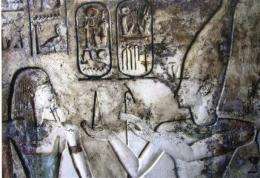
This undated hand out picture released Tuesday April 21, 2009, by Egypt's Supreme Council of Antiquities shows Pharaonic King Ramses II, right and Geb, god of earth, carved on a wall at one of four recently unearthed new temples in Qantara amidst the 3,000-year-old remains of an ancient fortified city that could have been used to impress foreign delegations visiting Egypt, antiquities authorities announced Tuesday April 21, 2009. (AP Photo/Egypt's Supreme Council of Antiquities)

(AP) -- Archaeologists exploring an old military road in the Sinai have unearthed four new temples amidst the 3,000-year-old remains of an ancient fortified city that could have been used to impress foreign delegations visiting Egypt, antiquities authorities announced Tuesday.

Among the discoveries was the largest mud brick temple found in the Sinai with an area of 70 by 80 meters (77 by 87 yards) and fortified with mud walls 3 meters (10 feet) thick, said Zahi Hawass, chief of Egypt's Supreme Council of Antiquities.

The find was made in Qantara, 2 1/2 miles (4 kilometers) east of the Suez Canal. These temples mark the latest discovery by digging up the remains of the city on the military road known as "Way of Horus." Horus is a falcon-headed god, who represented the greatest cosmic powers for .

The path once connected Egypt to Palestine and is close to present-day Rafah, which borders the Palestinian territory of Gaza.

Archaeologist Mohammed Abdel-Maqsoud, chief of the excavation team, said the large brick temple could potentially rewrite the historical and military significance of the Sinai for the ancient Egyptians.

The temple contains four hallways, three stone purification bowls and colorful inscriptions commemorating Ramses I and II. The grandeur and sheer size of the temple could have been used to impress armies and visiting foreign delegations as they arrived in Egypt, authorities said.

The dig has been part of a joint project with the Culture Ministry that started in 1986 to find fortresses along the military road. Hawass said early studies suggested the fortified city had been Egypt's military headquarters from the New Kingdom (1569-1081 B.C.) until the Ptolemaic era, a period lasting about 1500 years.

In a previous find, archaeologists there reported finding the first ever New Kingdom temple to be found in northern Sinai. Studies indicated the temple was built on top of an 18th Dynasty fort (1569-1315 B.C.).

Last year, a collection of reliefs belonging to King Ramses II and King Seti I (1314-1304 B.C.) were also unearthed along with rows of warehouses used by the ancient Egyptian army during the New Kingdom era to store wheat and weapons.

Abdel-Maqsoud said the fortified city corresponded to the inscriptions of the Way of Horus found on the walls of the Karnak Temple in Luxor which illustrated the features of 11 military fortresses that protected Egypt's eastern borders. Only five of them have been discovered to date.

©2009 The Associated Press. All rights reserved. This material may not be published, broadcast, rewritten or redistributed.


print this article email this article download pdf blog this article bookmark this article     Stumble it Digg this share on Facebook retweet share on Reddit add to delicious
Rate this story - 4.5 /5 (10 votes)


April 21, 2009 all stories

Comments: 0

4.5 /5 (10 votes)
  • Stumble this up

  • Digg this

  • share this

  • hide
  • Related Stories


  • hide
  • Relevant PhysicsForums posts

  • Questions about diffusion
    created 3 hours ago
  • Human Leukocyte Antigen (HLA) typing
    created 10 hours ago
  • Breeding program
    created Nov 20, 2009
  • How does a concentration gradient provide energy?
    created Nov 20, 2009
  • More from Physics Forums - Biology

Other News

Museum: Galileo's fingers, tooth are found (AP)

Museum: Galileo's fingers, tooth are found

Other Sciences / Archaeology & Fossils

created 22 hours ago | popularity 4 / 5 (1) | comments 5

(AP) -- Two fingers and a tooth removed from Galileo Galilei's corpse in a Florentine basilica in the 18th century and given up for lost have been found again and will soon be put on display, an Italian museum ...


Measure to change U. of Neb. stem-cell rule fails (AP)

Measure to change U. of Neb. stem-cell rule fails (Update 2)

Other Sciences / Other

created 21 hours ago | popularity 5 / 5 (1) | comments 0

(AP) -- The University of Nebraska's governing board on Friday voted not to place tighter restrictions on embryonic stem cell research than those outlined under federal guidelines, which were expanded after ...


Researcher: Faint writing seen on Shroud of Turin (AP)

Researcher: Faint writing seen on Shroud of Turin (Update)

Other Sciences / Archaeology & Fossils

created Nov 20, 2009 | popularity 2 / 5 (24) | comments 23

(AP) -- A Vatican researcher has rekindled the age-old debate over the Shroud of Turin, saying that faint writing on the linen proves it was the burial cloth of Jesus. Experts say the historian may be reading ...


Three of a kind

Three of a kind: Revealing language’s universal essence

Other Sciences / Social Sciences

created Nov 20, 2009 | popularity 3.9 / 5 (11) | comments 6

(PhysOrg.com) -- On the surface, English, Japanese, and Kinande, a member of the Bantu family of languages spoken in the Democratic Republic of Congo, have little in common. It is not just that the vocabularies ...


Maya

New insights into the life of the Maya

Other Sciences / Archaeology & Fossils

created Nov 16, 2009 | popularity 4.6 / 5 (15) | comments 7

(PhysOrg.com) -- Ancient artifacts are almost always concerned with rich and powerful religious and political leaders, but new excavations of an ancient Maya site have unearthed a pyramid decorated with murals ...