Breakthrough research could speed up the recovery of injured athletes
April 21, 2009 Breakthrough research could speed up the recovery of injured athletes

Enlarge

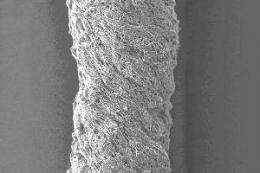
A bundle of Electrospun Fibres viewed under a powerful microscope.

(PhysOrg.com) -- A tendon can be one of the most common and frustrating injuries for an athlete - often forcing them to stay away from the sports field for up to eight weeks.

But now the pioneering research of a University of Manchester student could be about to speed up the recovery process.

Lucy Bosworth, from the University's School of Materials, has developed a way of spinning biodegradable nanofibres into a 'fabric' that could be used in the body as an artificial tendon.

The artificial tendon can be surgically grafted onto the site of an injury, where it encourages the injured tendon to grow and repair, before safely degrading.

And that, researchers believe, would dramatically decrease the time needed for a tendon to heal.

Currently patients face the choice of having a tendon from another part of the body surgically grafted onto the injury site or completely resting the injured area for a significant period of time.

Grafting a tendon from another part of the body creates a second site in the body that needs to heal. And the alternative of enforced rest for a number of weeks can be unpopular, especially for those who are committed to their sport.

Lucy says that using the artificial tendon would take away the need to operate on a second site in the body, which speeds up the recovery time.

And she believes the alternative approach would be of particular interest to athletes - amateur and professional - who are keen to speed up the time it takes for tendon injuries to heal.

Lucy is about to start the pre-clinical stage of her artificial tendon research. And she says they could be used in hospitals in less than three years.

"Tendons have a poor healing response," said Lucy, who is part of the School's Biomaterials Group. "If you damage them they often don't heal back to their original strength, you do get a lot of scar tissue and you can have ongoing pain.

"The way they are treated at the moment is with a graft where tendon is taken from somewhere else. But this creates two sites of injury or if you have a graft from someone else there is a chance of rejection.

"With ours it would just be a one-off surgery - you could even have it as a support mechanism before a tendon was to rupture.

"We are increasingly focusing on early sports injuries. Football and rugby players have a lot of tendon injuries and they really want to reduce their rehabilitation time. They don't want to be sitting around for six weeks waiting for it to heal."

Lucy creates the artificial tendons with a bio-polymer, which is a degradable polymer than can be used inside the body.

Lucy has developed a method of adapting the polymer fibres to a structure that's similar to tendon tissue and mimics natural tissue.

So far the project has benefited from an investment from the UMIP Premier Fund (UPF), managed by technology Venture Capital specialists, MTI Partners.

Now the virtual research centre RegeNer8 has made a grant of £50,000 to the University so that Lucy can continue with her research.

Professor Sandra Downes, from the School of Materials, said: "This is a major breakthrough, because currently there is no clinically available artificial tendon scaffold.

"This research is leading edge. And it is a major achievement for a PhD student to come up with something so significant.

"Our work in this area should lead to significant benefits for patients with tendon injuries in the future and we are pleased that this has been recognised by regeNer8."

Provided by University of Manchester (news : web)


print this article email this article download pdf blog this article bookmark this article     Stumble it Digg this share on Facebook retweet share on Reddit add to delicious
Rate this story - 3.8 /5 (4 votes)

Rank Filter

Move the slider to adjust rank threshold, so that you can hide some of the comments.


Display comments: newest first

  • dirk_bruere - Apr 21, 2009
    • Rank: 1 / 5 (1)
    I thought the tendon problem had been solved by using carbon fiber scaffolds which then stay in place and actually increase the strength?
  • Karrasko - Apr 22, 2009
    • Rank: not rated yet
    I would like to know which is the material used for this purpose, if it is possible. An answering to dirk, I think that carbon fiber is not bio-compatible. http://twitter.com/ESS_BILBAO

April 21, 2009 all stories

Comments: 2

3.8 /5 (4 votes)
  • Stumble this up

  • Digg this

  • share this

  • hide
  • Related Stories

  • USC researcher identifies stem cells in tendons that regenerate tissue in animal model
    created Sep 09, 2007 | popularity not rated yet | comments 0
  • Tendon complications, though rare, linked to statins
    created Feb 28, 2008 | popularity not rated yet | comments 0
  • Stem cell research to benefit horse owners and trainers
    created Oct 21, 2008 | popularity not rated yet | comments 0
  • Freeze-dried tendon implants prove effective in early studies
    created Jan 08, 2008 | popularity not rated yet | comments 0
  • Minimally invasive treatment reduces shoulder pain from tendonitis
    created Nov 28, 2007 | popularity not rated yet | comments 0


  • hide
  • Relevant PhysicsForums posts

  • Thin Film Laboratory resources
    created 9 hours ago
  • Theoretical air URGENT
    created 21 hours ago
  • photoconductivity of polymers
    created Nov 25, 2009
  • Heat pipe for high temperature
    created Nov 24, 2009
  • More from Physics Forums - Materials & Chemical Engineering

Other News

Nanowire Formation

Nanowires key to future transistors, electronics

Nanotechnology / Nanophysics

created 21 hours ago | popularity 4.8 / 5 (8) | comments 1

(PhysOrg.com) -- A new generation of ultrasmall transistors and more powerful computer chips using tiny structures called semiconducting nanowires are closer to reality after a key discovery by researchers ...


Water droplets direct self-assembly process in thin-film materials

Nanotechnology / Nanomaterials

created Nov 23, 2009 | popularity 5 / 5 (4) | comments 2

You can think of it as origami - very high-tech origami. Researchers at the University of Illinois have developed a technique for fabricating three-dimensional, single-crystalline silicon structures from thin films by coupling ...


Using superconducting probes to get a picture of what it's like inside CNTs

Nanotechnology / Nanophysics

created Nov 20, 2009 | popularity 4.4 / 5 (9) | comments 0

(PhysOrg.com) -- "Carbon nanotubes are exciting for fundamental physics, and for potential technological applications," Nadya Mason tells PhysOrg.com. "However, we are generally limited in the way that we can study them. ...


Peptides control crystal growth with 'switches, throttles and brakes'

Peptides control crystal growth with 'switches, throttles and brakes'

Nanotechnology / Bio & Medicine

created Nov 23, 2009 | popularity 4.8 / 5 (5) | comments 0

(PhysOrg.com) -- By producing some of the highest resolution images of peptides attaching to mineral surfaces, scientists have a deeper understanding how biomolecules manipulate the growth crystals. This research ...


Fast, easy, and highly sensitive arsenic detection with gold nanoparticles

Nanotechnology / Nanomaterials

created Nov 25, 2009 | popularity 5 / 5 (1) | comments 0

(PhysOrg.com) -- Mention of arsenic poisoning usually brings to mind underhanded murder. However, the danger of arsenic poisoning from contaminated drinking water is far greater. Low concentrations of arsenic are found in ...