World's First Hard X-ray Laser Achieves 'First Light'
April 21, 2009
World's First Hard X-ray Laser Achieves 'First Light'

Enlarge

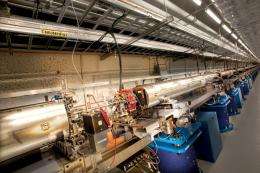
Only 12 out of a total 33 LCLS undulator magnets were needed to create the first pulses of laser light. Photo: Brad Plummer.

(PhysOrg.com) -- The world's brightest X-ray source sprang to life last week at the U.S. Department of Energy's SLAC National Accelerator Laboratory. The Linac Coherent Light Source (LCLS) offers researchers the first-ever glimpse of high-energy or "hard" X-ray laser light produced in a laboratory.

When fine tuning is complete, the LCLS will provide the world's brightest, shortest pulses of laser X-rays for scientific study. It will give scientists an unprecedented tool for studying and understanding the arrangement of atoms in materials such as metals, semiconductors, ceramics, polymers, catalysts, plastics, and , with wide-ranging impact on advanced energy research and other fields.

"This milestone establishes proof-of-concept for this incredible machine, the first of its kind," said SLAC Director Persis Drell. "The LCLS team overcame unprecedented technical challenges to make this happen, and their work will enable frontier research in a host of fields. For some disciplines, this tool will be as important to the future as the microscope has been to the past."

Even in these initial stages of operation, the LCLS X-ray beam is brighter than any other human-made source of short-pulse, hard X-rays. Initial tests produced laser light with a wavelength of 1.5 Angstroms, or 0.15 nanometers—the shortest-wavelength, highest-energy X-rays ever created by any laser. To generate that light, the team had to align the with extreme precision. The beam cannot deviate from a straight line by more than about 5 micrometers per 5 meters—an astounding feat of engineering.

"This is the most difficult lightsource that has ever been turned on," said LCLS Construction Project Director John Galayda. "It's on the boundary between the impossible and possible, and within two hours of start-up these guys had it right on."

Unlike conventional lasers, which use mirrored cavities to amplify light, the LCLS is a free-electron laser, creating light using free-flying electrons in a vacuum. The LCLS uses the final third of SLAC's two-mile linear accelerator to drive electrons to high energy and through an array of "undulator" magnets that steer the electrons rapidly back and forth, generating a brilliant beam of coordinated X-rays. In last week's milestone, LCLS scientists used only 12 of an eventual 33 undulator magnets to generate the facility's first .

The LCLS team is now honing the machine's performance to achieve the beam quality needed for the first scientific experiments, slated to begin in September. With its ultra-bright, ultrafast pulses, the LCLS will work much like a high-speed camera, capturing images of atoms and molecules in action. By stringing together many such images, researchers will create stop-motion movies that reveal the fundamental behavior of atoms and molecules on unprecedented timescales.

"The LCLS team saw a vision of a remarkable new tool for science that could be achieved by using the existing SLAC linear accelerator, and they delivered on that vision with remarkable speed and precision," said DOE Office of Science Acting Director Patricia Dehmer. "The science that will come from the LCLS will be as astounding and as unexpected as was the science that came from the lasers of a few decades ago. We do not yet know all that the LCLS will reveal about the world around us. But we can be sure that the new results will excite and energize the scientific communities that we serve."

Provided by SLAC National Accelerator Laboratory (news : web)

Filter


Move the slider to adjust rank threshold, so that you can hide some of the comments.


Display comments: newest first

zevkirsh
Apr 22, 2009

Rank: not rated yet
can we call this a xaser?
googleplex
Apr 22, 2009

Rank: 3 / 5 (2)
Cool death ray.
I wish they would have elaborated on what it can do. How odd that they built the thing without any idea of what they can use it for.
Was this military funded?
Rank 5 /5 (11 votes)
Related Stories
Relevant PhysicsForums posts
  • Orbital Decay Question
    created1 hour ago
  • Pure energy
    created6 hours ago
  • How to remove the magnetic property for screw driver?
    created9 hours ago
  • How to magnetize a concrete wall?
    created13 hours ago
  • Upward speed of an object in water
    created14 hours ago
  • flipping quarks
    created14 hours ago
  • More from Physics Forums - General Physics

More news stories

Physics research suggests new pathways for cancer progression

Observing that certain cancer cells may exhibit greater flexibility than normal cells, some scientists believe that this capability promotes rapid tumor growth. Now computer simulations developed by Boston University Biomedical ...

Physics / General Physics

created 1 hour ago | popularity 5 / 5 (1) | comments 0

Borexino Collaboration succeeds in spotting pep neutrinos emitted from the sun

(PhysOrg.com) -- To learn more about how the sun works, scientists study particles that are emitted from it into space due to thermonuclear reactions that occur inside; by applying known physics principles, ...

Physics / General Physics

created 3 hours ago | popularity 5 / 5 (4) | comments 0 | with audio podcast report

Transparent iron? For the first time, an experiment shows that atomic nuclei can become transparent

At the high-brilliance synchrotron light source PETRA III, a team of DESY scientists headed by Dr. Ralf Röhlsberger has succeeded in making atomic nuclei transparent with the help of X-ray light. At the ...

Physics / General Physics

created 22 hours ago | popularity 5 / 5 (9) | comments 3 | with audio podcast

Physicists build highly efficient 'no-waste' laser

A team of University of California, San Diego researchers has built the smallest room-temperature nanolaser to date, as well as an even more startling device: a highly efficient, "thresholdless" laser that ...

Physics / General Physics

created 22 hours ago | popularity 5 / 5 (17) | comments 4 | with audio podcast

Explained: Sigma

It's a question that arises with virtually every major new finding in science or medicine: What makes a result reliable enough to be taken seriously? The answer has to do with statistical significance -- but ...

Physics / General Physics

created 3 hours ago | popularity 5 / 5 (4) | comments 2


Apple to debut 'iPad 3' in March: report

Apple will unveil a new version of its market-ruling iPad table computer in March, according to a report in Dow Jones-owned technology blog All Things D.

Physically abused children report higher levels of psychosomatic symptoms

Children who display multiple psychosomatic symptoms, such as regular aches and pains and sleep and appetite problems, are more than twice as likely to be experiencing physical abuse at home than children who do not display ...

Facebook sees slowing growth

Few experts were surprised when Facebook disclosed in its recent IPO filing that its user growth had slowed in the U.S. and Canada. But a deeper look at Facebook's user numbers shows its growth is also slowing ...

New technology platform for molecule-based electronics

Researchers at the Nano-Science Center at the University of Copenhagen have developed a new nano-technology platform for the development of molecule-based electronic components using the wonder material graphene. At the same ...

60 percent of Spanish adolescents state they do not take drugs and rarely drink alcohol

Despite the clichés surrounding the habits of adolescents, the results of a study by the University of Seville show that most young people do not fit the risk profile of taking substances. Some 60% of ...

NFC aid for the visually and hearing impaired

As the proportion of senior citizens grows, their special needs are gaining momentum. Human eyesight, for example, weakens with age. VTT Technical Research Centre of Finland has been developing new NFC-based applications ...