Reef boom beats doom
April 21, 2009 Coral Reefs

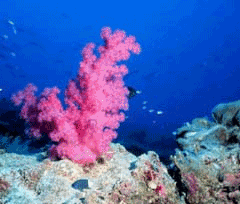
(PhysOrg.com) -- Marine scientists say they are astonished at the spectacular recovery of certain coral reefs in Australia's Great Barrier Reef Marine Park from a devastating coral bleaching event in 2006.

That year high sea temperatures caused massive and severe bleaching in the Keppel Islands, in the southern part of the Great Barrier Reef. The damaged reefs were quickly smothered by a single species of seaweed - an event that can spell the total loss of the corals.

However, a lucky combination of rare circumstances meant the reefs were able to achieve a spectacular recovery, with abundant corals re-established in a single year, said Dr Guillermo Diaz-Pulido, from the Centre for Marine Studies at The University of Queensland and the ARC Centre of Excellence for Coral Reef Studies (CoECRS).

Dr Diaz-Pulido said that the rapid recovery was due to an exceptional combination of previously-underestimated ecological mechanisms.

"Three factors were critical," he said.

"The first was exceptionally high regrowth of fragments of surviving coral tissue. The second was an unusual seasonal dieback in the seaweeds, and the third was the presence of a highly competitive coral species, which was able to outgrow the seaweed.

"But this also all happened in the context of a well-protected marine area and moderately good water quality.

"It is rare to see reports of reefs that bounce back from mass coral bleaching or other human impacts in less than a decade or two.

"The exceptional aspect was that corals recovered by rapidly regrowing from surviving tissue," said Dr Sophie Dove, also from CoECRS and The University of Queensland.

"Recovery of corals is usually thought to depend on sexual and the settlement and growth of new corals arriving from other reefs," she said.

"This study demonstrates that for fast-growing coral species asexual reproduction is a vital component of reef resilience."

Professor Ove Hoegh-Guldberg of the CoECRS and The University of Queensland said that coral reefs globally were increasingly being damaged by mass bleaching and climate change.

Their capacity to recovery from that damage was critical to their future, he said.

"Our study suggests that managing local stresses that affect reefs, such as overfishing and declining water quality, can have a big influence on the trajectory of reefs under rapid global change," Professor Hoegh-Guldberg said.

"Clearly, we need to urgently deal with the problem of rising carbon dioxide in the atmosphere, but managing reefs to reduce the impact of local factors can buy important time while we do this."

Understanding the different mechanisms of resilience is critical for reef management under climate change.

"Diversity in processes may well be critical to the overall resilience and persistence of coral reef ecosystems globally," said Dr Laurence McCook, from the Great Barrier Reef Marine Park Authority.

The research was partially funded by a Pew Fellowship in Marine Conservation awarded to Dr McCook, the Great Barrier Reef Marine Park Authority as well as the ARC Centre of Excellence program.

"This combination of circumstances provided a lucky escape for the coral reefs in Keppel Islands, but is also a clear warning for the Great Barrier Reef," Dr McCook said.

"As climate change and other human impacts intensify, we need to do everything we possibly can to protect the resilience of ."

More information: The research was published this week in the paper “Doom and boom on a resilient reef: Climate change, algal overgrowth and coral recovery”, in the journal PLoS ONE, by Guillermo Diaz-Pulido, Laurence J. McCook, Sophie Dove, Ray Berkelmans, George Roff, David I. Kline, Scarla Weeks, Richard D. Evans, David H. Williamson and Ove Hoegh-Guldberg.

Provided by University of Queensland (news : web)


print this article email this article download pdf blog this article bookmark this article     Stumble it Digg this share on Facebook retweet share on Reddit add to delicious
Rate this story - 4.3 /5 (12 votes)

Rank Filter

Move the slider to adjust rank threshold, so that you can hide some of the comments.


Display comments: newest first

  • jonnyboy - Apr 21, 2009
    • Rank: 2.7 / 5 (7)
    This study was not approved by the IPCC gestapo and shall immediately be removed from this and all other websites at once. Failure to comply with this notice shall subject the responsible parties (and anyone else we feel like)to academic execution.
  • MikeB - Apr 21, 2009
    • Rank: 2.4 / 5 (9)
    This is obviously a spoof planted by Global Warming Heretics. These corals could not have recovered from the terrible ACIDIFICATION of the oceans. Anyone who believes this tripe is living in a dream world. Has anyone here actually seen these corals with their own eyes? All that is left of the Great Barrier Reef is a pitiful mound with not one scintilla of coral life to be found on it. This mound will soon erode to nothing and then those who will not see the great truths of Global Warming will not be able to naysay it any longer. If there is any life there at all it is highly localized and will soon disappear. I know all this is true since I read it here at physorg. Please do your part to save the planet. Stop driving, turn off all your utilities, eat only locally grown produce and use hemp shopping bags (NOT PLASTIC!!!)
    That is what I am doing. I am writing this missive on a computer at the library. I also took a sponge bath in the men's room!
    Save the earth, do it for the children.
    Moonbeam Mike
  • Velanarris - Apr 22, 2009
    • Rank: 5 / 5 (2)
    Interesting that there is no mention of the fact that corals grow at an accelerated rate when Calcium Carbonate, produced through CaO and CO2 in aqueous solution, is in high abundance. Apparently these corals are able to magically synthesize the building materials they need without taking local concentration into account.
  • jeffhans - Apr 22, 2009
    • Rank: 3.7 / 5 (3)
    I thought the Great Barrier Reef was being destroyed through hordes of Crown-of-thorns Starfish http://www.treehu...fish.php . Shouldn't we stick to one explanation for why something is changing and stick to it?

April 21, 2009 all stories

Comments: 4

4.3 /5 (12 votes)
  • Stumble this up

  • Digg this

  • share this

  • hide
  • Related Stories

  • Larry's cool change good for reef
    created Mar 22, 2006 | popularity not rated yet | comments 0
  • Long-term recovery of reefs from bleaching requires local action to increase resilience
    created Feb 03, 2009 | popularity not rated yet | comments 0
  • Rising CO2 'will hit reefs harder'
    created Oct 27, 2008 | popularity not rated yet | comments 0
  • Fish species plays surprise role in aiding coral reef recovery
    created Dec 18, 2006 | popularity not rated yet | comments 0
  • Corals facing 'biggest impact in history'
    created Jun 19, 2006 | popularity not rated yet | comments 0


  • hide
  • Relevant PhysicsForums posts

  • The IPCC and the term "most"
    created Nov 23, 2009
  • Is global warming a fact?
    created Nov 23, 2009
  • Random variability of wind patterns
    created Nov 23, 2009
  • Record precipitation in the UK
    created Nov 22, 2009
  • How to move cloud from one time to another..
    created Nov 22, 2009
  • Which countries around the world cause the most destruction to the rain forest
    created Nov 21, 2009
  • More from Physics Forums - Earth

Other News

Cosmic 'dig' reveals vestiges of the Milky Way's building blocks

Cosmic 'Dig' Reveals Vestiges of the Milky Way's Building Blocks

Space & Earth / Astronomy

created 10 hours ago | popularity 4.9 / 5 (12) | comments 1

(PhysOrg.com) -- Peering through the thick dust clouds of our galaxy's "bulge" (the myriads of stars surrounding its center), a team of astronomers has unveiled an unusual mix of stars in the stellar grouping ...


No Wheel Stall in Diagnostic Drive

Spirit Mars Rover: No Wheel Stall in Diagnostic Drive

Space & Earth / Space Exploration

created 5 hours ago | popularity 5 / 5 (1) | comments 0

(PhysOrg.com) -- On Sol 2095 (Tuesday, Nov. 24), Spirit performed a set of diagnostic actions related to a stall of the right-rear wheel on the previous drive, three days earlier.


Monster Waves on the Sun are Real

Monster Waves on the Sun are Real (w/ Video)

Space & Earth / Astronomy

created 5 hours ago | popularity 5 / 5 (8) | comments 0

Sometimes you really can believe your eyes. That's what NASA's STEREO (Solar Terrestrial Relations Observatory) spacecraft are telling researchers about a controversial phenomenon on the sun known as the "solar ...


Oceanic crust formation is dynamic after all

Oceanic crust formation is dynamic after all

Space & Earth / Earth Sciences

created 9 hours ago | popularity 4.3 / 5 (3) | comments 0

Imagine the Earth's crust as the planet's skin: Some areas are old and wrinkled while others have a fresher, more youthful sheen, as if they had been regularly lathered with lotion.


Climate experts debate strategies for reducing atmospheric carbon and future warming

Climate experts debate strategies for reducing atmospheric carbon and future warming

Space & Earth / Environment

created 5 hours ago | popularity 3 / 5 (4) | comments 4

(PhysOrg.com) -- Reducing carbon dioxide to safe levels may require extracting carbon from the air, says Cornell climate researcher.