Plants could override climate change effects on wildfires
April 21, 2009 Plants could override climate change effects on wildfires

Enlarge

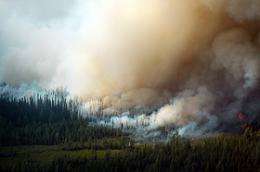
A wildfire burns in the boreal forests of Alaska's Yukon Flats in summer of 2006. (Photo courtesy of Philip Higuera)

(PhysOrg.com) -- The increase in warmer and drier climates predicted to occur under climate change scenarios has led many scientists to also predict a global increase in the number of wildfires. But a new study in the May issue of Ecological Monographs shows that in some cases, changes in the types of plants growing in an area could override the effects of climate change on wildfire frequency.

Philip Higuera of Montana State University and his colleagues show that although changing temperatures and moisture levels set the stage for changes in wildfire frequency, they can often be trumped by changes in the distribution and abundance of plants. Vegetation plays a major role in determining the flammability of an ecosystem, he says, potentially dampening or amplifying the impacts that climate change has on fire frequencies.

"Climate is only one control of fire regimes, and if you only considered climate when predicting fire under climate-change scenarios, you would have a good chance of being wrong," he says. "You wouldn't be wrong if vegetation didn't change, but the greater the probability that vegetation will change, the more important it becomes when predicting future fire regimes."

Higuera and his colleagues examined historical fire frequency in northern by analyzing sediments at the bottom of lakes. Using meter-long samples, called sediment cores, Higuera and his colleagues measured changes in the abundance of preserved plant parts, such as pollen, to determine the types of vegetation that dominated the landscape during different time periods in the past. Like rings in a tree, different layers of sediment represent different times in the past.

The researchers used dating to determine the sediment's age, which dates as far back as 15,000 years. They then measured charcoal deposits in the sediment to determine fire frequency during time periods dominated by different vegetation. Finally, they compared their findings to known historical climate changes.

In many cases, the authors discovered, changes in climate were less important than changes in vegetation in determining wildfire frequency. Despite a transition from a cool, dry climate to a warm, dry climate about 10,500 years ago, for example, the researchers found a sharp decline in the frequency of fires. Their cores from that time period revealed a vegetation change from flammable shrubs to fire-resistant deciduous trees, a trend which Higuera thinks was enough to offset the direct effects of climate on fire frequencies.

"In this case, a warmer climate was likely more favorable for fire occurrence, but the development of deciduous trees on the landscape offset this direct climatic effect. Consequently, we see very little fire," Higuera says.

Similarly, during the development of the modern spruce-dominated forest about 5000 years ago, temperatures cooled and moisture levels increased, which - considered alone - would create unfavorable conditions for frequent fires. Despite this change, the authors observed an increase in fire frequency, a pattern they attribute to the high flammability of the dense coniferous forests.

Higuera thinks this research has implications for predictions of modern-day changes in fire regimes based on climate change. These findings, Higuera says, emphasize that predicting future wildfire frequency shouldn't hinge on the direct impacts of climate change alone.

"Climate affects vegetation, vegetation affects fire, and both fire and vegetation respond to climate change," he says. "Most importantly, our work emphasizes the need to consider the multiple drivers of fire regimes when anticipating their response to ."

Source: Ecological Society of America


print this article email this article download pdf blog this article bookmark this article     Stumble it Digg this share on Facebook retweet share on Reddit add to delicious
Rate this story - 4.4 /5 (7 votes)

Rank Filter

Move the slider to adjust rank threshold, so that you can hide some of the comments.


Display comments: newest first

  • jonnyboy - Apr 21, 2009
    • Rank: 1 / 5 (1)
    This study was not approved by the IPCC gestapo and shall immediately be removed from this and all other websites at once. Failure to comply with this notice shall subject the responsible parties (and anyone else we feel like)to academic execution.
  • Damon_Hastings - Apr 22, 2009
    • Rank: 5 / 5 (1)
    This study was not approved by the IPCC gestapo and shall immediately be removed from this and all other websites at once. Failure to comply with this notice shall subject the responsible parties (and anyone else we feel like)to academic execution.

    Um... are you interpreting this article as in some way diminishing the evidence for climate change...?

    The article says that changes in vegetation (which both drive and are driven by climate change) could work to either override or amplify the effects of climate change on wildfires, depending on the situation. And it will probably be different in every region. So it's not really saying much at all about how badly climate change is likely to hurt us.

    Also, the examples given in the article involve natural changes in vegetation, over the span of thousands of years. Climate change will happen on a much shorter time scale. Now, climate change will cause rapid changes in vegetation, but most ecologists believe these changes will be favorable for increased wildfires.
  • Birger - Apr 22, 2009
    • Rank: not rated yet
    When California and other dry places suffered from wildfires last year, I thought long and hard about possible way to prevent firestorms from forming or spreading, but the options (such as very wide firebreaks where nearly all vegetation is removed) seemed too draconian.

    This article suggests that by planting corridors of more fire-resistent trees across the prevailing wind we might at least be able to control fire. My native town of Umea, north Sweden, actually is an early example of this approach; After the town burned down in 1888, birch trees were planted alongside all major streets. Since the leafs are quite humid, they will impede the flow of sparks and the ignition of new fires. Birches would probably consume too much water for the Californian summers, but what about native species of trees, succulents and/or cacti?

    The corridors would have to be wide enough to prevent embers carried by the firestorm "micro-weather" from jumping across, but would not be nearly as disruptive as the large-scale introduction of European trees during the last two centuries.
  • Sirussinder - Apr 22, 2009
    • Rank: not rated yet
    climate change,climate change,climate change,global warming,global warming

    blah blah blah blah...

April 21, 2009 all stories

Comments: 4

4.4 /5 (7 votes)
  • Stumble this up

  • Digg this

  • share this

  • hide
  • Related Stories

  • Warming climate may cause arctic tundra to burn
    created Mar 05, 2008 | popularity not rated yet | comments 0
  • Comet impact theory disproved
    created Jan 26, 2009 | popularity not rated yet | comments 0
  • Massive California fires consistent with climate change
    created Oct 24, 2007 | popularity not rated yet | comments 0
  • Wildfire drives carbon levels in northern forests
    created Oct 31, 2007 | popularity not rated yet | comments 0
  • Wildfires reduced by human activity
    created Sep 24, 2008 | popularity not rated yet | comments 0


  • hide
  • Relevant PhysicsForums posts

  • What is transpulmonary pressure?
    created Nov 24, 2009
  • Is there a gay gene?
    created Nov 23, 2009
  • Super quick question about Starling forces?
    created Nov 22, 2009
  • Questions about diffusion
    created Nov 22, 2009
  • More from Physics Forums - Biology

Other News

Variable Temperatures Leave Insects wtih a Frosty Reception

Biology / Plants & Animals

created 14 minutes ago | popularity not rated yet | comments 0

(PhysOrg.com) -- For the first time, scientists at The University of Western Ontario have shown that insects exposed to repeated periods of cold will trade reproduction for immediate survival.


Destruction spreads 'like a disease'

Biology / Ecology

created 1hour ago | popularity not rated yet | comments 0

(PhysOrg.com) -- People have cleared more than a quarter of the world’s forests and half of its grasslands, according to a paper published today in the Proceedings of the Royal Society by researchers from The University of Que ...


When camouflage is a plant's best protection

Rare woodland plant uses 'cryptic coloration' to hide from predators

Biology / Plants & Animals

created 2 hours ago | popularity not rated yet | comments 0

It is well known that some animal species use camouflage to hide from predators. Individuals that are able to blend in to their surroundings and avoid being eaten are able to survive longer, reproduce, and ...


Beer Here

Biology / Other

created 1hour ago | popularity 4 / 5 (1) | comments 0

(PhysOrg.com) -- Drinking beer is a simple act, but making beer is not. It starts out with genetics and tens of thousands of barley varieties and ends with a clear ambrosia that belies the time, effort and technology that ...


'Safety valve' protects photosynthesis from too much light

Biology / Cell & Microbiology

created 3 hours ago | popularity not rated yet | comments 0

Photosynthetic organisms need to cope with a wide range of light intensities, which can change over timescales of seconds to minutes. Too much light can damage the photosynthetic machinery and cause cell death. Scientists ...