Vesuvius, the world's most closely watched volcano
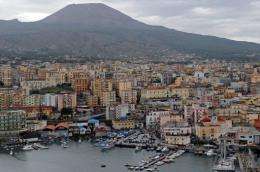
April 22, 2009 by Emmanuelle Andreani An aerial view of Torre del Greco, one of the villages inside the "red zone" near Mount Vesuvius volcano

Enlarge

An aerial view of Torre del Greco, one of the villages inside the "red zone" near Mount Vesuvius volcano. Nearly 2,000 years after wiping out Pompeii, Mount Vesuvius is among the most closely monitored in the world, its every shudder recorded.

Nearly 2,000 years after wiping out Pompeii, Mount Vesuvius is among the most closely monitored volcanoes in the world, its every shudder recorded.

"Vesuvius is one of the world's most dangerous volcanos: it is always active, and 600,000 people would be directly at risk if it erupts," says vulcanologist Claudio Scarpati.

On the flanks of the overlooking the bay of Naples in southern , rising up nearly 1,300 metres (some 4,200 feet), several dozen sensors record seismic activity, the temperature of the gas emitted by the volcano and topographical changes.

The sensors, some visible from the path that takes thousands of tourists up to the crater each year, transmit signals round the clock to the Vesuvius observatory in Naples some nine kilometres (six miles) west of the volcano.

Data transmitted each month by the European satellite on ground movements complement and update the observatory's information.

"There are always at least two experts at the observatory who analyse the data continuously," said Scarpati, a professor at the University of Naples. "And for good measure in case of a breakdown, the data are systematically sent by cable, telephone and radio."

Vesuvius, which has had about 30 major eruptions since the one that destroyed Pompeii in 79 AD, has been under expert surveillance since the 19th century when the first observatory was built on the volcano in 1845 on the orders of Ferdinand II, king of the Two Sicilies.

The last major eruption of the storied volcano was in March 1944 when it disgorged rivers of lava for 11 days, claiming 26 lives and displacing 12,000 people.

Francesco Russo, head of a Naples-area geologists association, warned in January that Vesuvius remains "a very dangerous volcano".

He told a news conference in Rome: "According to some statistics, there is a 27 percent chance of an explosive eruption in the next 100 years."

Public safety authorities developed the current disaster evacuation plan using as a model an explosive eruption in 1631 that killed some 4,000 people, Scarpati said.

"It's the worst type of eruption that could happen, even if a disaster of such magnitude is very unlikely today because the volcano's configuration is no longer the same," he said.

"Under the plan, everything within a 15-kilometre radius of the volcano would be evacuated," Scarpati said. Some 600,000 people in the 18 cities or towns in this so-called "red zone".

Such an operation would take around two weeks, public safety officials say.

"We should be able to predict an eruption of that magnitude within this time frame because early indicators would appear well beforehand," Scarpati said. "But we can't be 100 percent sure."

Russo said, for his part: "What is certain is that we will be better prepared than the Romans of Pompeii. Those poor people had no inkling that they were living at the foot of a volcano."

The that destroyed Pompeii killed some 30,000 people, burying villages and farmland as far as 25 kilometres away.

The thick blanket of ash and rock preserved much of Pompeii and its sister city Herculaneum for centuries until their chance discovery in 1748, giving the world a stunning snapshot of everyday life at the height of the Roman Empire.

(c) 2009 AFP


print this article email this article download pdf blog this article bookmark this article     Stumble it Digg this share on Facebook retweet share on Reddit add to delicious
Rate this story - 4.3 /5 (3 votes)


April 22, 2009 all stories

Comments: 0

4.3 /5 (3 votes)
  • Stumble this up

  • Digg this

  • share this

  • hide
  • Related Stories

  • Scientists warn of a Vesuvius eruption
    created Mar 07, 2006 | popularity not rated yet | comments 0
  • Magazine cover sparks Vesuvius alarm
    created Aug 31, 2007 | popularity not rated yet | comments 0
  • Chile's Chaiten volcano one of scores of active volcanoes in region
    created May 07, 2008 | popularity not rated yet | comments 0
  • Rare painted Roman-era statute is found
    created Mar 27, 2006 | popularity not rated yet | comments 0
  • Russia prepares for volcano eruption
    created Jul 23, 2007 | popularity not rated yet | comments 0


  • hide
  • Relevant PhysicsForums posts

  • cycles
    created 14 hours ago
  • The Origin of the term 'fossil' fuels
    created Nov 05, 2009
  • co2
    created Nov 03, 2009
  • Early Earths Sulfidic Ocean Conditions
    created Oct 30, 2009
  • More from Physics Forums - Earth

Other News

Deep creep means milder, more frequent earthquakes along Southern California's San Jacinto fault

Deep creep means milder, more frequent earthquakes along Southern California's San Jacinto fault

Space & Earth / Earth Sciences

created 14 hours ago | popularity 4.7 / 5 (3) | comments 0

With an average of four mini-earthquakes per day, Southern California's San Jacinto fault constantly adjusts to make it a less likely candidate for a major earthquake than its quiet neighbor to the east, the ...


Success in 'space elevator' competition (AP)

Success in 'space elevator' competition (Update 3)

Space & Earth / Space Exploration

created Nov 05, 2009 | popularity 4.3 / 5 (33) | comments 50

(AP) -- A robot powered by a ground-based laser beam climbed a long cable dangling from a helicopter on Wednesday to qualify for prize money in a $2 million competition to test the potential reality of the ...


In a Galaxy Far, Far Away...

In a Galaxy Far, Far Away...

Space & Earth / Astronomy

created Nov 06, 2009 | popularity 4.8 / 5 (5) | comments 17

(PhysOrg.com) -- Astronomers have published the discovery of the farthest known object in the cosmos: a star that exploded when the universe was only 630 million years old -- only 4.6% of its current age. ...


'Dropouts' pinpoint earliest galaxies

'Dropouts' pinpoint earliest galaxies

Space & Earth / Astronomy

created Nov 06, 2009 | popularity 4.2 / 5 (10) | comments 13

Astronomers, conducting the broadest survey to date of galaxies from about 800 million years after the Big Bang, have found 22 early galaxies and confirmed the age of one by its characteristic hydrogen signature ...


Space hotel taking bookings for 2012 opening

Space hotel taking bookings for 2012 opening

Space & Earth / Space Exploration

created Nov 05, 2009 | popularity 4.4 / 5 (21) | comments 11

(PhysOrg.com) -- The first orbiting space hotel is on track to open for its first customers in 2012, but hurry, as bookings are filling fast.