S.Korea scientists clone pig for human transplants
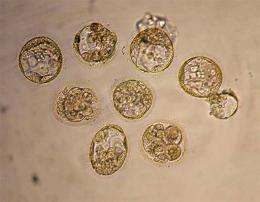
April 22, 2009 Cloned embryos, seen through a microscope

Enlarge

SKorean scientists said they have cloned a piglet whose organs were genetically modified to make them more suitable for human transplants. Lead scientist Lim Gio-Bin said the cloned piglet, born on April 3, had been genetically altered to lack the "alpha-gal" gene which triggers tissue rejection.

South Korean scientists said they have cloned a piglet whose organs were genetically modified to make them more suitable for human transplants.

Lead scientist Lim Gio-Bin said the cloned piglet, born on April 3, had been genetically altered to lack the "alpha-gal" gene which triggers tissue rejection.

He said his government-sponsored team, involving scientists from four universities and two research institutes, used of smaller-than-normal pigs to clone "mini-pigs" with modified genes.

Immuno-rejection has been a major hurdle in human organ transplants.

Pig organs are well suited for transplantation but are coated with sugar molecules that trigger acute rejection in human bodies. antibodies attach themselves to such molecules and quickly destroy the transplanted pig organ.

"Our team produced four cloned mini-pigs from about 100 surrogate pigs but only one male named Xeno survived," Lim told AFP, adding his team is now working to produce a female piglet.

"Through mating we will be able to produce many genetically modified mini-pigs whose organs are more suitable for xenotransplantation (transplantation between different species)," he said.

In Xeno, the scientist said his team adopted almost identical technology to that used by US scientists in 2002 to create cloned piglets, in which one copy of the sugar-producing gene was "knocked out."

An organism receives two copies of a gene, one from the mother and one from the father. Scientists have tried to produce pigs lacking both copies, so far unsuccessfully.

"Through our achievement became the second country in the world to clone such piglets after the United States," Lim said.

"I believe our methods are slightly better. Xeno will help us accumulate technology and resources, which can be used to produce many mini-pigs of good quality."

Lim said his team would conduct clinical trials on humans in 2012 and he believed genetically modified mini-pigs could be used commercially around 2017.

(c) 2009 AFP


print this article email this article download pdf blog this article bookmark this article     Stumble it Digg this share on Facebook retweet share on Reddit add to delicious
Rate this story - 4 /5 (4 votes)


April 22, 2009 all stories

Comments: 0

4 /5 (4 votes)
  • Stumble this up

  • Digg this

  • share this

  • hide
  • Related Stories


  • hide
  • Relevant PhysicsForums posts

Other News

Scientists visualize how bacteria talk to one another

Scientists visualize how bacteria talk to one another

Biology / Cell & Microbiology

created 16 hours ago | popularity 4.9 / 5 (9) | comments 1

Using imaging mass spectrometry, researchers at the University of California, San Diego have developed tools that will enable scientists to visualize how different cell populations of cells communicate. Their ...


Laser etching safe alternative for labeling grapefruit

Laser etching safe alternative for labeling grapefruit

Biology / Other

created Nov 03, 2009 | popularity 4.4 / 5 (14) | comments 8

Laser labeling of fruit and vegetables is a new, patented technology in which a low-energy carbon dioxide laser beam is used to label, or "etch" information on produce, thereby eliminating the need for common ...


Caught in the act: Butterfly mate preference shows how 1 species can become 2

Caught in the act: Scientists find butterflies splitting into two species

Biology / Plants & Animals

created Nov 05, 2009 | popularity 4.5 / 5 (8) | comments 4

(PhysOrg.com) -- Breaking up may actually not be hard to do, say scientists who've found a population of tropical butterflies that may be on its way to a split into two distinct species.


Wolves, moose and biodiversity: An unexpected connection

Wolves, moose and biodiversity: An unexpected connection

Biology / Ecology

created Nov 02, 2009 | popularity 4.9 / 5 (7) | comments 4

Moose eat plants; wolves kill moose. What difference does this classic predator-prey interaction make to biodiversity?


Can biodiversity persist in the face of climate change?

Can biodiversity persist in the face of climate change?

Biology / Ecology

created Nov 06, 2009 | popularity 3 / 5 (8) | comments 2

(PhysOrg.com) -- Predictions made over the last decade about the impacts of climate change on biodiversity may be exaggerated, according to a paper published in the journal Science.