Physicists develop powerful method of suppressing errors in many types of quantum computers
(PhsyOrg.com) -- Researchers at the National Institute of Standards and Technology have demonstrated a technique for efficiently suppressing errors in quantum computers. The advance could eventually make it much easier to build useful versions of these potentially powerful but highly fragile machines, which theoretically could solve important problems that are intractable using today's computers.
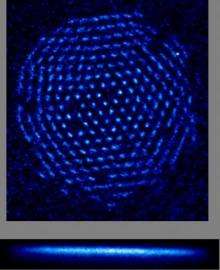
The new error-suppression method, described in the April 23 issue of Nature, was demonstrated using an array of about 1,000 ultracold beryllium ions (electrically charged atoms) trapped by electric and magnetic fields. Each ion can act as a quantum bit (qubit) for storing information in a quantum computer. These ions form neatly ordered crystals, similar to arrays of qubits being fabricated by other researchers using semiconducting and superconducting circuitry. Arrays like this potentially could be used as multi-bit quantum memories.
The new NIST technique counteracts a major threat to the reliability of quantum memories: the potential for small disturbances, such as stray electric or magnetic fields, to create random errors in the qubits. The NIST team applied customized sequences of microwave pulses to reverse the accumulation of such random errors in all qubits simultaneously.
"Simulations show that under appropriate conditions this method can reduce the error rate in quantum computing systems up to a hundred times more than comparable techniques. Our measurement results validate these predictions," says Hermann Uys, a NIST guest researcher who is a lead author of the paper. Uys is visiting from the Council for Scientific and Industrial Research, Pretoria, South Africa.
Co-lead author Michael J. Biercuk, a NIST post-doc, notes that correcting qubit errors after they occur will require extraordinary resources, whereas early suppression of errors is far more efficient, and improves the performance of subsequent error correction. The new NIST error-suppression method could enable quantum computers of various designs to achieve error rates far below the so-called fault-tolerance threshold of about 1 error in 10,000 computational operations (0.01 percent), Biercuk says. If error rates can be reduced below this level, building a useful quantum computer becomes considerably more realistic.
Quantum computers, by relying on the unusual properties of the atomic-scale world to store and process data, could someday break commonly used encryption codes, perform faster searches of enormous databases, and determine the most efficient schedules for everything from airlines to traveling salespeople. They could also simulate complex quantum systems that are too difficult to study using today's computers or through direct experiments. But first, practical quantum computers need to be built, and their components need to be reliable.
Unlike today's computers, which use transistors that are switched on or off to represent bit values of 1 or 0, quantum computers would manipulate the properties of qubits to represent 1 or 0 or-thanks to the peculiarities of the quantum world-both at the same time. But these "quantum states" are so delicate that qubit values would be highly susceptible to errors caused by the slightest electronic noise.
Under ideal conditions, and in the absence of deliberate manipulations, ion qubit states evolve in a predictable way, similar to a spinning top tipped from its vertical axis. Environmental interference can lead to a buildup of error, but the new NIST pulse method can reverse this accumulation, thus preserving the original state.
The NIST method is an adaptation of "spin echo" techniques used for decades to suppress errors in nuclear magnetic resonance (the basis of magnetic resonance imaging). In spin echo, evenly spaced control pulses will nearly reverse the buildup of error, as long as fluctuations are slow relative to the time between pulses.
Recently, scientists at another institution published a theory of how to modify pulse timing in order to improve noise suppression. The NIST team conducted the first experimental demonstration of this theory, and then extended these ideas by generating novel pulse sequences tailored to the ambient noise environment. These novel sequences can be found quickly through an experimental feedback technique, and were shown to significantly outperform other sequences without the need for any knowledge of the noise characteristics. The researchers tested these pulse sequences under realistic noise conditions simulating those appropriate for different qubit technologies, making their results broadly applicable.
More information: M.J. Biercuk, H. Uys, A.P. VanDevender, N. Shiga, W.M. Itano and J.J. Bollinger. Optimized Dynamical Decoupling in a Model Quantum Memory. Nature. April 23.
Source: National Institute of Standards and Technology (news : web)


