Scientists identify host factors critical to dengue virus infection
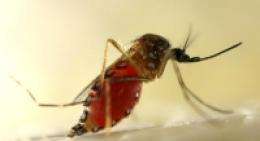
By painstakingly silencing genes one at a time, scientists at Duke University Medical Center have identified dozens of proteins the dengue fever virus depends upon to grow and spread among mosquitoes and humans.
The research, appearing in the April 23 issue of the journal Nature, opens the door to new ways to potentially prevent or treat the disease, which infects millions of people around the globe every year.
Dengue fever is a mosquito-borne illness that can cause debilitating sickness and death. According to the World Health Organization, almost half the people in the world are vulnerable to the dengue virus. Public health officials are worried because dengue appears to be popping up in places where it has rarely appeared before and there is some concern that current epidemics are may be fueled by global warming.
"Dengue is a nasty disease, and right now, there is no treatment for it and no way to prevent it," says Mariano Garcia-Blanco, M.D., Ph.D., professor of molecular genetics and microbiology at Duke University Medical Center and senior author of the study. "But if we can find a weakness in the virus, we can design a strategy to fight it. This study has helped us identify some gaps in dengue's armor."
Garcia-Blanco, who is also professor of emerging infectious diseases at the Duke-NUS Graduate Medical School in Singapore, used RNA interference (RNAi) to unlock dengue's secrets. RNA interference is a normal biological process cells use to turn gene expression on or off depending upon which gene products, or proteins, are needed at any given moment. "That very same system proved to be the perfect investigative tool for our study," says Garcia-Blanco.
Garcia-Blanco and colleagues in Duke's RNAi facility were able to knock down gene function in fruit fly cells infected with a strain of the dengue virus known as DENV-2. Silencing one gene at a time (there were about 14,000 of them) allowed researchers to pinpoint which genes, or host factors, were essential to viral growth and which ones were not. They used fruit flies as a model because the genetic tools needed for the same work in mosquitoes have not been developed yet.
The process yielded 116 host factors that appeared to be important to successful dengue infection in fruit flies. In testing several of these host factors in mosquitoes at Johns Hopkins University, researchers subsequently discovered that at least one - and possibly a second - was necessary for dengue infection to occur in the insects.
Scientists also infected human cells with the DENV-2 virus and found 82 of the mosquito genes had analogous genes in humans. About half that number turned out to be dengue-specific host factors important in human infection.
"Each one of these newly identified host factors is a potential therapeutic target that could be used to block or slow dengue infection," says Garcia-Blanco. Currently, there are no vaccines to prevent the disease, "so new ways to fight the disease are important," he added. There are a couple of dengue vaccine candidates in development.
Scientists say the study reflects the value of the growing research partnership between Duke University Medical Center and the two-year old Duke-NUS Graduate Medical School in Singapore. Since opening its doors to its first class of medical students in 2007, the Duke-NUS Graduate Medical School has attracted some of the top students and scientists from around the world. Garcia-Blanco says Singapore's critical mass of knowledge about dengue was key to the success of the current study.
"I like to say that my research is a tale of two islands. I was born in Puerto Rico, where dengue thrives, but Singapore is my classroom. The faculty there has nurtured my enthusiasm for virology and given me the intellectual support to translate their knowledge about dengue into application in Duke's laboratories, where the RNAi studies were done. Each of us needs the other in this venture, and we are hoping this partnership continues."
Source: Duke University Medical Center (news : web)


