Animals that seem identical may be completely different species
April 22, 2009 Animals that seem identical may be completely different species

Enlarge

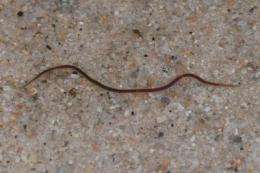
This is the Lumbriculus variegatus worm. Credit: Image: Biopix

Animals that seem identical may belong to completely different species. This is the conclusion of researchers at the University of Gothenburg, Sweden, who have used DNA analyses to discover that one of our most common segmented worms is actually two types of worm. The result is one of many suggesting that the variety of species on the earth could be considerably larger than we thought.

"We could be talking about a large number of species that have existed undiscovered because they resemble other known species," says Professor Christer Erséus.

The segmented that were studied by Christer Erséus, doctoral student Daniel Gustavsson and their American colleague, are identical in appearance. From the very first time that they were described, they have been treated as the same species, and they are also found together in freshwater environments in North America, Sweden and the rest of Europe.

But when the researchers examined the worms using advanced methods for DNA analysis, they discovered that they were in fact two different species. Both species of worm differ in one of the examined genes by 17 percent, which is twice as much as the equivalent difference between humans and chimpanzees.

The research results, which are being published in the journal Molecular Phylogenetics and Evolution, could have major consequences. For example, the worms are frequently used for laboratory testing around the world, to examine the effects of environmental toxins.

"Different species have different characteristics. If it emerged that these two species differ in terms of their tolerance towards certain toxins, then it could be difficult to make comparisons between different studies," says Christer Erséus.

And as this advanced DNA technology is tested increasingly within various animal groups, it could, according to Christer Erséus, mean that our perception of the earth's biodiversity may need to be revised.
"There could be ten times as many species in total, compared with what we previously thought," he says.

The new of worm has not yet been given a name, since researchers have not yet decided which of the two will keep the old name, Lumbriculus variegatus.

Source: University of Gothenburg (news : web)


print this article email this article download pdf blog this article bookmark this article     Stumble it Digg this share on Facebook retweet share on Reddit add to delicious
Rate this story - 4.3 /5 (7 votes)


April 22, 2009 all stories

Comments: 0

4.3 /5 (7 votes)
  • Stumble this up

  • Digg this

  • share this

  • hide
  • Related Stories

  • Zombie worms found in Britain's North Sea
    created Oct 19, 2005 | popularity not rated yet | comments 0
  • Opening a can of worms: Serendipitous discovery reveals earthworms more diverse than first thought
    created Oct 10, 2008 | popularity not rated yet | comments 0
  • Humans and chimpanzees, how similar are we?
    created Nov 20, 2006 | popularity not rated yet | comments 0
  • Slow human evolution revealed by worm genome
    created Jan 09, 2006 | popularity not rated yet | comments 0
  • Scientists uncover new dolphin species in Australian waters
    created Nov 21, 2008 | popularity not rated yet | comments 0


  • hide
  • Relevant PhysicsForums posts

Other News

Scientists trace shark fins to their geographic origin for first time using DNA tools

Scientists trace shark fins to their geographic origin for first time using DNA tools

Biology / Ecology

created 17 minutes ago | popularity not rated yet | comments 0

Millions of shark fins are sold at market each year to satisfy the demand for shark fin soup, a Chinese delicacy, but it has been impossible to pinpoint which sharks from which regions are most threatened ...


Lymnaea stagnalis

Right/left handedness of snails changed in the lab

Biology / Plants & Animals

created 22 hours ago | popularity 4.7 / 5 (6) | comments 2

(PhysOrg.com) -- Like most animals, snails have either left- or right-handed asymmetry (chirality), both internally and externally, and the handedness is hereditary. A new study has for the first time found ...


Biology of emergent Salmonella exposed

Biology of emergent Salmonella exposed

Biology / Biotechnology

created 11 hours ago | popularity not rated yet | comments 0

Researchers have characterised a new multi drug resistant strain of Salmonella Typhimurium that is causing life-threatening disease in Africa.


Scientists get up close to bacteria's toxic pumps

Scientists get up close to bacteria's toxic pumps

Biology / Cell & Microbiology

created 16 hours ago | popularity not rated yet | comments 0

Scientists are building a clearer image of the machinery employed by bacteria to spread antibiotic resistance or cause diseases such as whooping cough, peptic stomach ulcers and legionnaires' disease.


It takes two to infect: Structural biologists shed light on mechanism of invasion protein

Biology / Cell & Microbiology

created 17 hours ago | popularity 5 / 5 (1) | comments 0

Bacteria are quite creative when infecting the human organism. They invade cells, migrate through the body, avoid an immune response and misuse processes of the host cell for their own purposes. To this end every bacterium ...