Mysterious space blob discovered at cosmic dawn (w/Video)
April 22, 2009 Mysterious space blob discovered at cosmic dawn

Enlarge

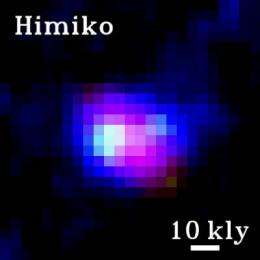
This image of the Himiko object is a composite and in false color. The thick horizontal bar at the lower right corner presents a size of 10 thousand light year. Credit: This image is created by M. Ouchi et al., which is the reproduction of Figure 2 in the article of The Astrophysical Journal May 2009 - 10 v696 issue.

(PhysOrg.com) -- A team of astronomers, led by Carnegie's Masami Ouchi, have discovered a mysterious, giant object that existed when the universe was only 800 million years old. Dubbed an extended "Lyman-Alpha blob," it is a huge body of gas. It is named Himiko for a legendary Japanese queen and stretches for 55 thousand light years, a record for that early point in time. Its length is comparable to the radius of the Milky Way's disk.

Using information from a suite of telescopes, astronomers have discovered a mysterious, giant object that existed at a time when the universe was only about 800 million years old. Objects such as this one are dubbed extended Lyman-Alpha blobs; they are huge bodies of gas that may be precursors to galaxies. This blob was named Himiko for a legendary, mysterious Japanese queen. It stretches for 55 thousand light years, a record for that early point in time. That length is comparable to the radius of the Milky Way's disk.

FLV player

Using information from a suite of telescopes, astronomers have discovered a mysterious, giant object that existed at a time when the universe was only about 800 million years old.

The researchers are puzzled by the object. Even with superb data from the world's best telescopes, they are not sure what it is. Because it is one of the most distant objects ever found, its faintness does not allow the researchers to understand its physical origins. It could be ionized gas powered by a super-massive black hole; a primordial galaxy with large gas accretion; a collision of two large young galaxies; super wind from intensive ; or a single giant galaxy with a large mass of about 40 billion Suns. Because this mysterious and remarkable object was discovered early in the history of the in a Japanese Subaru field, the researchers named the object after the legendary mysterious queen in ancient Japan.

"The farther out we look into space, the farther we go back in time, " explained lead author Masami Ouchi, a fellow at the Observatories of the Carnegie Institution who led an international team of astronomers from the U.S., Japan, and the United Kingdom. "I am very surprised by this discovery. I have never imagined that such a large object could exist at this early stage of the universe's history. According to the concordance model of Big Bang cosmology, small objects form first and then merge to produce larger systems. This blob had a size of typical present-day galaxies when the age of the universe was about 800 million years old, only 6% of the age of today's universe!"

Extended blobs discovered thus far have mostly been seen at a distance when the universe was 2 to 3 billion years old. No extended blobs have previously been found when the universe was younger. Himiko is located at a transition point in the evolution of the universe called the reionization epoch—it's as far back as we can see to date. And at 55 thousand light years, Himiko is a big blob for that time.

This reionizing chapter in the universe was at the cosmic dawn, the epoch between about 200 million and one billion years after the Big Bang. During this period, neutral hydrogen began to form quasars, stars, and the first galaxies. Astronomers probe this era by searching for characteristic hydrogen signatures from the scattering of photons created by ionized gas clouds.

The team initially identified Himiko among 207 distant galaxy candidates seen at optical wavelengths using the Subaru telescope from the Subaru/XMM-Newton Deep Survey Field located in the constellation of Cetus. They then made spectroscopic observations to measure the distance with the Keck/DEIMOS and Carnegie's Magellan/IMACS instrumentation. Himiko was an extraordinarily bright and large candidate for a distant galaxy. "We hesitated to spend our precious telescope time by taking spectra of this weird candidate. We never believed that this bright and large source was a real distant object. We thought it was a foreground interloper contaminating our galaxy sample," continued Ouchi. "But we tried anyway. Then, the spectra exhibited a characteristic hydrogen signature clearly indicating a remarkably large distance—12.9 billion !"

"Using infrared data from NASA's Spitzer Space Telescope and the United Kingdom Infrared Telescope, radio data from the VLA, and X-ray imaging from the XMM-Newton satellite, we were able to estimate the star-formation rate and stellar mass of this galaxy and to investigate whether it contains an active nucleus powered by a super-massive black hole," remarked James Dunlop a team member at Edinburgh. "We found that the stellar mass of Himiko is an order of magnitude larger than other objects known at a similar epoch, but we cannot as yet tell if the center houses an active and growing black hole."

"One of the puzzling things about Himiko is that it is so exceptional," said Carnegie's Alan Dressler, a member of the team. "If this was the discovery of a class of objects that are ancestors of today's galaxies, there should be many more smaller ones already found—a continuous distribution. Because this object is, to this point, one-of-a-kind, it makes it very hard to fit it into the prevailing model of how normal galaxies were assembled. On the other hand, that's what makes it interesting!"

More information: The research is published in the May 10, 2009, issue of The Astrophysical Journal.

Source: Carnegie Institution


print this article email this article download pdf blog this article bookmark this article     Stumble it Digg this share on Facebook retweet share on Reddit add to delicious
Rate this story - 4.9 /5 (25 votes)

Rank Filter

Move the slider to adjust rank threshold, so that you can hide some of the comments.


Display comments: newest first

  • Modernmystic - Apr 22, 2009
    • Rank: 1.3 / 5 (3)
    Perhaps just a fluke. A huge amount of gas just happened to accumulate in this spot jump starting galaxy formation by a few billion years.

    Considering the volume of the universe at the time I don't think it's such a stretch to think it might have happened in one area.
  • E_L_Earnhardt - Apr 23, 2009
    • Rank: 3 / 5 (2)
    Good Work! It's an area of deep time and interest!
  • Honor - Apr 23, 2009
    • Rank: not rated yet
    Space Monsters, we must build a DIEBuster before it reaches earth!
  • seanpu - Apr 24, 2009
    • Rank: 1 / 5 (3)
    but as the big bang didn't happen, then this is probably a closer, dim object. unless they triangulate its distance they can't say how far away it is. red-shift distance.
  • Honor - Apr 24, 2009
    • Rank: 1 / 5 (1)
    what if it's just light from an object that has had it's light twisted and bent all round from somewhere else by gravitational lensing and is actually alot closer but since the light traveled so far it's red shift indicates that.
  • OckhamsRazor - Apr 25, 2009
    • Rank: 1 / 5 (1)
    If you try and blur the pixelated image with your eyes, it almost looks like an accretion disc on its end and tilted to the left. But it doesn't explain the gas around it the way it is, especially the trail at the right of it. Just an observation!
  • omatumr - Apr 26, 2009
    • Rank: 1 / 5 (4)
    So far as I can tell, there was no "cosmic dawn", nor Big Bang, nor a primordial universe filled with Hydrogen.

    In fact, measurements suggest that nuclear matter is not evolving in this direction:

    H --> He --> C --> . . . Fe --> Neutron Stars

    But is driven in the opposite direction by repulsive interactions between neutrons:

    Neutron Stars -(emit neutrons)-> n --> H and e-

    That seems to be the energy source that powers the Sun and provides a continuous supply of solar wind H flowing out from the solar surface: http://arxiv.org/.../0411255

    Oliver K. Manuel
    http://www.omatumr.com

April 22, 2009 all stories

Comments: 7

4.9 /5 (25 votes)
  • Stumble this up

  • Digg this

  • share this

  • hide
  • Related Stories

  • Falling onto the dark
    created Jul 03, 2006 | popularity not rated yet | comments 0
  • 'Big baby' galaxy found in newborn Universe
    created Sep 28, 2005 | popularity not rated yet | comments 0
  • Galaxy Clusters Formed Early
    created Feb 17, 2005 | popularity not rated yet | comments 0
  • Massive galaxy cluster found 10 billion light years away
    created Jun 06, 2006 | popularity not rated yet | comments 0
  • New view of secret space blobs
    created Jan 28, 2005 | popularity not rated yet | comments 0


  • hide
  • Relevant PhysicsForums posts

  • Question about 2-body gravity
    created Nov 24, 2009
  • life on Mars
    created Nov 24, 2009
  • Semi-major axis from cartesian co-ordinates
    created Nov 23, 2009
  • Primary Mirror grinding
    created Nov 23, 2009
  • dark energy can escape black holes.
    created Nov 23, 2009
  • Are there green, purple and pink stars?
    created Nov 22, 2009
  • More from Physics Forums - General Astronomy

Other News

Monster Waves on the Sun are Real

Monster Waves on the Sun are Real (w/ Video)

Space & Earth / Astronomy

created 36 minutes ago | popularity 5 / 5 (2) | comments 0

Sometimes you really can believe your eyes. That's what NASA's STEREO (Solar Terrestrial Relations Observatory) spacecraft are telling researchers about a controversial phenomenon on the sun known as the "solar ...


No Wheel Stall in Diagnostic Drive

Spirit Mars Rover: No Wheel Stall in Diagnostic Drive

Space & Earth / Space Exploration

created 54 minutes ago | popularity 5 / 5 (1) | comments 0

(PhysOrg.com) -- On Sol 2095 (Tuesday, Nov. 24), Spirit performed a set of diagnostic actions related to a stall of the right-rear wheel on the previous drive, three days earlier.


Image: Prometheus Plays Tug of War with One of Saturn's Rings

Image: Prometheus Plays Tug of War with One of Saturn's Rings

Space & Earth / Space Exploration

created 44 minutes ago | popularity 4 / 5 (1) | comments 0

(PhysOrg.com) -- The diminutive moon Prometheus whips gossamer ice particles out of Saturn's F ring in this image taken by the Cassini spacecraft on Aug. 21, 2009.


Climate experts debate strategies for reducing atmospheric carbon and future warming

Climate experts debate strategies for reducing atmospheric carbon and future warming

Space & Earth / Environment

created 1hour ago | popularity 3 / 5 (2) | comments 2

(PhysOrg.com) -- Reducing carbon dioxide to safe levels may require extracting carbon from the air, says Cornell climate researcher.


Cosmic 'dig' reveals vestiges of the Milky Way's building blocks

Cosmic 'Dig' Reveals Vestiges of the Milky Way's Building Blocks

Space & Earth / Astronomy

created 5 hours ago | popularity 5 / 5 (8) | comments 1

(PhysOrg.com) -- Peering through the thick dust clouds of our galaxy's "bulge" (the myriads of stars surrounding its center), a team of astronomers has unveiled an unusual mix of stars in the stellar grouping ...