'Smart' underwear eases ulcers
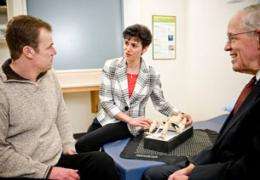
(PhysOrg.com) -- By any stretch, underwear has always been considered a good idea. But now, thanks to the work of a province-wide team of researchers led by the University of Alberta, unmentionables have risen to the ranks of smart.
Vivian Mushahwar, a University of Alberta cell biologist and Alberta Heritage Foundation for Medical Research senior scholar, and her team have designed "smart" underwear in an effort to prevent pressure ulcers from developing on bed-ridden people or those in wheelchairs. The undergarments sense that a person's skin is under pressure because of immobility, and, in turn, stimulate muscles in those areas to circulate blood and prevent ulcers from forming.
"It would take me 20 years to get the results this team will be able to achieve in five years," said Mushahwar, a professor in the Faculty of Medicine & Dentistry and at the Centre for Neuroscience, of the collaborative nature of the project. "Our team is designing neural devices with input from the people who will use them, and from the doctors and rehabilitation specialists who know the risks, and who themselves have dreamed of creative solutions."
Made up of scientists, engineers, physicians, therapists and nurses, The Smart Neural Prostheses to Restore Motor and Sensory Function team is one of five that were successful in AHFMR's second Interdisciplinary Team Grants competition. This $50-million program provides opportunities for collaborative teams of scientists and physicians from across the province to tackle research questions and healthcare challenges in areas of priority for Alberta. Alberta Health and Wellness has contributed $17 million towards the AHFMR team grants program.
Louise Miller, president and founding member of the Spinal Cord Injury Treatment Centre Society, says she was in tears when she heard about the number of disciplines participating in the team, resulting in a sharing of expertise and knowledge.
"I anticipate exciting developments, which will benefit a number of people with disabilities, allowing them to maintain their independence and maximize their abilities," said Miller, who sustained a spinal cord injury in 1984 following surgery.
"Many people I know have and do suffer with pressure ulcers-imagine the costs to the health system, never mind the impact on people's lives. We really look to the scientists to implement the results generated from the team's research efforts that will prevent this problem."
Mushahwar's team of 16 researchers is co-lead by AHFMR investigators Richard Stein, a professor in the Department of Physiology and the Centre for Neuroscience at the U of A, and Zelma Kiss, a neurosurgeon at the University of Calgary.
The team is focused on three major research projects including the smart underwear. The second project looks into new devices which will help people with spinal cord injuries to stand and walk, while the third involves the development of a system that stimulates small regions of the spinal cord and brain to restore walking, a sense of touch, and the sensations of pressure, movement, temperature and pain for people with injuries, Parkinson's disease, multiple sclerosis, ALS and other degenerative diseases.
"Our team is working on these three major projects simultaneously," said Stein. "We will take what we learn about preventing pressure ulcers and apply those results to our research into standing and walking, and vice-versa."
Team partners include people with brain and spinal injuries, doctors, nurses, rehabilitation and home care specialists from the Intensive Care Unit at the Foothills Medical Centre in Calgary, the Allen Gray Continuing Care Centre in Edmonton, Home and Extended Care in Edmonton, and the Glenrose Rehabilitation Hospital in Edmonton.
Funding support for this research team has also been provided by the Canada Foundation for Innovation and the Spinal Cord Injury Treatment Centre Society. All told, AHFMR invested $25 million in research teams with members across Alberta.
"AHFMR's Interdisciplinary Grants program brings together the best minds in medical research," says Doug Horner, Minister of Advanced Education and Technology. "With Alberta's new innovation system, these collaborative teams can accelerate their discoveries and generate tremendous new technologies for our health system, benefitting Albertans and people around the world."
Provided by University of Alberta


