Chandra Shows Shocking Impact of Galaxy Jet
April 22, 2009 by Anita Heward Chandra Shows Shocking Impact of Galaxy Jet

Enlarge

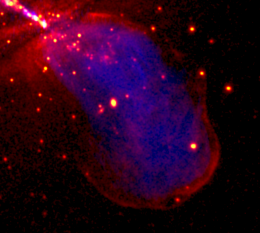
The image shows in red the X-ray emission produced by high-energy particles accelerated at the shock front where Centaurus A's expanding radio lobe (shown in blue) collides with the surrounding galaxy. (In the top-left corner X-ray emission from close to the central black hole, and from the X-ray jet extending in the opposite direction can also be seen.)

(PhysOrg.com) -- A survey by the Chandra X-ray observatory has revealed in detail, for the first time, the effects of a shock wave blasted through a galaxy by powerful jets of plasma emanating from a supermassive black hole at the galactic core. The observations of Centaurus A, the nearest galaxy that contains these jets, have enabled astronomers to revise dramatically their picture of how jets affect the galaxies in which they live. The results will be presented on Wednesday 22nd April at the European Week of Astronomy and Space Science in Hatfield by Dr Judith Croston of the University of Hertfordshire.

A team led by Dr Croston and Dr Ralph Kraft, of the Harvard-Smithsonian Center for Astrophysics in the USA, used very deep X-ray observations from Chandra to get a new view of the jets in Centaurus A. The jets inflate large bubbles filled with energetic particles, driving a shock wave through the stars and gas of the surrounding galaxy. By analysing in detail the X-ray emission produced where the supersonically expanding bubble collides with the surrounding galaxy, the team were able to show for the first time that particles are being accelerated to very high energies at the shock front, causing them to produce intense X-ray and gamma-ray radiation. Very high-energy gamma-ray radiation was recently detected from Centaurus A for the first time by another team of researchers using the High Energy Stereoscopic System (HESS) telescope in Namibia.

"Although we expect that galaxies with these are common in the Universe, Centaurus A is the only one close enough to study in such detail," said Dr Croston. "By understanding the impact that the jet has on the galaxy, its gas and stars, we can hope to understand how important the shock waves are for the life cycles of other, more distant galaxies."

The powerful jets are found in only a small fraction of galaxies but are most common in the largest galaxies, which are thought to have the biggest black holes. The jets are believed to be produced near to a central , and travel close to the speed of light for distances of up to hundreds of thousands of light years. Recent progress in understanding how galaxies evolve suggests that these jet-driven bubbles, called radio lobes, may play an important part in the life cycle of the largest galaxies in the Universe.

Energetic particles from radio galaxies may also reach us directly as cosmic rays hitting the Earth's atmosphere. Centaurus A is thought to produce many of the highest energy cosmic rays that arrive at the Earth. The team believe that their results are important for understanding how such high-energy particles are produced in galaxies as well as for understanding how massive evolve.

The results of this research will be published in a forthcoming issue of the Monthly Notices of the Royal Astronomical Society.
Provided by Royal Astronomical Society (news : web)


print this article email this article download pdf blog this article bookmark this article     Stumble it Digg this share on Facebook retweet share on Reddit add to delicious
Rate this story - 4.7 /5 (7 votes)


April 22, 2009 all stories

Comments: 0

4.7 /5 (7 votes)
  • Stumble this up

  • Digg this

  • share this

  • hide
  • Related Stories

  • New X-ray source in nearby galaxy spawns mystery
    created Jan 09, 2008 | popularity not rated yet | comments 0
  • Chandra Sheds Light on Galaxy Collision
    created Mar 29, 2007 | popularity not rated yet | comments 0
  • Chandra data reveal rapidly whirling black holes
    created Jan 10, 2008 | popularity not rated yet | comments 0
  • Black hole outflows from Centaurus A detected with APEX
    created Jan 28, 2009 | popularity not rated yet | comments 0
  • Chandra finds black holes are 'green'
    created Apr 24, 2006 | popularity not rated yet | comments 0


  • hide
  • Relevant PhysicsForums posts

  • The shape of our solar system's orbits.
    created 22 hours ago
  • Above or Below the Line of Nodes
    created Nov 07, 2009
  • Supernova vs. Nova?
    created Nov 07, 2009
  • Supernova's Gamma Rays and Comets
    created Nov 06, 2009
  • More from Physics Forums - General Astronomy

Other News

Deep creep means milder, more frequent earthquakes along Southern California's San Jacinto fault

Deep creep means milder, more frequent earthquakes along Southern California's San Jacinto fault

Space & Earth / Earth Sciences

created 8 hours ago | popularity 4.7 / 5 (3) | comments 0

With an average of four mini-earthquakes per day, Southern California's San Jacinto fault constantly adjusts to make it a less likely candidate for a major earthquake than its quiet neighbor to the east, the ...


Success in 'space elevator' competition (AP)

Success in 'space elevator' competition (Update 3)

Space & Earth / Space Exploration

created Nov 05, 2009 | popularity 4.3 / 5 (33) | comments 50

(AP) -- A robot powered by a ground-based laser beam climbed a long cable dangling from a helicopter on Wednesday to qualify for prize money in a $2 million competition to test the potential reality of the ...


In a Galaxy Far, Far Away...

In a Galaxy Far, Far Away...

Space & Earth / Astronomy

created Nov 06, 2009 | popularity 4.8 / 5 (5) | comments 15

(PhysOrg.com) -- Astronomers have published the discovery of the farthest known object in the cosmos: a star that exploded when the universe was only 630 million years old -- only 4.6% of its current age. ...


'Dropouts' pinpoint earliest galaxies

'Dropouts' pinpoint earliest galaxies

Space & Earth / Astronomy

created Nov 06, 2009 | popularity 4.2 / 5 (10) | comments 13

Astronomers, conducting the broadest survey to date of galaxies from about 800 million years after the Big Bang, have found 22 early galaxies and confirmed the age of one by its characteristic hydrogen signature ...


Space hotel taking bookings for 2012 opening

Space hotel taking bookings for 2012 opening

Space & Earth / Space Exploration

created Nov 05, 2009 | popularity 4.4 / 5 (20) | comments 11

(PhysOrg.com) -- The first orbiting space hotel is on track to open for its first customers in 2012, but hurry, as bookings are filling fast.