A Biological Basis for the 8-Hour Workday? Researchers uncover 8- and 12-hour Cycles of Gene Activity
(PhysOrg.com) -- The circadian clock coordinates physiological and behavioral processes on a 24-hour rhythm, allowing animals to anticipate changes in their environment and prepare accordingly. Scientists already know that some genes are controlled by the clock and are turned on only one time during each 24-hour cycle.
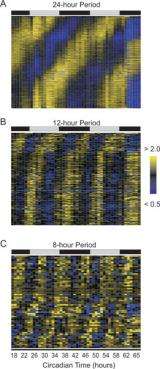
Now, researchers at the University of Pennsylvania School of Medicine and the Salk Institute for Biological Studies found that some genes are switched on once every 12 or 8 hours, indicating that shorter cycles of the circadian rhythm are also biologically encoded. Using a novel time-sampling approach in which the investigators looked at gene activity in the mouse liver every hour for 48 hours, they also found 10-fold more genes controlled by the 24-hour clock than previously reported.
This the first report where researchers have found other periodicities than the 24-hour cycle functioning in a live animal.
These findings, which appear in the April issue of PLoS Genetics, have implications for better understanding disruptions to normal circadian rhythms that contribute to a host of pathologies such as cardiovascular and metabolic disease, cancer, and aging-related disorders.
“The principal frequency, which is not a surprise, is the 24-hour cycle, and it is the most prevalent,” says senior author John Hogenesch, PhD, Associate Professor of Pharmacology in the Institute for Translational Medicine and Therapeutics at Penn. “What was a surprise to us - although we set up the experiment to see exactly this - are the 12-hour and the 8-hour cycles.
To uncover these shorter oscillations, the Hogenesch and Salk team isolated RNA from the livers of mice every hour for 48 hours. Microarray analysis showed that more than 3,000 genes were expressed on a circadian rhythm - which account for approximately 4% of all of the genes expressed in the liver. Additionally, 260 genes were expressed on a 12-hour cycle and 63 genes were expressed on an 8-hour cycle. The investigators saw similar 12-hour gene expression patterns in five other tissues.
“There is an obvious biological basis to a 12-hour rhythm,” Hogenesch says. “The 12-hour genes predicted dusk and dawn. These are two really, really stressful transitions that your body goes through and your mind goes through. Anybody who has young children realizes that they are more likely to cry around those times - and you’re more likely to cry with them.” The shift in gene expression controlled by these harmonics can help an animal prepare for the behavioral and physiological changes that accompany the shift from light to dark and back.
“We have less of a handle on the 8-hour rhythms,” he says, “but the fact that we can see them reliably means to me there is the possibility that there could be a biological basis to an 8-hour cycle.”
Parallel experiments using RNA samples from synchronized tissue culture cells uncovered only genes that cycled on a 24-hour rhythm and showed no evidence of the shorter oscillations, suggesting that some of the timing cues are systemically controlled and some are controlled by the cell itself.
Feeding appears to control one of the 12-hour gene expression peaks. Mice consume about 20% of their daily calories right after they wake at dusk, which is near one gene expression peak. When the researchers restricted feeding to a different time of day one 12-hour peak disappeared and the other became more pronounced. “We were left with the autonomously driven circadian protein transcription - the 24-hour component - which was unshifted by the feeding change,” Hogenesch says.
The high-density time sampling had an additional payoff: The team gained a sharper picture of the genes controlled by the 24-hour circadian clock. “We were able to more precisely measure the number of protein transcripts and the identity of the transcripts than we were able to with less frequent time sampling.
“The largest previously identified sets included 400 to 500 circadian-controlled genes and now we have 3,000 that are oscillating in the liver,” says Hogenesch. Using improved statistical methods also led to better accuracy. “We were able to more precisely say that, for example, the pituitary gland has 10-fold fewer oscillating protein transcripts than the liver, and cell-autonomous models have 10-fold less than that.”
Co-first authors on the paper are Michael E. Hughes of Penn and Luciano DiTacchio of the Salk Institute for Biological Sciences, La Jolla, CA. Other co-authors included Kevin R. Hayes and Julie E. Baggs of Penn, and Christopher Vollmers, S. Pulivarthy, the Salk researchers were led by Dr. Satchidananda Panda, Assistant Professor in the Regulatory Biology Laboratory and also corresponding author of the manuscript.
Provided by University of Pennsylvania (news : web)


