Pillars of Creation formed in the shadows
April 23, 2009 Pillars of Creation formed in the shadows

Enlarge

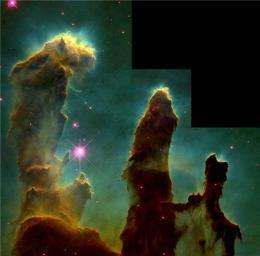
'Pillars of Creation' in the Eagle Nebula. Credit: ESA/NASA

Research by astronomers at the Dublin Institute of Advanced Studies suggests that shadows hold the key to how giant star-forming structures like the famous "Pillars of Creation" take shape.

The pillars are dense columns within giant clouds of dust and gas where form.  Several theories have been proposed to explain why the pillars develop around the edge of ionised gas bubbles surrounding young, very hot stars. Using computer models, the Dublin group has found that partially-shadowed clumps of gas tend to creep towards darker areas, causing pile-ups behind dense knots of gas and dust that screen the intense emitted by the stars.

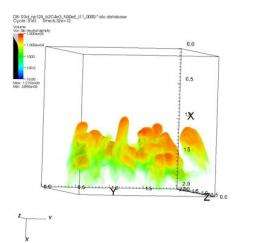
Jonathan Mackey, who is presenting the results at the European Week of Astronomy and Space Science in Hatfield said, “We created a simulation with a random distribution of lots of dense clouds with different sizes and shapes.  We found that in certain cases a number of clouds can merge together in the shadows to form structures that look very like observed pillars.  They are sufficiently dense to match the observations, can form in about 150 000 years and can survive for about 100 000 years.  Although this is a preliminary study, we believe our results are quite robust and will be confirmed by more detailed modelling.”
Pillars of Creation formed in the shadows
Enlarge

Still from 3-D simulation showing development of pillars after 200 thousand years. Credit: Mackey/Lim

The team, led by Dr Andrew Lim, found that the configuration of clumps of gas had to be favourable for the pillars to form.  Some age estimates put the Eagle Nebula pillars at no more than 100 000 years old, and models show that the shadow from a single clump would not attain the density to form a pillar in that relatively short timescale.

“Many of our models do not produce pillars that are as long and narrow as those in the Eagle Nebula, at least not at the observed gas density.  It needs the right configuration of dense clumps of gas to form a long pillar.  Unless the shadowed region is already very dense to begin with, it just takes too long to collect and organise the gas into a pillar,” said Lim.

The group plans to add increasing levels of realism to the model over the next couple of years, bringing in more accurate representations of the complex chemistry of interstellar gas, the effects of radiation from diffuse sources.  Adding in the effects of gravity will also be important as the pillars contain dense gas condensations which are in the process of collapsing under their own weight to form the next generation of stars.

Mackey said, "Gravity is relatively unimportant when the pillars are forming, but there comes a point when they get very dense and it cannot be ignored any longer.  We plan to include gravitation in future work so that we can study the next generation of stars which are forming in the pillars."

Source: Royal Astronomical Society (news : web)


print this article email this article download pdf blog this article bookmark this article     Stumble it Digg this share on Facebook retweet share on Reddit add to delicious
Rate this story - 4.7 /5 (9 votes)


April 23, 2009 all stories

Comments: 0

4.7 /5 (9 votes)
  • Stumble this up

  • Digg this

  • share this

  • hide
  • Related Stories

  • Peering into the Pillars of Creation
    created Feb 15, 2007 | popularity not rated yet | comments 0
  • Spitzer Captures Cosmic 'Mountains of Creation'
    created Nov 10, 2005 | popularity not rated yet | comments 0
  • Famous Space Pillars Feel the Heat of Star's Explosion
    created Jan 09, 2007 | popularity not rated yet | comments 0
  • Gigantic Dust Pillars In Carina Nebula Harbor Embedded Stars, Say Researchers
    created May 30, 2005 | popularity not rated yet | comments 0
  • Spitzer Captures Fruits of Massive Stars' Labors
    created May 31, 2005 | popularity not rated yet | comments 0


  • hide
  • Relevant PhysicsForums posts

  • Sideral question
    created 13 hours ago
  • Doppler shifted blackbody spectrum
    created 16 hours ago
  • Earth v. Moon
    created 18 hours ago
  • help me with coordinates and orbits
    created 18 hours ago
  • basic 'our universe' question..
    created Nov 20, 2009
  • deriving keplers law
    created Nov 19, 2009
  • More from Physics Forums - General Astronomy

Other News

Astronauts finish another spacewalk, still no baby (AP)

Astronauts finish another spacewalk, still no baby

Space & Earth / Space Exploration

created 5 hours ago | popularity 3 / 5 (2) | comments 0

(AP) -- A spacewalking astronaut put aside the impending birth of his daughter and blazed through his first-ever venture outside the International Space Station on Saturday.


Unseasonably hot and dry weather combined with strong winds to fan scores of blazes in the country's southeastern states

Australia issues 'catastrophic' alerts as fires rage

Space & Earth / Environment

created 11 hours ago | popularity 4.5 / 5 (2) | comments 0

Australia has issued "catastrophic" alerts after record-breaking temperatures and wild lightning storms sparked more than 100 fires across the country, officials said Saturday.


Commuters wait on the platform shrouded by fog in London

Climate change not man-made, say majority of Britons: poll

Space & Earth / Environment

created Nov 15, 2009 | popularity 3.3 / 5 (15) | comments 45

Less than half of Britons believes that human activity is to blame for global warming, according to a poll carried out for The Times newspaper and published on Saturday.


Mysteriously warm times in Antarctica

Mysteriously warm times in Antarctica

Space & Earth / Earth Sciences

created Nov 18, 2009 | popularity 4.2 / 5 (21) | comments 28

(PhysOrg.com) -- A new study of Antarctica's past climate reveals that temperatures during the warm periods between ice ages (interglacials) may have been higher than previously thought. The latest analysis ...


UN: Fight climate change with free condoms (AP)

UN: Fight climate change with free condoms

Space & Earth / Environment

created Nov 18, 2009 | popularity 3.1 / 5 (11) | comments 22

(AP) -- The battle against global warming could be helped if the world slowed population growth by making free condoms and family planning advice more widely available, the U.N. Population Fund said Wednesday.