Nuts at dawn: Britain's squirrels fight for survival
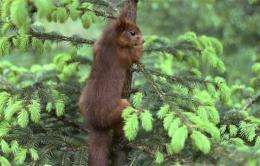
April 23, 2009 by Elodie Mazein A red squirrel, seen in Gateshead, northeastern England

Enlarge

Where there were once 3.5 million red squirrels in Britain, only about 150,000 remain. About 75 percent of these live in the wild in Scotland, while most of the rest are protected in nature reserves in northern England.

Deep in the heart of England's seemingly peaceful countryside, a fierce battle for survival is being waged between the domestic red squirrel, its tougher grey cousin -- and a new mutant arrival.

Where there were once 3.5 million in Britain, only about 150,000 remain. About 75 percent of these live in the wild in Scotland, while most of the rest are protected in nature reserves in northern .

A plethora of organisations comprising hundreds of members have sprung up in their support, and in recent months they have stepped up their efforts to check the cause of this slaughter -- the grey squirrel.

Imported from the United States in 1876 to populate country estates, the greys were larger and had thicker fur than their English cousins and quickly began to dominate -- so much so that in 1930, it became illegal to release them into the wild.

But the containment policy failed and the greys began to encroach on the reds' territory, with disastrous results.

The reds were less hardy than their American cousins -- they need more space and their food takes longer to ripen -- but it was the squirrel pox virus that did the most harm. Greys are immune, but it proves fatal for reds.

"It can take only one grey squirrel to introduce this virus to a local population of red squirrels, and then the virus can spread throughout the reds with devastating effect," says the group Save our Squirrels (SOS).

As a result, red squirrels -- viewed in the early 20th century as a pest to be hunted down and killed -- have been a protected species since 1981.

At the same time, the reputation of the greys, who now number about 2.5 million in England and Wales, gets worse and worse.

Some organisations believe in radical action. The Red Squirrel Protection Partnership (RSPP), in Northumberland in northern England, has a clear plan -- to trap and kill as many grey squirrels as possible.

According to the RSPP's website, 22,287 squirrels have been killed since January 2007, as supporters act with military-style precision. Some of these end up on the butcher's block or on restaurant menus.

"We only call ourselves the Red Squirrel Protection Partnership because if we called it the Grey Squirrel Annihilation League people might be a bit less sympathetic," supporter Baron Rupert Mitford told the Guardian newspaper.

Public organisations have so far shied away from such a radical solution but the tactic is gaining ground.

For example, the Saving Scotland's Red Squirrels project, launched in February by a coalition of Scottish groups, purports to protect the habitat of red squirrels and "control" the grey population.

A few timid voices defend the greys, however, noting they face a similar fate to the red squirrels at the hand of a new arrival -- the black squirrel.

These are the result of a genetic mutation of the grey squirrels and are spreading across Britain from East Anglia, where the greys were first introduced.

According to a study by Alison Thomas, a geneticist at Anglia Ruskin University in Cambridge, the black squirrel made up almost half the rodent population in some areas at the beginning of 2008.

"The estimate is about 25,000 (black squirrels) today, but the black mutation gene has a dominant aspect which explains their rapid increase," she told AFP.

With a thicker coat and a higher level of testosterone than either the red or grey squirrels, the black mutants have been dubbed the "super-squirrel" and are proving more attractive to females -- ensuring their population flourishes.

(c) 2009 AFP


print this article email this article download pdf blog this article bookmark this article     Stumble it Digg this share on Facebook retweet share on Reddit add to delicious
Rate this story - 3.5 /5 (2 votes)

Rank Filter

Move the slider to adjust rank threshold, so that you can hide some of the comments.


Display comments: newest first

  • Nik_2213 - Apr 24, 2009
    • Rank: not rated yet
    Bring them on: Our big tabby cats would welcome the challenge...

    IMHO, very few cats are nimble enough to catch reds. By comparison, greys are just faster rats...

April 23, 2009 all stories

Comments: 1

3.5 /5 (2 votes)
  • Stumble this up

  • Digg this

  • share this

  • hide
  • Related Stories

  • New hope for the red squirrel
    created Oct 16, 2008 | popularity not rated yet | comments 0
  • Research: Gray squirrel at risk in Britain
    created Apr 27, 2008 | popularity not rated yet | comments 0
  • Culling grey squirrels may be problematic
    created Aug 03, 2006 | popularity not rated yet | comments 0
  • Computers to save unique type of American red squirrel
    created Apr 27, 2006 | popularity not rated yet | comments 0
  • Female red squirrels opt for quantity over quality
    created Jul 07, 2008 | popularity not rated yet | comments 0


  • hide
  • Relevant PhysicsForums posts

Other News

Scientists successfully reprogram blood cells

Biology / Cell & Microbiology

created 6 hours ago | popularity 5 / 5 (2) | comments 0

Researchers have transplanted genetically modified hematopoietic stem cells into mice so that their developing red blood cells produce a critical lysosomal enzyme -preventing or reducing organ and central nervous system damage ...


Iowa State University researcher discovers key to vital DNA, protein interaction

Researchers discover key to vital DNA, protein interaction

Biology / Other

created 2 hours ago | popularity not rated yet | comments 0

(PhysOrg.com) -- A researcher at Iowa State University has discovered how a group of proteins from plant pathogenic bacteria interact with DNA in the plant cell, opening up the possibility for what the scientist ...


Study shows that some malignant tumors can be shut down after all

Biology / Cell & Microbiology

created 10 hours ago | popularity 5 / 5 (3) | comments 1

Oncologists have had their hands tied because more than half of all human cancers have mutations that disable a protein called p53. As a critical anti-cancer watchdog, p53 masterminds several cancer-fighting operations within ...


New discovery allows scientists for the first time to experimentally annotate genomes

New discovery allows scientists for the first time to experimentally annotate genomes

Biology / Biotechnology

created 5 hours ago | popularity 5 / 5 (3) | comments 0

Over the last 20 years, the sequencing of the human genome, along with related organisms, has represented one of the largest scientific endeavors in the history of mankind. The information collected from genome ...


Wasp

Well-traveled wasps provide hope for vanishing species

Biology / Plants & Animals

created 6 hours ago | popularity not rated yet | comments 0

They may only be 1.5mm in size, but the tiny wasps that pollinate fig trees can travel over 160km in less than 48 hours, according to research from scientists at the University of Leeds. The fig wasps are transporting ...