Largest collection of anomalous white dwarfs observed by Hubble
April 23, 2009 Largest collection of anomalous white dwarfs observed in new Hubble images

Enlarge

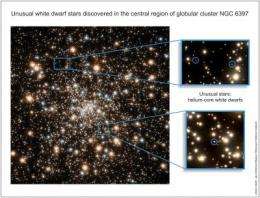
Twenty-four unusual stars have been spotted in an ancient swarm of stars in the Milky Way. These white dwarfs, a type of dead star, are made of helium rather than the usual carbon and oxygen, and appear as faint, pale blue stars. This collection of helium-core white dwarfs was discovered by a team including Professor Adrienne Cool of San Francisco State University and Rachel Strickler of UC Santa Cruz. They suggest that thousands of stars in star cluster NGC 6397 are coupled with close companions that interfere with their normal development, resulting in these odd white dwarfs made of helium. Credit: Jay Anderson / Space Telescope Science Institute

Twenty-four unusual stars, 18 of them newly discovered, have been observed in new Hubble telescope images. The stars are white dwarfs, a common type of dead star, but they are odd because they are made of helium rather than the usual carbon and oxygen. This is the first extensive sequence of helium-core white dwarfs to be observed in a globular cluster, a dense swarm of some of the oldest stars in our galaxy.

A study, accepted for publication in the , suggests that these helium-core have had their lives cut short because of their orbital dance around a partner star.

"Helium-core white dwarfs have only about half the mass of typical white dwarfs, but they are found concentrated in the center of the cluster" said Adrienne Cool, professor of physics and astronomy at San Francisco State University, who co-authored the study with graduate student Rachel R. Strickler. "With such low masses, the helium-core white dwarfs ought to be floating all around the cluster, according to theory. The fact that we find them only in the central regions suggests that they have heavy companions -- partner that anchor them to the cluster center."

Being coupled with companions also helps explain the stars' atypical chemical make up. White dwarfs are stars that have reached the end of their lives and have run out of fuel. Most stars burn their fuel leaving behind a dense ball of carbon and oxygen, but these white dwarfs are made of . Cool suggests that a star that goes on to become a helium-core white dwarf must have a close companion so that when the star became a red giant and expanded, its outer layers spilled onto the companion. The star never had the chance to reach maturity and burn its helium into carbon and oxygen.

The study focused on star cluster NGC 6397, one of the globular clusters closest to Earth at approximately 7,200 away. Six helium-core white dwarfs have been observed before in this cluster. Cool and colleagues discovered the first three in 1998.

"This is the first time that helium-core white dwarf stars have been discovered in partnerships with other white dwarfs in a globular cluster," Cool said. "This large sample allows us to answer questions about the mass and nature of the partner stars, and the prevalence of these kinds of binaries in the globular cluster."

Binary stars play an important role in the evolution of star clusters. Their continual dance around each other provides energy to the cluster that astronomers believe can help prevent black holes from forming. From the data, Cool and her team are able to infer that one to five percent of stars in this globular cluster will end their lives as helium-core white dwarfs with companion stars, a finding that will help improve theoretical models of cluster dynamics. "It may not sound like a lot but it doesn't take many binaries to stir things up," Cool said.

One finding remains a mystery. Despite the Hubble camera's high level of sensitivity, the faintest helium-core white dwarfs appear to be missing.

"It's possible that these helium-core white dwarfs cool so slowly that they haven't had time to get very faint yet," Cool said. Another possibility is that the oldest binaries containing helium-core white dwarfs have been destroyed by interactions with other stars in the cluster.

More information: "Helium-Core in the Globular Cluster NGC 6397" will be published in the July 1, 2009 issue of the Astrophysical Journal.

Source: San Francisco State University (news : web)


print this article email this article download pdf blog this article bookmark this article     Stumble it Digg this share on Facebook retweet share on Reddit add to delicious
Rate this story - 4.7 /5 (6 votes)


April 23, 2009 all stories

Comments: 0

4.7 /5 (6 votes)
  • Stumble this up

  • Digg this

  • share this

  • hide
  • Related Stories

  • Astronomers discover how white dwarf stars get their 'kicks'
    created Dec 04, 2007 | popularity not rated yet | comments 0
  • Hubble Sees Faintest Stars in a Globular Cluster
    created Aug 17, 2006 | popularity not rated yet | comments 0
  • Astronomers Find Origin Of Extreme-Helium Stars
    created Mar 20, 2006 | popularity not rated yet | comments 0
  • New type of pulsating white dwarf star discovered
    created May 01, 2008 | popularity not rated yet | comments 0
  • What's My Age? Mystery Star Cluster Has 3 Different Birthdays
    created Jul 10, 2008 | popularity not rated yet | comments 0


  • hide
  • Relevant PhysicsForums posts

  • The shape of our solar system's orbits.
    created 13 hours ago
  • Above or Below the Line of Nodes
    created 17 hours ago
  • Supernova vs. Nova?
    created 23 hours ago
  • Supernova's Gamma Rays and Comets
    created Nov 06, 2009
  • More from Physics Forums - General Astronomy

Other News

Success in 'space elevator' competition (AP)

Success in 'space elevator' competition (Update 3)

Space & Earth / Space Exploration

created Nov 05, 2009 | popularity 4.3 / 5 (33) | comments 50

(AP) -- A robot powered by a ground-based laser beam climbed a long cable dangling from a helicopter on Wednesday to qualify for prize money in a $2 million competition to test the potential reality of the ...


Space hotel taking bookings for 2012 opening

Space hotel taking bookings for 2012 opening

Space & Earth / Space Exploration

created Nov 05, 2009 | popularity 4.4 / 5 (20) | comments 11

(PhysOrg.com) -- The first orbiting space hotel is on track to open for its first customers in 2012, but hurry, as bookings are filling fast.


'Dropouts' pinpoint earliest galaxies

'Dropouts' pinpoint earliest galaxies

Space & Earth / Astronomy

created Nov 06, 2009 | popularity 4.1 / 5 (9) | comments 12

Astronomers, conducting the broadest survey to date of galaxies from about 800 million years after the Big Bang, have found 22 early galaxies and confirmed the age of one by its characteristic hydrogen signature ...


This undated file picture shows part of the Pastoruri snowcapped mountain in the central Peruvian Andes

'Whitewash' could slow global warming: Peruvian scientist

Space & Earth / Earth Sciences

created Nov 04, 2009 | popularity 1.4 / 5 (9) | comments 11

A Peruvian scientist has called on his country to help slow the melting of Andean glaciers by daubing white paint on the rock and earth left behind by receding ice so they will absorb less heat.


In a Galaxy Far, Far Away...

In a Galaxy Far, Far Away...

Space & Earth / Astronomy

created Nov 06, 2009 | popularity 4.8 / 5 (4) | comments 10

(PhysOrg.com) -- Astronomers have published the discovery of the farthest known object in the cosmos: a star that exploded when the universe was only 630 million years old -- only 4.6% of its current age. ...