New biosensor for most serious form of Listeria food poisoning bacteria
April 23, 2009 New biosensor for most serious form of Listeria food poisoning bacteria

Enlarge

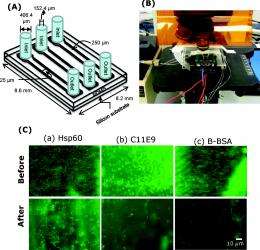
Schematic drawing (top left) of a microfluidic biochip for capturing Listeria. A prototype chip, top right, is connected with microfluidic tubings, and at bottom are images of bacteria on a chip. Credit:The American Chemical Society.

(PhysOrg.com) -- Scientists in Indiana are reporting development of a new biosensor for use in a faster, more sensitive test for detecting the deadliest strain of Listeria food poisoning bacteria. That microbe causes hundreds of deaths and thousands of hospitalizations each year in the United States, particularly among people with weakened immune systems. Their study appears in the current issue of ACS’ Analytical Chemistry.

Arun Bhunia and colleagues note in the new study that fast, highly effective tests already are available for five of the six known species of Listeria. These tests use antibodies that signal the presence of the bacteria. However, no rapid, sensitive tests are available for detecting Listeria monocytogenes, the deadliest of the species, the researchers say.

The scientists describe development of the biosensor using so-called heat shock proteins — which the body produces in response to stress — instead of the antibodies used in other tests. They showed that their new sensor was faster and more sensitive at detecting the deadly than antibody-based tests. It had a microbe capture rate up to 83 percent higher than antibody-based tests.

The new biosensor will reduce the likelihood of false-positive results for Listeria monocytogenes and may lead to improved tests for detecting other types of dangerous pathogens, the researchers say.

Provided by American Chemical Society (news : web)


print this article email this article download pdf blog this article bookmark this article     Stumble it Digg this share on Facebook retweet share on Reddit add to delicious
Rate this story - 5 /5 (1 vote)


April 23, 2009 all stories

Comments: 0

5 /5 (1 vote)
  • Stumble this up

  • Digg this

  • share this

  • hide
  • Related Stories


  • hide
  • Relevant PhysicsForums posts

  • Goddard
    created 7 hours ago
  • Rate Laws
    created 9 hours ago
  • why oxygen, cannot act as a pi-donor while NO can?
    created Nov 20, 2009
  • Aspirin
    created Nov 19, 2009
  • More from Physics Forums - Chemistry

Other News

Accidental discovery produces durable new blue pigment for multiple applications

Accidental discovery produces durable new blue pigment for multiple applications

Chemistry / Biochemistry

created Nov 16, 2009 | popularity 4.5 / 5 (30) | comments 6

An accidental discovery in a laboratory at Oregon State University has apparently solved a quest that over thousands of years has absorbed the energies of ancient Egyptians, the Han dynasty in China, Mayan ...


One word: bioplastics

One word: bioplastics

Chemistry / Materials Science

created Nov 17, 2009 | popularity 4.5 / 5 (11) | comments 4

(PhysOrg.com) -- Every year, more than 250 billion pounds of plastic are produced worldwide. Much of it ends up in the world's oceans, a fact that troubles MIT biology professor Anthony Sinskey.


New on-off 'switch' triggers and reverses paralysis in animals with a beam of light

New on-off 'switch' triggers and reverses paralysis in animals with a beam of light (w/ Video)

Chemistry / Biochemistry

created Nov 18, 2009 | popularity 4.8 / 5 (5) | comments 3

In an advance with overtones of Star Trek phasers and other sci-fi ray guns, scientists in Canada are reporting development of an internal on-off "switch" that paralyzes animals when exposed to a beam of ultraviolet ...


New research provides blueprint for molecular basis of global warming

New research provides blueprint for molecular basis of global warming

Chemistry / Materials Science

created Nov 17, 2009 | popularity 4 / 5 (4) | comments 3

A new study indicates that major chemicals most often cited as leading causes of climate change, such as carbon dioxide and methane, are outclassed in their warming potential by compounds receiving less attention.


Ethanol

Microbes to Take Over Ethanol Production?

Chemistry / Biochemistry

created Nov 20, 2009 | popularity 3.5 / 5 (6) | comments 0

(PhysOrg.com) -- Not too long ago, it seemed that ethanol production was the wave of the future. The use of trash, wood chips or different types of plants -- usually grass or corn -- to make ethanol was considered ...