Even in the Digital Age, building a great gadget doesn't guarantee success
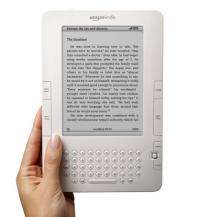
Publish a book on paper, says a sheepish Beth Collins, and "I'm hesitant to read it." But send it through the ether to her feather-light Kindle 2, Amazon's whiz-bang electronic reading machine, and she's eager to get lost in its pages_virtual though they may be.
"The Kindle is more portable. It's more readable," said Collins, 56, a high school administrator.
If enough people buy Kindles or Sony's rival device or a yet-to-debut electronic newspaper from Plastic Logic, the world of publishing could change forever -- from how the written word is sold to how easy it would be to have your novel published. It even would alter the meaning of publishing.
But the "ifs" are huge. Even in the Digital Age, building a great gadget doesn't guarantee consumers will come.
Will people, for instance, fork out for Blu-ray video systems or instead decide that their standard DVDs are sharp enough? Could next year's Chevrolet Volt plug-in hybrid car wallop Big Oil, or will it collect dust at dealerships if gas prices stay low? Will the Google-based Android phone finally connect the search engine to your pocket, or has Apple's iPhone already cemented its place as the hippest of hip candy?
Designers and market analysts say a device can't have too few features or too many. It must perform tasks that no device has ever done, or at least do them so elegantly as to seem new. Its value must be obvious at a glance.
Finally, the device needs to capture that most enigmatic of qualities -- it's gotta be cool.
Even then disappointment could come from failing to make the right partnerships, pitch the innovation the right way or become favored by "early adopters," such as Collins, who set trends for the rest of us.
In today's economic climate, the gadget also must weather a wintry marketplace.
"In the end, you want something that looks cool and is easy to use," said Michael Song of the Institute for Entrepreneurship and Innovation at the University of Missouri-Kansas City.
Garmin International, which has a hit in its Nuvi navigation devices, talks about making gadgets as simple to use as an ATM or a gas pump. In developing applications for smart phones, designers at Handmark Inc. in Kansas City constantly keep an eye on how their products are used.
As Steve Jobs, the driving force behind Apple Inc., famously said: "Design is not just what it looks like and feels like. Design is how it works."
Yet working well isn't enough.
Theorist Everett Rogers studied such things as preventing scurvy in the British navy or persuading Peruvian villagers to boil drinking water. Good ideas, he concluded, don't always catch on.
His 1962 book, "Diffusion of Innovations," listed factors that determine what technology takes hold. Subsequent revisions applied his thinking to controlling the spread of AIDS and the success of the Palm Pilot electronic organizer. Rogers returned to the same five factors:
• Does the new thing have some relative advantage? For Collins, the ability to cram thousands of books into a device that's more compact than a single paperback makes the Kindle a winner.
• Is it compatible with past experience? Certainly the Kindle is easy to read. The letters look identical to those on a printed page (and they can be expanded to large print).
Yet even with a fast-growing 260,000 titles, Amazon's Kindle library still leaves out more than it includes. The company says it is shooting "to have every book, ever published, in any language, in print or out of print, all available in less than 60 seconds."
• Is it too complex? Here, things get relative. It's pretty simple to download books to the Kindle over a wireless connection and read them, but is it as simple as pulling a book from a shelf and turning the pages?
Rogers argued that trialability -- whether a new user can test it -- is critical. In that respect, online-only Amazon has a problem. As good as the device might be, a consumer first has to gamble the $359 purchase. It's like asking someone who has never driven to order a car online.
• Finally, it must be easy for people to observe the device's new advantage. Because it was hard for illiterate Peruvian villagers without a grasp of germ theory to see better health from boiled water, they didn't bother with it.
"Part of that is also, 'What will other people think of me?'" said Song, the college professor. "Will I seem cool and hip, or will I look ridiculous?"
Unveiled after great hype in 2001, the self-balancing Segway scooter was a radical new way to get around with intuitive controls. Lean forward on the two-wheeled platform and the electric motor moved you forward. Lean back, you stopped.
But the product was labeled a pointless enemy of walking rather than a revolution in transportation. It has not caught on beyond the occasional security detail and a few factory floors.
Now the Segway's maker hopes a two-person, more carlike version called the Personal Urban Mobility and Accessibility vehicle, or PUMA, may recoup some of the investment.
Then there's the iPod. It wasn't the first small digital music player. When it came out, competing devices offered more storage or better battery life_a giant factor for gadget hounds everywhere. Other devices had more options, performed more tricks, but, oh, how people loved the iPod's little wheel.
"The bottom line was the iPod was fun," said Matthew Kressy, an instructor at the Rhode Island School of Design. "It changed the user's experience. All of a sudden you were using the little dial and scrolling through your songs. There was the tactile sensation of the button and the tick, tick, tick sound in the headphones. They broke through."
The iPod also came with the iTunes Store, which made finding and organizing songs instinctive. And one price, 99 cents a song. Simple. (Only last week, after Apple became the world's largest music retailer, has iTunes begun to vary prices.)
Any number of confounding variables will figure in whether the Kindle will do to reading what the iPod has done to music, or wind up on the trash heap of gadget history.
Amazon's Kindle bookstore offers most books for a flat $9.99. While it lacks the Apple mystique, Amazon has a broad customer base that already is comfy with buying things at its Web site.
So far, the bookseller has piled up raves for the Kindle from the likes of the trendsetting contraption critic for The Wall Street Journal and the persnickety gadget geeks at the Gizmodo and Engadget Web sites.
Yet there are doubters, like Joshua Benton of the Nieman Journalism Lab.
"I'm a nerdy guy. And I'm a writer. I work at Harvard, which is filled with nerdy people who are writers," Benton recently wrote on his blog. "I am the exact target audience for the Kindle _ precisely the mix of book reader and tech lover who should want one. And yet, 15 months after the Kindle, I have not seen one single Kindle in the flesh. Not one."
Amazon is coy about sales.
"We are very pleased with how Kindle's been received and the great demand, but as a matter of company policy, we do not disclose unit sales," spokeswoman Cinthia Portugal wrote in an e-mail.
Collins already is on her second Kindle. She adored the original version, but now it seems_hard to say this about an electronic reader purchased in 2008 -- somewhat dated. The newer Kindle 2 turns pages more naturally, holds far more books and boasts a longer-lasting battery.
It also has competitors. Sony has a Reader Digital Book. While critics are less enthusiastic about the workings of the Sony gadget, the company has partnered with Google in its fast-growing effort to scan into digital form nearly every book in the world.
And Plastic Logic of Mountain View, Calif., is coming out with a lighter, thinner and larger electronic reader that will work strictly off a touchscreen and be aimed more at newspapers and magazines.
"What we have going for us is that the people who are providing content to us know how to reach their customers. And we're going to keep it simple," said Daren Benzi, a vice president at Plastic Logic.
As Handmark develops new software for the iPhone, the BlackBerry and the Palm, it finds more success as it teams its technology with established brands such as Zagat restaurant reviews and prominent news organizations, said Evan Conway, Handmark's vice president for marketing.
Then, he said, it's important to watch how people play with the technology.
"Day one, there's going to be a lot of usage," Conway said. "But what is it the next week, and the second month? You have to make sure people really use this."
Collins said she hardly goes anywhere without her Kindle 2. She's packed it with about 200 books and counting.
"I'm hooked."
___
(c) 2009, The Kansas City Star.
Visit The Star Web edition on the World Wide Web at www.kansascity.com
Distributed by McClatchy-Tribune Information Services.


