Fire influences global warming more than previously thought
April 23, 2009 Fire influences global warming more than previously thought

Enlarge

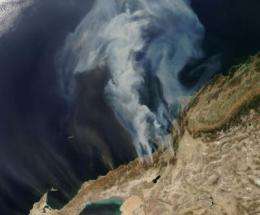
These are smoke plumes from southern California wildfires billowing out over the Pacific ocean. The red outlines indicate active fires. These wildfires spread over a two-week period in October 2007, burning more than 500,000 acres, according to the California Department of Forestry and Fire Protection. Credit: Image courtesy of MODIS Rapid Response Project at NASA/GSFC.

Fire's potent and pervasive effects on ecosystems and on many Earth processes, including climate change, have been underestimated, according to a new report.

"We've estimated that deforestation due to burning by humans is contributing about one-fifth of the human-caused greenhouse effect -- and that percentage could become larger," said co-author Thomas W. Swetnam of The University of Arizona in Tucson.

"It's very clear that is a primary catalyst of global ," said Swetnam, director of UA's Laboratory of Tree-Ring Research.

"The paper is a call to arms to earth scientists to investigate and better evaluate the role of fire in the Earth system," he said.

The team also reports that all fires combined release an amount of carbon dioxide into the atmosphere equal to 50 percent of that coming from the combustion of fossil fuels.

"Fires are obviously one of the major responses to climate change, but fires are not only a response -- they feed back to warming, which feeds more fires," Swetnam said.
Fire influences global warming more than previously thought
Enlarge

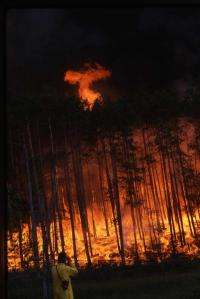
This is a forest fire in Siberia. Credit: Laboratory of Tree-Ring Research, The University of Arizona

When vegetation burns, the resulting release of stored carbon increases global warming. The more fires, the more carbon dioxide released, the more warming -- and the more warming, the more fires.

The very fine soot, known as , that is released into the atmosphere by fires also contributes to warming.

"The scary bit is that, because of the feedbacks and other uncertainties, we could be way underestimating the role of fire in driving future climate change," Swetnam said.

The report's 22 authors call for the Intergovernmental Panel on Climate Change, or IPCC, to recognize the overarching role of fire in and to incorporate fire better into future models and reports about climate change.

David Bowman, a lead co-author, said, "We're most concerned that fire has not been rigorously and adequately incorporated in the . It's remarkable that such an integral part of the landscape has been so sidelined."

Swetnam, Bowman of the University of Tasmania in Hobart, Australia, the other lead co-author Jennifer K. Balch of the National Center for Ecological Analysis and Synthesis in Santa Barbara, Calif. and their colleagues will publish their paper, "Fire in the Earth System," in the April 24 issue of the journal Science. A complete list of authors is at the end of this release.

Because fire on Earth predates humans, its ubiquitous activity is simultaneously accepted and overlooked. Bowman says, "Fire is extraordinarily obvious, but deeply subtle."

The article ties together various threads of knowledge about fire from disparate fields including ecology, global modeling, physics, anthropology, environmental history, medicine and climatology.

A more complete understanding of how the Earth works requires recognizing how fire is intertwined with and also a driver of human history and the Earth's history, the authors write.

Balch said of the article, "This synthesis is a prerequisite for adaptation to the apparent recent intensification of fire feedbacks, which have been exacerbated by climate change, rapid land-cover transformation, and exotic species introductions."

She commented about "fires where we don't normally see fires," and pointed to the occurrence of bigger and more frequent fires from the western U.S. to the tropics.

Swetnam said that, in addition to the burning in the tropics, huge tracts of the boreal forests of Siberia, Canada and northern Europe burn each year.

"The role of fire in forests in the boreal zone is unappreciated," he said.

"Russian forests alone contain more than 50 percent of the carbon stored on land in the Northern Hemisphere," Swetnam wrote in an e-mail, adding that warming is happening fastest at high latitudes.

In some recent years, the acreage burned in the forests of Siberia exceeded the size of the U.S. state of Virginia, he said. As the world warms, more of those regions are likely to burn, accelerating the warming.

Calling for a holistic fire science, Balch said, "We don't think about fires correctly."

"Fire is as elemental as air or water. We live on a fire planet. We are a fire species. Yet, the study of fire has been very fragmented. We know lots about the carbon cycle, the nitrogen cycle, but we know very little about the fire cycle, or how fire cycles through the biosphere."

Source: University of Arizona (news : web)


print this article email this article download pdf blog this article bookmark this article     Stumble it Digg this share on Facebook retweet share on Reddit add to delicious
Rate this story - 4.3 /5 (12 votes)

Rank Filter

Move the slider to adjust rank threshold, so that you can hide some of the comments.


Display comments: newest first

  • jeffsaunders - Apr 24, 2009
    • Rank: 5 / 5 (1)
    fires do burn off areas as mentioned regularly. Where I live the fires will burn hundreds of thousands of hectares almost every year. There is some overlap but most areas will get burned again in a few years. This means the forest must grow back.

    However, There are areas that get burned in other parts of the world (where the forest is slow to grow back) that get turned into grassland and used for grazing. Pasture land raises the temperature locally and also reduces the rainfall locally.

    This temperature increase is not as severe in grassland as in urban land use but is still significant.

April 23, 2009 all stories

Comments: 1

4.3 /5 (12 votes)
  • Stumble this up

  • Digg this

  • share this

  • hide
  • Related Stories

  • Wildfire drives carbon levels in northern forests
    created Oct 31, 2007 | popularity not rated yet | comments 0
  • Global warming aided by drought, deforestation link
    created Dec 08, 2008 | popularity not rated yet | comments 0
  • US fires release large amounts of carbon dioxide
    created Nov 01, 2007 | popularity not rated yet | comments 0
  • Comet impact theory disproved
    created Jan 26, 2009 | popularity not rated yet | comments 0
  • Fires in Far Northern Forests to Have Cooling, Not Warming, Effect
    created Nov 16, 2006 | popularity not rated yet | comments 0


  • hide
  • Relevant PhysicsForums posts

  • cycles
    created 13 hours ago
  • The Origin of the term 'fossil' fuels
    created Nov 05, 2009
  • co2
    created Nov 03, 2009
  • Early Earths Sulfidic Ocean Conditions
    created Oct 30, 2009
  • vegetation
    created Oct 29, 2009
  • climate change
    created Oct 29, 2009
  • More from Physics Forums - Earth

Other News

Deep creep means milder, more frequent earthquakes along Southern California's San Jacinto fault

Deep creep means milder, more frequent earthquakes along Southern California's San Jacinto fault

Space & Earth / Earth Sciences

created 12 hours ago | popularity 4.7 / 5 (3) | comments 0

With an average of four mini-earthquakes per day, Southern California's San Jacinto fault constantly adjusts to make it a less likely candidate for a major earthquake than its quiet neighbor to the east, the ...


Success in 'space elevator' competition (AP)

Success in 'space elevator' competition (Update 3)

Space & Earth / Space Exploration

created Nov 05, 2009 | popularity 4.3 / 5 (33) | comments 50

(AP) -- A robot powered by a ground-based laser beam climbed a long cable dangling from a helicopter on Wednesday to qualify for prize money in a $2 million competition to test the potential reality of the ...


In a Galaxy Far, Far Away...

In a Galaxy Far, Far Away...

Space & Earth / Astronomy

created Nov 06, 2009 | popularity 4.8 / 5 (5) | comments 16

(PhysOrg.com) -- Astronomers have published the discovery of the farthest known object in the cosmos: a star that exploded when the universe was only 630 million years old -- only 4.6% of its current age. ...


'Dropouts' pinpoint earliest galaxies

'Dropouts' pinpoint earliest galaxies

Space & Earth / Astronomy

created Nov 06, 2009 | popularity 4.2 / 5 (10) | comments 13

Astronomers, conducting the broadest survey to date of galaxies from about 800 million years after the Big Bang, have found 22 early galaxies and confirmed the age of one by its characteristic hydrogen signature ...


Space hotel taking bookings for 2012 opening

Space hotel taking bookings for 2012 opening

Space & Earth / Space Exploration

created Nov 05, 2009 | popularity 4.4 / 5 (21) | comments 11

(PhysOrg.com) -- The first orbiting space hotel is on track to open for its first customers in 2012, but hurry, as bookings are filling fast.