Wetlands likely source of methane from ancient warming event
April 23, 2009
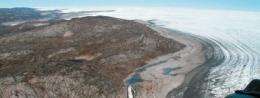
Horizontal banding of ice layers reveals thousands of years of ice formation at Greenland's Pakitsoq ice margin. Geoscientists frequent Greenland's ice sheets to build records of paleoclimate. Credit: Scripps Institution of Oceanography, UC San Diego
An expansion of wetlands and not a large-scale melting of frozen methane deposits is the likely cause of a spike in atmospheric methane gas that took place some 11,600 years ago, according to an international research team led by Scripps Institution of Oceanography at UC San Diego.
The finding is expected to come as a relief to scientists and climate watchers concerned that huge accelerations of global warming might have been touched off by methane melts in the past and could happen again now as the planet warms. By measuring the amount of carbon-14 isotopes in methane from air bubbles trapped in glacial ice, the researchers determined that the surge that took place nearly 12,000 years ago was more chemically consistent with an expansion of wetlands. Wetland regions, which produce large amounts of methane from bacterial breakdown of organic matter, are known to have spread during warming trends throughout history.
"This is good news for global warming because it suggests that methane clathrates do not respond to warming by releasing large amounts of methane into the atmosphere," said Vasilii Petrenko, a postdoctoral fellow at University of Colorado, Boulder, who led the analysis while a graduate student at Scripps.
The results appear in April 24 editions of the journal Science.
Scientists had long been concerned about the potential for present-day climate change to cause a thawing of Arctic permafrost and a warming of ocean waters great enough to trigger a huge release of methane that would send planetary warming into overdrive. Vast amounts of methane are sequestered in solid form, known as methane clathrate, in seafloor deposits and in permafrost. Cold temperatures and the intense pressure of the deep ocean stabilize the methane clathrate masses and keep methane from entering the atmosphere.
Scientists have estimated that a melting of only 10 percent of the world's clathrate deposits would create a greenhouse effect equal to a tenfold increase in the amount of carbon dioxide in the atmosphere. For comparison, the warming trend observed in the last century has taken place with only a 30 percent increase of atmospheric carbon dioxide.
The research team, overseen by Scripps geoscientist and study co-author Jeff Severinghaus, collected what may be the largest ice samples ever for a climate change study. The researchers cut away 15 tons of ice from a site called Pakitsoq at the western margin of the Greenland ice sheet to collect the ancient air trapped within. Methane exists in low concentrations in this air and only a trillionth of any given amount contains the carbon-14 isotope that the researchers needed to perform the analysis. Levels of carbon-14, which has a half-life of 5,730 years, were too high in the methane to have come from clathrates, the researchers concluded.
"This study is important because it confirms that wetlands and moisture availability change dramatically along with abrupt climate change," said Severinghaus. "This highlights in a general way the fact that the largest impacts of future climate change may be on water resources and drought, rather than temperature per se."
The burst of methane took place immediately after an abrupt transition between climatic periods known as the Younger Dryas and Preboreal. During this event, temperatures in Greenland rose 10° C (18° F) in 20 years. Methane levels over 150 years rose about 50 percent, from 500 parts per billion in air to 750 parts per billion.
In addition to Petrenko and Severinghaus, researchers from the Australian Nuclear Science and Technology Organisation (ANSTO), Oregon State University, the National Institute of Water and Atmospheric Research in New Zealand, the Technical University of Denmark and the Commonwealth Scientific and Industrial Research Organisation in Australia contributed to the report.
The work was supported by grants from the National Science Foundation, the Packard Foundation, the American Chemical Society, the ANSTO Cosmogenic Climate Archives of the Southern Hemisphere project and the New Zealand Foundation of Science and Technology.
-
Frozen methane chunks not responsible for abrupt increases in atmospheric methane
Feb 09, 2006 |
not rated yet |
0
-
Study: Ancient humans 'altered' climate
Sep 09, 2005 |
not rated yet |
0
-
Large methane release could cause abrupt climate change as happened 635 million years ago
May 28, 2008 |
not rated yet |
0
-
Explaining the methane mystery
Sep 27, 2006 |
not rated yet |
0
-
Causes of methane growth revealed
Sep 09, 2005 |
not rated yet |
0
-
Engineers build first sub-10-nm carbon nanotube transistor
Feb 01, 2012 |
4.9 / 5 (33) |
30
-
Something old, something new: Evolution and the structural divergence of duplicate genes
Jan 31, 2012 |
4.6 / 5 (7) |
1
-
The hidden nanoworld of ice crystals: Revealing the dynamic behavior of quasi-liquid layers
Jan 30, 2012 |
5 / 5 (4) |
1
-
Stock market network reveals investor clustering
Jan 27, 2012 |
3.9 / 5 (23) |
8
-
Of microchemistry and molecules: Electronic microfluidic device synthesizes biocompatible probes
Jan 26, 2012 |
5 / 5 (2) |
0
-
Do some geologists actually act a lot like Randy Marsh?
Feb 11, 2012
-
Discrepancy between oxygen and carbon-dioxide levels
Feb 09, 2012
-
where gems are found in the world
Feb 09, 2012
-
Wind Waves in Reservoir ~ Wind run-up and Wind set-up
Feb 08, 2012
-
Balance of oxygen in the atmosphere
Feb 01, 2012
-
The case for a methanol-based economy
Jan 30, 2012
- More from Physics Forums - Earth
More news stories
Salvage workers begin pumping fuel from Italian shipwreck
Salvage workers Sunday began pumping fuel from the shipwrecked Italian cruise liner Costa Concordia, a day ahead of schedule, officials said.
5 hours ago |
not rated yet |
0
Latin America mining boom clashes with conservation
Latin America is experiencing a mining boom as prices rise fuelled by a hike in global demand, but the region is also being hit by a wave of violent protests, strikes and rallies by environmentalists.
13 hours ago |
5 / 5 (1) |
1
Political leaders play key role in how worried Americans are by climate change: study
More than extreme weather events and the work of scientists, it is national political leaders who influence how much Americans worry about the threat of climate change, new research finds.
Feb 06, 2012 |
5 / 5 (6) |
73
NASA budget will axe Mars deal with Europe: scientists
US President Barack Obama's budget proposal to be submitted next week for 2013 will cut NASA's budget by 20 percent and eliminate a major partnership with Europe on Mars exploration, scientists said Thursday.
Space & Earth / Space Exploration
Feb 10, 2012 |
5 / 5 (3) |
58
Humans may have helped the decline of African rainforests 3000 years ago
(PhysOrg.com) -- Large areas of rainforests in Central Africa mysteriously disappeared over three thousand years ago, to be replaced by savannas. The prevailing theory has been that the cause was a change ...
Scientists discover molecular secrets of 2,000-year-old Chinese herbal remedy
For roughly two thousand years, Chinese herbalists have treated Malaria using a root extract, commonly known as Chang Shan, from a type of hydrangea that grows in Tibet and Nepal. More recent studies suggest that halofuginone, ...
Overeating may double risk of memory loss
New research suggests that consuming between 2,100 and 6,000 calories per day may double the risk of memory loss, or mild cognitive impairment (MCI), among people age 70 and older. The study was released today and will be ...
New method to examine batteries -- MRI from the inside
There is an ever-increasing need for advanced batteries for portable electronics, such as phones, cameras, and music players, but also to power electric vehicles and to facilitate the distribution and storage of energy derived ...
A mitosis mystery solved: How chromosomes align perfectly in a dividing cell
Although the process of mitotic cell division has been studied intensely for more than 50 years, Whitehead Institute researchers have only now solved the mystery of how cells correctly align their chromosomes during symmetric ...
Lab study raises questions over nano-particle impact
Tests involving chickens have raised questions about the impact on health from engineered nano-particles, the ultra-fine grains commonly used in drugs and processed foods, scientists said on Sunday.
Starve a virus, feed a cure? Findings show how some cells protect themselves against HIV
A protein that protects some of our immune cells from the most common and virulent form of HIV works by starving the virus of the molecular building blocks that it needs to replicate, according to research published online ...