What makes a cow a cow? Complete bovine genome sequenced
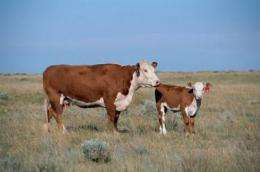
Researchers report today in the journal Science that they have sequenced the bovine genome, for the first time revealing the genetic features that distinguish cattle from humans and other mammals.
The six-year effort involved an international consortium of researchers and is the first full genome sequence of any ruminant species. Ruminants are distinctive in that they have a four-chambered stomach that - with the aid of a multitude of resident microbes - allows them to digest low quality forage such as grass.
The bovine genome consists of at least 22,000 protein-coding genes and is more similar to that of humans than to the genomes of mice or rats, the researchers report. However, the cattle genome appears to have been significantly reorganized since its lineage diverged from those of other mammals, said University of Illinois animal sciences professor Harris Lewin, whose lab created the high-resolution physical map of the bovine chromosomes that was used to align the sequence. Lewin, who directs the Institute for Genomic Biology, also led two teams of researchers on the sequencing project and is the author of a Perspective article in Science on the bovine genome sequence and an accompanying study by the Bovine Genome and Analysis Consortium.
"Among the mammals, cattle have one of the more highly rearranged genomes," Lewin said. "They seem to have more translocations and inversions (of chromosome fragments) than other mammals, such as cats and even pigs, which are closely related to cattle.
"The human is actually a very conserved genome as compared to the ancestral genome of all placental mammals, when you look at its overall organization."
The sequence of the cow's 29 pairs of chromosomes and its X chromosome (the Y chromosome was not studied) also provides new insights into bovine evolution and the unique traits that make cattle useful to humans, Lewin said.
For example, Illinois animal sciences research professor Denis Larkin conducted an analysis of the chromosome regions that are prone to breakage when a cell replicates its genome in preparation for the creation of sperm and egg cells. He showed that in the cattle genome these breakpoint regions are rich in repetitive sequences and segmental duplications and include species-specific variations in genes associated with lactation and immune response.
A previous study from Lewin's lab published this month in Genome Research showed that the breakpoint regions of many species' chromosomes are rich in duplicated genes and that the functions of genes found in these regions differ significantly from those occurring elsewhere in the chromosomes.
These repeats and segmental duplications occur by means of many different mechanisms, one of which involves sporadic and repeated insertions of short bits of genetic material, called retroposons, into the genome.
"The cow genome has many types of repeats that accumulate over time," Lewin said. "And one of the things that we found is that the new ones are blasting into where the old ones are in the breakpoint regions and breaking them apart. That's the first time that that's been seen."
"The repeats do a lot of things," he said. "They can change the regulation of the genes. They can make the chromosomes unstable and make them more likely to recombine with other pieces of chromosomes inappropriately."
Lewin calls the breakpoint regions "hotspots of evolution in the genome."
Another analysis led by Lewin, a study of metabolic genes performed by Seongwon Seo, a postdoctoral fellow in Lewin's lab and now a professor at Chungnam National University in South Korea, found that five of the 1,032 genes devoted to metabolic functions in humans are missing from the cattle genome or have radically diverged. This suggests that cattle have some unique metabolic pathways, Lewin said.
These differences in metabolism, along with changes in genes devoted to reproduction, lactation and immunity are a big part of "what makes a cow a cow," Lewin said.
For example, one of the changed genes, histatherin, produces a protein in cow's milk that has anti-microbial properties. The researchers also found multiple copies of a gene for an important milk protein, casein, in a breakpoint region of one of the chromosomes.
“Having the genome sequence is now the window to understanding how these changes occurred, how ruminants ended up with a four-chambered stomach instead of one, how the cow’s immune system operates and how it is able to secrete large amounts of protein in its milk,” Lewin said.
Source: University of Illinois at Urbana-Champaign (news : web)


