Shadow of a forming star
April 23, 2009 by Robert Massey
Shadow of a forming star

Enlarge

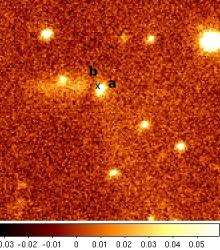
A false color image of 2M171123 taken with the CTIO 4-m telescope. The label ‘a’ marks the protostar 2M171123 and the label ‘b’ represents its probable shadow. At the distance of 424 light years to the system, each side of the image frame corresponds to about 3 million million million (trillion) km.

(PhysOrg.com) -- A team of astronomers from the Instituto Astrofisica Canarias (IAC) have found an interesting shadow cast by a forming star system. Team member Dr Basmah Riaz, an ER fellow for the Marie Curie CONSTELLATION network, will present the results of their work on Thursday 23rd April in a poster at the European Week of Astronomy and Space Science conference at the University of Hertfordshire.

In March 2008 the scientists observed the young star (protostar) system 2M171123 in the B59 molecular cloud, with the Cerro Tololo Inter-American Observatory (CTIO) 4-m telescope in Chile. They found an odd feature in their image - a shadowed dark lane just to the west of the protostar with a thickness of about 54 billion kilometres (360 times the distance from the Earth to the Sun).

Silhouetted images of young star systems and the disks that often surround them (some of which will go on to form planets) are common. But interestingly, in this case the shadow is offset from the protostar, and the offset has been confirmed by comparing the position of this system in the CTIO observations by another at infrared wavelengths from the .

Explaining their result, the team suggests a scenario in which the protostar casts its shadow onto a nearby background cloud of material. A scattering cloud that lies offset from the star acts as a screen onto which its shadow is projected. The team has also confirmed that this is not an edge-on disk, but a system viewed at an intermediate inclination.

This is thus an interesting new observation of an offset shadowed lane among young stellar objects. In the future the team plan to obtain images of the system at higher resolution and look out for any variability in the shadowed lane over time.

Provided by Royal Astronomical Society (news : web)

4.6 /5 (5 votes)  

Rank 4.6 /5 (5 votes)
Related Stories
Relevant PhysicsForums posts
  • Scale of the Universe
    created10 hours ago
  • Titan's lack of impact craters
    createdFeb 09, 2012
  • Real pictures of black hole eating a star?
    createdFeb 08, 2012
  • Hypothetical way to travel faster than light, but not technically exceed lightspeed
    createdFeb 06, 2012
  • How do scientists monitor the Sun's activity?
    createdFeb 05, 2012
  • Search patterns in observational studies
    createdFeb 05, 2012
  • More from Physics Forums - General Astronomy

More news stories

Humans may have helped the decline of African rainforests 3000 years ago

(PhysOrg.com) -- Large areas of rainforests in Central Africa mysteriously disappeared over three thousand years ago, to be replaced by savannas. The prevailing theory has been that the cause was a change ...

Space & Earth / Environment

created 21 hours ago | popularity 4.3 / 5 (12) | comments 12 | with audio podcast report

Could Venus be shifting gear?

(PhysOrg.com) -- ESA’s Venus Express spacecraft has discovered that our cloud-covered neighbour spins a little slower than previously measured. Peering through the dense atmosphere in the infrared, the ...

Space & Earth / Space Exploration

created 17 hours ago | popularity 5 / 5 (7) | comments 7 | with audio podcast

NASA budget will axe Mars deal with Europe: scientists

US President Barack Obama's budget proposal to be submitted next week for 2013 will cut NASA's budget by 20 percent and eliminate a major partnership with Europe on Mars exploration, scientists said Thursday.

Space & Earth / Space Exploration

created 20 hours ago | popularity 5 / 5 (2) | comments 18

Two new moons for Jupiter

Advances in technology have lead to the discovery of new planets outside of our Solar System, and now even new moons in our own backyard.

Space & Earth / Space Exploration

created 17 hours ago | popularity 4 / 5 (1) | comments 7

Mars Science Laboratory computer issue resolved

(PhysOrg.com) -- Engineers have found the root cause of a computer reset that occurred two months ago on NASA's Mars Science Laboratory and have determined how to correct it.

Space & Earth / Space Exploration

created 18 hours ago | popularity 4.7 / 5 (6) | comments 3 | with audio podcast


Anonymous knocks CIA website offline (Update)

The website of the Central Intelligence Agency was inaccessible on Friday after the hacker group Anonymous claimed to have knocked it offline.

New error-correcting codes guarantee the fastest possible rate of data transmission

Error-correcting codes are one of the triumphs of the digital age. They’re a way of encoding information so that it can be transmitted across a communication channel — such as an optical fiber o ...

Google users warned of threat to smartphone wallets

Users of Google smartphone wallets were being warned on Friday that there is a way to crack pass codes intended to thwart thieves from going on illicit shopping sprees.

New power source discovered

(PhysOrg.com) -- Researchers at the Massachusetts Institute of Technology (MIT) and RMIT University have made a breakthrough in energy storage and power generation.

The power of estrogen -- male snakes attract other males

A new study has shown that boosting the estrogen levels of male garter snakes causes them to secrete the same pheromones that females use to attract suitors, and turned the males into just about the sexiest ...

Small modular reactor design could be a 'SUPERSTAR'

(PhysOrg.com) -- Though most of today's nuclear reactors are cooled by water, we've long known that there are alternatives; in fact, the world's first nuclear-powered electricity in 1951 came from a reactor ...