Presto! Fast color-changing material may lead to more powerful computers (w/Video)
April 23, 2009
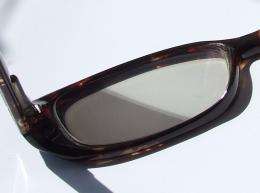
Scientists have developed a material, which quickly changes color when exposed to light, that could be used in various applications, from optical data storage in computers to improved sunglasses. Credit: Wikipedia Commons
(PhysOrg.com) -- Researchers in Japan are reporting development of a new so-called "photochromic" material that changes color thousands of times faster than conventional materials when exposed to light.
The development could lead to a wide range of new products including improved sunglasses, more powerful computers, dynamic holograms, and better medicines, the researchers say. Their report appears in the Journal of the American Chemical Society.
In the new study, Jiro Abe and colleagues note that photochromic materials are most familiar as the invisible layers found in the lenses of many high-end sunglasses, which change color when exposed to sunlight. For years, researchers have explored the possibility of using these unusual materials for optical data storage in computers and as “molecular switches” for more controlled drug delivery.
This video is not supported by your browser at this time.
Video: Researchers in Japan are reporting development of a new so-called 'photochromic' material that changes color thousands of times faster than conventional materials when exposed to light.
Conventional photochromic materials, however, tend to be relatively slow-acting (tens of seconds to hours) and unstable, which prevents their use for many advanced applications, the scientists say.The scientists describe development of a unique photochromic material that shows instantaneous coloration upon exposure to ultraviolet light and its disappearance within tens of milliseconds when the light is turned off. The decoloration speed is thousands of times faster than conventional materials. The material is also more stable and longer-lasting, they note.
In laboratory studies, the scientists showed that the new material could instantly change from colorless to blue in both solid form and in solution when they exposed the molecules to ultraviolet light, and quickly back to colorless when the light is turned off. The development opens the door to futuristic technologies “with unprecedented switching speeds and remarkable stabilities,” the article notes.
More information: Journal of the American Chemical Society, “A Fast Photochromic Molecule That Colors Only under UV Light”
-
'Smart' sunglasses feature lenses that change color on demand
Mar 27, 2007 |
not rated yet |
0
-
New method could lead to narrower chip patterns
Apr 10, 2009 |
not rated yet |
0
-
Promising new material for capturing CO2 from smokestacks
Mar 03, 2008 |
not rated yet |
0
-
'Recordable' proteins as next-generation memory storage materials
Feb 11, 2008 |
not rated yet |
0
-
New 'Pure Light' Technology Makes Computer Screens, Cell Phone Displays More Power Efficient
Jan 05, 2005 |
not rated yet |
0
-
Engineers build first sub-10-nm carbon nanotube transistor
Feb 01, 2012 |
4.9 / 5 (30) |
30
-
Something old, something new: Evolution and the structural divergence of duplicate genes
Jan 31, 2012 |
4.6 / 5 (7) |
1
-
The hidden nanoworld of ice crystals: Revealing the dynamic behavior of quasi-liquid layers
Jan 30, 2012 |
5 / 5 (3) |
1
-
Stock market network reveals investor clustering
Jan 27, 2012 |
3.9 / 5 (23) |
8
-
Of microchemistry and molecules: Electronic microfluidic device synthesizes biocompatible probes
Jan 26, 2012 |
5 / 5 (1) |
0
-
Stoichiometry
1 hour ago
-
Boiling and melting point of impure substances
2 hours ago
-
Safe nitrogen compound to decompose a 500 deg C in a furnace?
9 hours ago
-
[ask]electron inside drinking water
Feb 08, 2012
-
How to avoid formation of Lithium Chromate ???
Feb 08, 2012
-
how to choose a reduced or oxidated form in a redox
Feb 08, 2012
- More from Physics Forums - Chemistry
More news stories
Hydrogen from acidic water: Researchers develop potential low cost alternative to platinum for splitting water
A technique for creating a new molecule that structurally and chemically replicates the active part of the widely used industrial catalyst molybdenite has been developed by researchers with the Lawrence Berkeley ...
12 hours ago |
5 / 5 (10) |
11
|
Flexible paper robots
(PhysOrg.com) -- These inexpensive robots can stretch, bend and twist under control, and lift objects up to 120 times their own weight. Being soft, they can apply gentle and even pressure, and adapt to varied ...
10 hours ago |
5 / 5 (5) |
2
|
Engineers find inspiration for new materials in Piranha-proof armor
(PhysOrg.com) -- Its a matchup worthy of a late-night cable movie: put a school of starving piranha and a 300-pound fish together, and who comes out the winner?
19 hours ago |
4.3 / 5 (3) |
2
|
New method makes culture of complex tissue possible in any lab
Scientists at the University of California, San Diego have developed a new method for making scaffolds for culturing tissue in three-dimensional arrangements that mimic those in the body. This advance, published online in ...
9 hours ago |
5 / 5 (4) |
0
|
Materials that shrink when heated
One common reason that people with fillings experience toothache is that their fillings expand at a different rate to the original tooth when, for example, drinking a hot drink. Contrary to intuition, however, ...
11 hours ago |
5 / 5 (2) |
1
'Dark plasmons' transmit energy
Microscopic channels of gold nanoparticles have the ability to transmit electromagnetic energy that starts as light and propagates via "dark plasmons," according to researchers at Rice University.
FDA-approved drug rapidly clears amyloid from the brain, reverses Alzheimer's symptoms in mice
Neuroscientists at Case Western Reserve University School of Medicine have made a dramatic breakthrough in their efforts to find a cure for Alzheimer's disease. The researchers' findings, published in the journal Science, show t ...
Ultraviolet protection molecule in plants yields its secrets
Lying around in the sun all day is hazardous not just for humans but also for plants, which have no means of escape. Ultraviolet (UV) radiation from the sun can damage proteins and DNA inside cells, leading ...
Soraa LED light may dim 50-watt halogen rivals
(PhysOrg.com) -- Soraa, a Fremont, California company founded in 2008, this week launched its first product, a light that uses LEDS (light emitting diodes). The "Soraa LED MR16 lamp" is the "perfect" replacement ...
Anyone can learn to be more inventive, cognitive researcher says
There will always be a wild and unpredictable quality to creativity and invention, says Anthony McCaffrey, a cognitive psychology researcher at the University of Massachusetts Amherst, because an "Aha moment" is rare and ...
Researchers weigh in on ethics of H5N1 research
(Medical Xpress) -- In a commentary on the biosecurity controversy surrounding publication of bird flu research details, a bioethicist and a vaccine expert at Johns Hopkins reaffirm that "all scientists have an affirmativ ...
Apr 24, 2009
Rank: not rated yet
Apr 24, 2009
Rank: not rated yet
Apr 24, 2009
Rank: not rated yet
Apr 24, 2009
Rank: not rated yet
Apr 24, 2009
Rank: not rated yet
May 06, 2009
Rank: 1 / 5 (2)
What else out there is -that- sensitive to molecular polarization?
More things that you might think. More fundamental things..than you might think.
Nanoparticles, for example. VERY sensitive to changing their actual chemical/elemental character with minimal input. In ways that mass groups of atomic structures (massed atoms) cannot and do not.
ie, isolation of individual atoms. Very sensitive.
This is the basis of the 12,000 year old science of alchemy.
Transmutation.
May 10, 2009
Rank: not rated yet