'Sleep talking' PCs save energy and money
April 24, 2009
'Sleep talking' PCs save energy and money

Enlarge

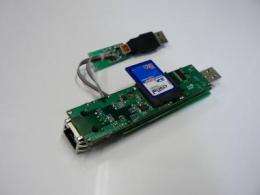
Figure 4 from the NSDI 2009 paper, "Somniloquy: Augmenting Network Interfaces to Reduce PC Energy Usage." The photograph captures the gumstix-based Somniloquy prototype -- Wired-1NIC version. Credit: Yuvraj Agarwal

Personal computers may soon save large amounts of energy by "sleep talking." Computer scientists at UC San Diego and Microsoft Research have created a plug-and-play hardware prototype for personal computers that induces a new energy saving state known as "sleep talking." Normally PCs can be in either awake mode—where they consume power even if they are not being used, or in a low power sleep mode—where they save substantial power but are essentially inactive and unresponsive to network traffic. The new sleep talking state provides much of the energy savings of sleep mode and some of the network-and-Internet-connected convenience of awake mode.

UC San Diego computer science Ph.D. student Yuvraj Agarwal presented this work on April 23, 2009 at the USENIX Symposium on Networked Systems Design and Implementation (NSDI 2009). Computer scientists at UC San Diego and Microsoft Research in Redmond, Washington and Cambridge, UK collaborated on this project and the NSDI 2009 paper, "Somniloquy: Augmenting Interfaces to Reduce PC Energy Usage."

"Large numbers of people keep their PCs in awake mode even though the PCs are relatively idle for long blocks of time because they want to stay connected to an internal network or the Internet or both," said Agarwal. "I realized that most of the tasks that people keep their computers on for—like ensuring remote access and availability for virus scans and backup, maintaining presence on instant messaging (IM) networks, being available for incoming voice-over-IP (VoIP) calls, and file sharing and downloading—can be achieved at much lower power-use levels than regular awake mode," said Agarwal.

Following this realization, the team built a small USB-connected hardware and software plug-in system that allows a PC to remain in sleep mode while continuing to maintain network presence and run well-defined application functions. It supports instant messaging applications, VoIP, large background web downloads, peer-to-peer file sharing networks such as BitTorrent, and remote access. The computer scientists say their system is easily extensible to support other applications.

The computer scientists named their system Somniloquy, which means "the act or habit of talking in one's sleep." In fact, the system allows a PC to appear to "say" to other hosts on the network, "I'm awake and I can perform non-power-intensive tasks"—even though the PC is in sleep mode. If more computational muscle or resources present on the PC such as stored files are required, Somniloquy wakes up the PC.

The goal of Somniloquy is to encourage people to put their PCs in sleep mode more often, for example when they are not being used for computationally demanding tasks. "Reducing energy consumed by wall-powered devices, especially computing equipment, offers a huge opportunity to save money and reduce greenhouse gasses," said Agarwal.

"Somniloquy uses a very small low-power computer. It has a low-power processor, some memory, a lightweight operating system, and a small amount of flash to store data. Everything is scaled down and extremely energy efficient," said Agarwal, a self described "computer systems" researcher who uses hardware insights to build better energy-efficient computer systems.

Somniloquy's low-power secondary processor functions at the PC's network interface. It runs an embedded operating system and impersonates the sleeping PC to other hosts on the network. Somniloquy will wake up the PC over the USB bus if necessary. For example, during a movie download, when the flash memory fills up, Somniloquy will wake up the PC and transfer the data. When the transfer is complete, it will go back to sleep mode and Somniloquy will again impersonate the on the network.

The current prototypes work for desktops and laptops, over wired and wireless networks, and are incrementally deployable on systems with an existing network interface. It does not require any changes to the operating system on the PC, to routers or other network infrastructure, or to remote application servers.

The researchers evaluated Somniloquy in various settings and say that it consumes 11 to 24 times less power than a PC in idle state, which could translate to energy savings of 60 to 80 percent depending on their use model.

In the future, Somniloquy could be incorporated into the network interface card of new PCs, which would eliminate the need for the prototype's external USB plug-in hardware.

More information: "Somniloquy: Augmenting Network Interfaces to Reduce PC Energy Usage," by Yuvraj Agarwal from UC San Diego, Steve Hodges, Ranveer Chandra, James Scott, and Paramvir (Victor) Bahl from Research, and Rajesh Gupta from UC San Diego, was presented on April 23, 2009 at USENIX Symposium on Networked Systems Design and Implementation. http://mesl.ucsd.edu/yuvraj/research/documents/Somniloquy-NSDI09-Yuvraj-Agarwal.pdf

Source: University of California - San Diego (news : web)

4.8 /5 (16 votes)  

Filter


Move the slider to adjust rank threshold, so that you can hide some of the comments.


Display comments: newest first

thales
Apr 24, 2009

Rank: not rated yet
I want one.
holoman
Apr 24, 2009

Rank: not rated yet
Evotek in 1982 invented the technology for disk drives.
QubitTamer
Apr 24, 2009

Rank: 1 / 5 (6)
Come on...the idea that a computer is in sleep mode but still processing bit-torrent downloads or IM chat is ludicrous. The market for this stupidity is purely the ignorant and gullible.
LuckyBrandon
Apr 24, 2009

Rank: not rated yet
ok the technology to save power is always a good thing, i myself HATE my big ass $600 electric bills every month, and I refuse to turn off my 7 systems sitting here at home...why the hell would I put my domain controller to sleep after all :)

But, with that being said...sleeping systems can be woke up via WOL (Wake on LAN) technology thats existed since...well, a long time ago....
However I have been in the middle of massive domain migrations that are halted when migrating clients thanks to those pesky dang sleep cycles....
CWFlink
Apr 26, 2009

Rank: not rated yet
WOL has been around a long time, almost since the beginning of Ethernet, but even older is the idea of an IO processor that off-loads IO functionality from the CPU. There is little new here, except the idea of saving energy. Casting an old idea into the context of the PC "sleep" state, in the context of a "Green America" is a good publicity trick, but the technology is not revolutionary.

I admit that the SPECIFIC IO functionality to off-load to the low power IO processor takes some work to identify because of the complexity and diversity of the protocols a PC must handle.

But then again, the "magic" in the the GREEN revolution is that thousands will be made rich by "reinventing" old ideas and casting them in the glow of "green". It is worth doing, but not necessarily revolutionary.
Zeph
Apr 28, 2009

Rank: 5 / 5 (1)
By far most good ideas are variations on previous good ideas - the devil is in the details, and each increment deserves to be evaluated on where it takes the concepts and how well they work.

The innovation here is not the concept of having an I/O processor, but the idea of one smart enough to act as a low power multiprotocol caching proxy for its host. For example, handling a large file download to an onboard Flash buffer and periodically waking the main computer to write to disk is not revolutionary - but getting this to actually work and save power is a worthwhile achievement, not to be disparaged (if they do indeed make this work).

The described functions are orders of magnitude more complex than WOL (wherein a tiny bit of logic in a controller just waits for a bit pattern from some other computer which has all the smarts - similar to an X10 light switch but on ethernet); the similarities are very superficial.

Is this a "reinvention" in green clothing? That seems like a cynical dismissal rather than an evalution. It's the application of existing concepts combined with new development to address a given domain - saving energy while staying online. Calling it a "reinvention" is like calling the first Roomba a reinvention of an old concept, or calling the first gas powered lawnmower ho-hum because gas engines had already been used in cars. Or like calling the original Mac (and Lisa) uninteresting because they were in large part inspired by the work at Xerox PARC on the west coast and the lisp machines from the east coast - but they added their own variations and innovations to that.
Rank 4.8 /5 (16 votes)
Relevant PhysicsForums posts
  • Remote Internet voting security flaw?
    createdFeb 01, 2012
  • iPhone battery over time
    createdJan 30, 2012
  • Best alternate Tablet to an iPad for writing math or physics equations?
    createdJan 26, 2012
  • Sending SMS to a website
    createdJan 20, 2012
  • Need help with my technical fest!
    createdJan 19, 2012
  • Ubislate 7 upgrade to the world's cheapest tablet
    createdJan 06, 2012
  • More from Physics Forums - Computing & Technology

More news stories

Hackers intercept FBI, Scotland Yard call (Update)

(AP) -- Trading jokes and swapping leads, investigators from the FBI and Scotland Yard spent the conference call strategizing about how to bring down the hacking collective known as Anonymous, responsible ...

Technology / Internet

created 13 hours ago | popularity 5 / 5 (7) | comments 22

Japanese entrepreneurs aim for Silicon Valley

For an emerging generation of Japanese innovators, the dream isn't a job for life at a big company. They have new ambitions, and they're determined to go places. Especially Silicon Valley.

Technology / Business

created 10 hours ago | popularity 5 / 5 (1) | comments 1

A 'natural' solution for transportation

As the United States transitions away from a primarily petroleum-based transportation industry, a number of different alternative fuel sources—ethanol, biodiesel, electricity and hydrogen—have each ...

Technology / Energy & Green Tech

created 14 hours ago | popularity 3 / 5 (2) | comments 13

Hackers deface website of lawyers for US Marine

Members of the hacker group Anonymous defaced the website on Friday of the law firm that defended a US Marine who faced charges in connection with the 2005 killing of 24 Iraqi civilians.

Technology / Internet

created 7 hours ago | popularity 5 / 5 (2) | comments 2

TV executives crave viewers who watch 2 screens

Forget the small screen and the big screen. The hottest new thing in television is the "second screen" - the one on the tablet computer or cell phone that an increasing number of viewers keep an eye on while they're watching ...

Technology / Telecom

created 7 hours ago | popularity 1 / 5 (2) | comments 0


Amazon fungi found that eat polyurethane, even without oxygen

(PhysOrg.com) -- Until now polyurethane has been considered non-biodegradable, but a group of students from Yale University in the US has found fungi that will not only eat and digest it, they will do so even in the absence ...

Scientists chart high-precision map of Milky Way's magnetic fields

(PhysOrg.com) -- Scientists at the Naval Research Laboratory (NRL) are part of an international team that has pooled their radio observations into a database, producing the highest precision map to date of ...

Whole exome sequencing identifies cause of metabolic disease

Sequencing a patient's entire genome to discover the source of his or her disease is not routine – yet. But geneticists are getting close.

Hearing metaphors activates brain regions involved in sensory experience

When a friend tells you she had a rough day, do you feel sandpaper under your fingers? The brain may be replaying sensory experiences to help understand common metaphors, new research suggests.

Renowned physicist invents microscope that can peer at living brain cells

(PhysOrg.com) -- Ever since scientists began studying the brain, they’ve wanted to get a better look at what was going on. Researchers have poked and prodded and looked at dead cells under electron microscopes, ...

New kind of high-temperature photonic crystal could someday power everything from smartphones to spacecraft

A team of MIT researchers has developed a way of making a high-temperature version of a kind of materials called photonic crystals, using metals such as tungsten or tantalum. The new materials — which ...