Chip simulates metabolism of medicine in human body
April 24, 2009 Chip simulates metabolism of medicine in human body

Enlarge

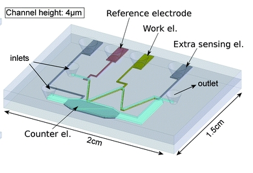
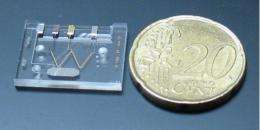
Photograph and diagram of the chip showing the inlets and outlets for fluids, the W-shaped fluid channel and the different electrodes.

(PhysOrg.com) -- A tiny electrochemical cell, developed by researchers of the MESA+ Institute for Nanotechnology, The Netherlands, is able to mimick the behaviour of medicine inside a human body. This chip is presented in the journal Lab on a Chip.

How a medicine reacts in the body to form different substances can now be simulated in a special fluidic chip developed at the University of Twente. This miniaturized electrochemical cell enables the rapid screening of new medicines. Researchers at the UT’s MESA+ Institute for Nanotechnology presented the chip in the international authoritative journal ‘’.

Chip simulates metabolism of medicine in human body

Photograph and diagram of the chip showing the inlets and outlets for fluids, the W-shaped fluid channel and the different electrodes.

The chip is an extremely small electrochemical cell: a cell in which the chemical reactions that take place in the human body are simulated. The volume of the most important fluid channel on the chip is only 9.6 nanolitre, a nanolitre being a billionth of a litre. If a medicine is added to the fluid in the channel, it will oxidize to form various constituents. The in the cell can be controlled using variations in voltage on the minuscule electrodes. The cell is about a thousand times smaller than the usual electrochemical cells and, according to the researcher, Mathieu Odijk, the advantage of its tiny dimensions is that very small samples are sufficient to carry out complete tests.

Mr Odijk has already used the new cell to conduct tests on the anti-malarial drug, amodiaquine. He traces the various reaction products by coupling the cell to external measuring equipment: a liquid chromatograph and a mass spectrometer. Next, Mr Odijk hopes to integrate components of these measuring devices on to the chip to produce a complete, but extremely compact, measuring system. This will be a significant next step in his research.

More information: The article ‘A microfluidic for electrochemical conversions in drug metabolism studies’ by M. Odijk, A. Baumann, W. Lohmann, F.T.G. van den Brink, W. Olthuis, U. Karst and A. van den Berg, appeared in Lab on a Chip.

Provided by University of Twente (news : web)


print this article email this article download pdf blog this article bookmark this article     Stumble it Digg this share on Facebook retweet share on Reddit add to delicious
Rate this story - 5 /5 (5 votes)


April 24, 2009 all stories

Comments: 0

5 /5 (5 votes)
  • Stumble this up

  • Digg this

  • share this

  • hide
  • Related Stories

  • Explosion on chip sets liquid in motion
    created Oct 30, 2008 | popularity not rated yet | comments 0
  • Mini-laboratory gets megaproductive
    created Oct 31, 2008 | popularity not rated yet | comments 0
  • Make your own microfluidic device with new kit from U-M
    created Jul 24, 2008 | popularity not rated yet | comments 0
  • Bioelectronics: Progress toward drug screening with a cell–transistor biosensor
    created Jun 25, 2007 | popularity not rated yet | comments 0
  • 'Lab on a chip' mimics brain chemistry
    created Feb 12, 2008 | popularity not rated yet | comments 0


  • hide
  • Relevant PhysicsForums posts

Other News

Toward home-brewed electricity with 'personalized solar energy'

Toward home-brewed electricity with 'personalized solar energy'

Chemistry / Materials Science

created Nov 04, 2009 | popularity 3.4 / 5 (9) | comments 4

New scientific discoveries are moving society toward the era of "personalized solar energy," in which the focus of electricity production shifts from huge central generating stations to individuals in their ...


Scientists Reproduce a Building Block of Life in Laboratory

Scientists Reproduce a Building Block of Life in Laboratory

Chemistry / Biochemistry

created Nov 06, 2009 | popularity 4.8 / 5 (23) | comments 0

(PhysOrg.com) -- NASA scientists studying the origin of life have reproduced uracil, a key component of our hereditary material, in the laboratory.


Newly Discovered Fat Molecule: An Undersea Killer with an Upside

Newly Discovered Fat Molecule: An Undersea Killer with an Upside

Chemistry / Biochemistry

created Nov 05, 2009 | popularity 4.8 / 5 (9) | comments 0

(PhysOrg.com) -- A chemical culprit responsible for the rapid, mysterious death of phytoplankton in the North Atlantic Ocean has been found by collaborating scientists at Rutgers University and the Woods Hole ...


CU-Boulder map of human bacterial diversity shows wide interpersonal differences

Map of Human Bacterial Diversity Shows Wide Interpersonal Differences

Chemistry / Biochemistry

created Nov 05, 2009 | popularity 4.7 / 5 (11) | comments 0

(PhysOrg.com) -- A University of Colorado at Boulder team has developed the first atlas of bacterial diversity across the human body, charting wide variations in microbe populations that live in different ...


Mimicking nature, scientists can now extend redox potentials

Mimicking nature, scientists can now extend redox potentials

Chemistry / Biochemistry

created Nov 04, 2009 | popularity 4.8 / 5 (5) | comments 0

(PhysOrg.com) -- New insight into how nature handles some fundamental processes is guiding researchers in the design of tailor-made proteins for applications such as artificial photosynthetic centers, long-range ...