Swift satellite comet tally highlighted
April 24, 2009
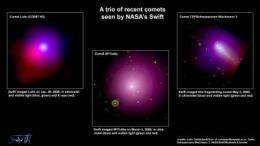
This is a montage of comets Lulin, Tuttle and SW3. Credit: NASA/Swift/Bodewits & Immler and Univ. of Leicester/Bodewits et al.
A montage of comet images made using NASA's Swift spacecraft illustrates just how different three comets can be. The images, including a never-released image of Comet 8P/Tuttle, were shown during a webcast called "Around the World in 80 Telescopes" Organized by the European Southern Observatory headquartered in Garching, Germany.
Swift's primary job is to quickly alert astronomers about new gamma-ray bursts - powerful explosions from distant dying stars. "But Swift's rapid response and flexibility allow us to perform other science while the spacecraft is waiting for gamma-ray bursts to occur," said presenter Geronimo Villanueva, a planetary scientist at NASA's Goddard Space Flight Center in Greenbelt, Md.
From its orbital perch, Swift can view targets using ultraviolet wavelengths, visible light, and X rays -- and it's the only observatory that sees them at the same time. Between bursts, astronomers task Swift to survey the entire sky at X-ray wavelengths, monitor exploding stars, image galaxies, and study comets.
Comets are clumps of frozen gases mixed with dust sometimes called "dirty snowballs." These icy bodies cast off gas and dust whenever they venture near the sun. Most recently, Swift observed Comet Lulin as part of a study led by Jenny Carter at the University of Leicester, U.K. Lulin was faintly visible to the naked eye when it passed 38 million miles from Earth --- or about 160 times farther than the moon - in late February.
Other comets captured by Swift include 73P/Schwassmann-Wachmann 3 (SW3) -- a fragmenting comet that passed Earth in 2006 -- and 8P/Tuttle, which rounded the sun in January 2008. "One of my projects is to work out the composition of Tuttle by studying the gases that surround it," Villanueva said. Swift's Ultraviolet/Optical Telescope includes a device called a grism that can separate wavelengths in ultraviolet light in much the same way as a prism spreads sunlight into colors. "Swift's grism covers a 'sweet spot' where many key comet gases strongly emit."
Swift also detects X rays from comets. The X rays arise through a process called charge exchange, as fast-moving ions emitted by the sun snatch electrons from neutral comet gases. Because this interaction occurs over such a large region, cometary X-ray emission can reach powers as high as a billion watts.
Comets provide excellent laboratories to explore this process, which may play an important role in young planetary systems and other places where hot and cold gases collide. Cometary X rays also serve as a way to probe conditions in solar ions streaming through the solar system (the solar wind).
Comet Lulin provides the best example of cometary X rays Swift has seen so far. "Lulin produced a lot of gas and very little dust, which reflects sunlight and makes comets much brighter," said team member Stefan Immler, also at Goddard. This low dust content made Lulin faint enough that Swift could simultaneously image the comet in ultraviolet and X rays.
"The problem with many comets is that we often cannot use all of Swift's instruments because they are simply too bright," Villanueva explained. Comet 17P/Holmes, which underwent a surprising outburst in October 2007, shed a lot of dust. "But we never detected X rays from Holmes, and it was too bright to study its ultraviolet spectrum."
Neither SW3 nor Tuttle could be imaged in X rays with Swift, although NASA's Chandra X-ray Observatory detected both comets. They each produced much less water than Comet Lulin, which was gushing out nearly 800 gallons of water a second when Swift observed it.
"Someone calculated that's equivalent to $17,000 of bottled water each second," Villanueva added, smiling.
Source: NASA/Goddard Space Flight Center
-
Swift’s Comet Tally
Apr 06, 2009 |
not rated yet |
0
-
Scientists Probe Green Comet
Feb 20, 2009 |
not rated yet |
0
-
NASA's Swift looks to comets for a cool view
Dec 03, 2008 |
not rated yet |
0
-
Scientists measure how deep 'Deep Impact' was, with X-rays
Jul 08, 2005 |
not rated yet |
0
-
NASA Swift Satellite Offers a Different View of the Great Comet Collision
Jul 05, 2005 |
not rated yet |
0
-
Engineers build first sub-10-nm carbon nanotube transistor
Feb 01, 2012 |
4.9 / 5 (33) |
30
-
Something old, something new: Evolution and the structural divergence of duplicate genes
Jan 31, 2012 |
4.6 / 5 (7) |
1
-
The hidden nanoworld of ice crystals: Revealing the dynamic behavior of quasi-liquid layers
Jan 30, 2012 |
5 / 5 (4) |
1
-
Stock market network reveals investor clustering
Jan 27, 2012 |
3.9 / 5 (23) |
8
-
Of microchemistry and molecules: Electronic microfluidic device synthesizes biocompatible probes
Jan 26, 2012 |
5 / 5 (2) |
0
-
Never ending outer space.....
Feb 11, 2012
-
Neutron Star fragments?
Feb 11, 2012
-
stationary or not?
Feb 11, 2012
-
Scale of the Universe
Feb 10, 2012
-
Titan's lack of impact craters
Feb 09, 2012
-
Real pictures of black hole eating a star?
Feb 08, 2012
- More from Physics Forums - General Astronomy
More news stories
Latin America mining boom clashes with conservation
Latin America is experiencing a mining boom as prices rise fuelled by a hike in global demand, but the region is also being hit by a wave of violent protests, strikes and rallies by environmentalists.
20 hours ago |
5 / 5 (1) |
1
Salvage workers begin pumping fuel from Italian shipwreck
Salvage workers Sunday began pumping fuel from the shipwrecked Italian cruise liner Costa Concordia, a day ahead of schedule, officials said.
12 hours ago |
5 / 5 (2) |
0
Political leaders play key role in how worried Americans are by climate change: study
More than extreme weather events and the work of scientists, it is national political leaders who influence how much Americans worry about the threat of climate change, new research finds.
Feb 06, 2012 |
5 / 5 (8) |
75
NASA budget will axe Mars deal with Europe: scientists
US President Barack Obama's budget proposal to be submitted next week for 2013 will cut NASA's budget by 20 percent and eliminate a major partnership with Europe on Mars exploration, scientists said Thursday.
Space & Earth / Space Exploration
Feb 10, 2012 |
5 / 5 (4) |
58
Humans may have helped the decline of African rainforests 3000 years ago
(PhysOrg.com) -- Large areas of rainforests in Central Africa mysteriously disappeared over three thousand years ago, to be replaced by savannas. The prevailing theory has been that the cause was a change ...
Scientists discover molecular secrets of 2,000-year-old Chinese herbal remedy
For roughly two thousand years, Chinese herbalists have treated Malaria using a root extract, commonly known as Chang Shan, from a type of hydrangea that grows in Tibet and Nepal. More recent studies suggest that halofuginone, ...
New method to examine batteries -- MRI from the inside
There is an ever-increasing need for advanced batteries for portable electronics, such as phones, cameras, and music players, but also to power electric vehicles and to facilitate the distribution and storage of energy derived ...
A mitosis mystery solved: How chromosomes align perfectly in a dividing cell
Although the process of mitotic cell division has been studied intensely for more than 50 years, Whitehead Institute researchers have only now solved the mystery of how cells correctly align their chromosomes during symmetric ...
Google might launch Drive for cloud storage soon
(PhysOrg.com) -- Google's next big move, according to the Wall Street Journal, is a cloud storage service called Drive. Hardly first to the plate, Google is simply catching up to introducing its cloud reposi ...
Lab study raises questions over nano-particle impact
Tests involving chickens have raised questions about the impact on health from engineered nano-particles, the ultra-fine grains commonly used in drugs and processed foods, scientists said on Sunday.
Starve a virus, feed a cure? Findings show how some cells protect themselves against HIV
A protein that protects some of our immune cells from the most common and virulent form of HIV works by starving the virus of the molecular building blocks that it needs to replicate, according to research published online ...