Scientists identify key factors in heart cell creation
April 26, 2009 Gladstone scientists identify key factors in heart cell creation

Enlarge

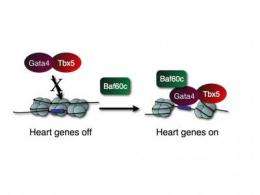
This represents how the cardiogenic factors turn on heart genes. The transcription factors, Tbx5 and Gata4, can't access the DNA unless Baf60c is present. When all three are introduced, Baf60c helps open up the closed chromatin, and lets Tbx5 and Gata4 work together to turn on the heart genes. Credit: Benoit Bruneau, The Gladstone Institute of Cardiovascular Disease

Scientists at the Gladstone Institute of Cardiovascular Disease have identified for the first time key genetic factors that drive the process of generating new heart cells. The discovery, reported in the current issue of the journal Nature, provides important new directions on how stem cells may be used to repair damaged hearts.

For decades, scientists were unable to identify a single factor that could turn nonmuscle cells into beating . Using a clever approach, the research team led by Benoit Bruneau, Ph.D., found that a combination of three genes could do the trick. This is the first time any combination of factors has been found to activate cardiac differentiation in mammalian cells or tissues.

"The heart has very little regenerative capacity after it has been damaged," said Dr. Bruneau. "With the leading cause of death in the Western world, this is a significant first step in understanding how we might create new cells to repair a damaged heart."

Two of the three genes encode proteins called transcription factors, which are master regulators that bind to DNA and determine which genes get activated or shut off. The two transcription factors, GATA4 and TBX5, cause human heart disease when mutated and also cooperate with each other to control other genes. When Dr. Bruneau and postdoctoral fellow Jun K. Takeuchi added different combinations of transcription factors to mouse cells, these two seemed important for pushing cells into heart cells—but they were not enough.

"When we finally identified the key factor that could work with GATA4 and TBX5 to turn cells into beating heart cells, it was somewhat of a surprise to us," said Dr. Bruneau.

The surprising factor was a cardiac-specific protein called BAF60c, which helps determine whether like GATA4 and TBX5 can even gain access to the DNA regions they were supposed to turn on or off. "Our previous studies had shown that chromatin remodeling complexes were important," said Dr. Bruneau. "Mice with lower levels of these complexes have severe heart defects and defective cardiac differentiation. These observations prompted us to look at Baf60c in heart differentiation."

The effect was dramatic. Addition of the three factors directed differentiation of mouse mesoderm, which normally has the potential to make bone, blood, muscle, heart, and other tissues, specifically into cardiac muscle cells (cardiomyocytes) that beat rhythmically, just like normal heart cells. In fact, even cells that normally contribute to the placenta could be induced to transform into beating cardiomyocytes.

"Together, these factors give us a potent mechanism to control cellular differentiation," said Dr. Bruneau. "This knowledge may help us to understand how to reprogram new cardiomyocytes for therapeutic purposes."

Source: Gladstone Institutes (news : web)


print this article email this article download pdf blog this article bookmark this article     Stumble it Digg this share on Facebook retweet share on Reddit add to delicious
Rate this story - 5 /5 (2 votes)


April 26, 2009 all stories

Comments: 0

5 /5 (2 votes)
  • Stumble this up

  • Digg this

  • share this

  • hide
  • Related Stories

  • Scientists identify role of tiny RNAs in controlling stem cell fate
    created Mar 05, 2008 | popularity not rated yet | comments 0
  • Researchers identify proteins that help develop mammalian hearts
    created May 16, 2008 | popularity not rated yet | comments 0
  • Process for expansion and division of heart cells identified
    created Feb 17, 2009 | popularity not rated yet | comments 0
  • Gene directs stem cells to build the heart
    created Jul 02, 2008 | popularity not rated yet | comments 0
  • New role found for a cardiac progenitor population
    created May 14, 2008 | popularity not rated yet | comments 0


  • hide
  • Relevant PhysicsForums posts

  • Swine flu vaccination
    created 11 hours ago
  • Improving the brain through chemistry
    created Nov 07, 2009
  • Sleep / REM Sleep and homeostasis
    created Nov 07, 2009
  • The Biceps Reflex
    created Nov 05, 2009
  • More from Physics Forums - Medical Sciences

Other News

The Link Between Birdsong And Human Language

The Link Between Birdsong And Human Language

Medicine & Health / Neuroscience

created 24 minutes ago | popularity not rated yet | comments 0

Scientists studying how Bengalese finches use sets of syllables to communicate are a step closer to understanding how humans develop and use vocabulary. After studying the neural networks in finch brains, ...


A pain in the neck: Researcher studies the effects of too much texting on college students

Medicine & Health / Health

created 54 minutes ago | popularity not rated yet | comments 0

The world record for fastest text message typing is held by a 21-year old college student from Utah, but his dexterous digits could mean serious injury later on. Most adults aged 18-21 prefer texting over e-mail or phone ...


Women More Likely Than Men to Suffer Depression After Stroke

Medicine & Health / Psychology & Psychiatry

created 24 minutes ago | popularity not rated yet | comments 0

(PhysOrg.com) -- Depression occurs in as many as one-third of patients after a stroke, and women are at somewhat higher risk, according to a large new review of studies. Post-stroke depression is associated with greater disability, ...


Many lack the skills to make good health decisions

Medicine & Health / Health

created 1hour ago | popularity not rated yet | comments 0

(PhysOrg.com) -- Some 93 million Americans do not have the numerical skills necessary to make well-informed decisions about their medical care, reports a Cornell professor, who has some suggestions on changing that.


curly hair

Single gene may cause curly hair

Medicine & Health / Genetics

created 8 hours ago | popularity 4.7 / 5 (3) | comments 0

(PhysOrg.com) -- Scientists in Australia have identified a single gene that strongly influences whether you have curly or straight hair.