Catching the lightwave: Nano-mechanical sensors 'wired' by photonics
April 26, 2009 Catching the lightwave: Nano-mechanical sensors 'wired' by photonics

Enlarge

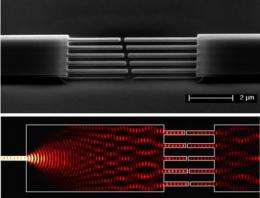
Electronmicroscopic image of array (top) and simulation of lightwaves through array (bottom). Credit: Li, Pernice, Tang

As researchers push towards detection of single molecules, single electron spins and the smallest amounts of mass and movement, Yale researchers have demonstrated silicon-based nanocantilevers, smaller than the wavelength of light, that operate on photonic principles eliminating the need for electric transducers and expensive laser setups.

The work reported in an April 26 advance online publication of Nature Nanotechnology ushers in a new generation of tools for ultra-sensitive measurements at the .

In nanoelectromechanical systems (NEMS), cantilevers are the most fundamental mechanical sensors. These tiny structures — fixed at one end and free at the other — act like nano-scale diving boards that "bend" when molecules "jump" on them and register a change that can be measured and calibrated. This paper demonstrates how NEMS can be improved by using integrated photonics to sense the cantilever motion.

"The system we developed is the most sensitive available that works at room temperature. Previously this level of sensitivity could only be achieved at extreme low temperatures" said senior author Hong Tang, assistant professor of electrical and mechanical engineering in the Yale School of Engineering and Applied Sciences.

Their system can detect as little deflection in the nano-cantilever sensors as 0.0001 Angstroms — one ten thousandth of the size of an atom

To detect this tiny motion, the Yale team devised a photonic structure to guide the light wave through a cantilever. After exiting from the free end of the cantilever, the light tunnels through a nanometer gap and is collected on chip. "Detecting the lightwave after this evanescent tunneling," says Tang, "gives the unprecedented sensitivity."

Tang's paper also details the construction of a sensor multiplex — a parallel array of 10 nano-cantilevers integrated on a single photonic wire. Each cantilever is a different length, like a key on a xylophone, so when one is displaced it registers its own distinctive "tone."

"A multiplex format lets us make more complex measurements of patterns simultaneously — like a tune with chords instead of single notes," said postdoctoral fellow Mo Li, the lead author of the paper.

At the heart of this breakthrough is the novel way Tang's group "wired" the sensors with light. Their technique is not limited by the bandwidth constraints of electrical methods or the diffraction limits of light sources.

"We don't need a laser to operate these devices," said Wolfram Pernice, a co-author of the paper. "Very cheap LEDs will suffice." Futhermore, the LED light sources — like the million LED pixels that make up a laptop computer screen — can be scaled in size to integrate into a nanophotonic-chip — an important feature for this application.

"This development reinforces the practicality of the new field of nanooptomechanics," says Tang, "and points to a future of compact, robust and scalable systems with high sensitivity that will find a wide range of future applications — from chemical and biological sensing to optical signal processing."

More information: Citation: Nature Nanotechnology: Advance Online Publication April 26, 2009; doi: 10.1038/NNANO.2009.92

Source: Yale University (news : web)


print this article email this article download pdf blog this article bookmark this article     Stumble it Digg this share on Facebook retweet share on Reddit add to delicious
Rate this story - 4.8 /5 (5 votes)

Rank Filter

Move the slider to adjust rank threshold, so that you can hide some of the comments.


Display comments: newest first

  • Fazer - Apr 26, 2009
    • Rank: 5 / 5 (1)
    Wow, brilliant. Two big steps in one: using photonics in nano-cantilever systems, and coming up with the zylophone contraption to allow for a much broader sensing capability.

    On a completely different topic, how small will sensors like these need to be before they would start sensing abnormalities in space that would circumstantially indicate the presence of additional, compressed spacial dimensions?
  • jsovine - Apr 27, 2009
    • Rank: not rated yet
    ...how small will sensors like these need to be before they would start sensing abnormalities in space that would circumstantially indicate the presence of additional, compressed spacial dimensions?


    Wow, interesting question.

    6/5

  • Fazer - Apr 27, 2009
    • Rank: not rated yet
    Thanks jsovine.

    "Their system can detect as little deflection in the nano-cantilever sensors as 0.0001 Angstroms %u2014 one ten thousandth of the size of an atom"

    That is soooooo small, I just wonder if anyone on here knows the size limit for proving/disproving string theory. I know it must be small, and somewhere I may have heard that it is too small to ever be possible, but I am not talking about detecting string loops directly, I'm talking about detecting manifestations that extra dimensions may cause on space that might show up at small but measurable scales. Things that could not be explained by QM.

April 26, 2009 all stories

Comments: 3

4.8 /5 (5 votes)
  • Stumble this up

  • Digg this

  • share this

  • hide
  • Related Stories

  • 'The photon force is with us': Harnessing light to drive nanomachines
    created Nov 26, 2008 | popularity not rated yet | comments 0
  • Mechanical Motion Used to 'Spin' Atoms in a Gas
    created Dec 07, 2006 | popularity not rated yet | comments 0
  • Researchers advance nano-scale electromechanical sensors
    created Nov 11, 2008 | popularity not rated yet | comments 0
  • 'Nanocantilevers' yield surprises critical for designing new detectors
    created Aug 28, 2006 | popularity not rated yet | comments 0
  • NEMS device detects the mass of a single DNA molecule
    created May 19, 2005 | popularity not rated yet | comments 0


  • hide
  • Relevant PhysicsForums posts

Other News

Findings show nanomedicine promising for treating spinal cord injuries

Findings show nanomedicine promising for treating spinal cord injuries

Nanotechnology / Bio & Medicine

created 11 hours ago | popularity 4.5 / 5 (4) | comments 0

(PhysOrg.com) -- Researchers at Purdue University have discovered a new approach for repairing damaged nerve fibers in spinal cord injuries using nano-spheres that could be injected into the blood shortly ...


New Digital 'Electronics' Concept May Continue Moore's Law

New Digital 'Electronics' Concept May Continue Moore's Law

Nanotechnology / Nanophysics

created Nov 05, 2009 | popularity 4.6 / 5 (53) | comments 9

(PhysOrg.com) -- Computers of the future could be operating not on electrons, but on tiny waves traveling through an electron "fluid," if a new proposal is successful. The new circuit design, recently introduced ...


Nanoparticles for gene therapy improve

Nanoparticles for gene therapy improve

Nanotechnology / Bio & Medicine

created Nov 06, 2009 | popularity 5 / 5 (4) | comments 3

(PhysOrg.com) -- About five years ago, Professor Janet Sawicki at the Lankenau Institute in Pennsylvania read an article about nanoparticles developed by MIT's Robert Langer for gene therapy, the insertion ...


Breakthrough in industrial-scale nanotube processing

Breakthrough in industrial-scale nanotube processing

Nanotechnology / Nanomaterials

created Nov 02, 2009 | popularity 4.9 / 5 (20) | comments 3

(PhysOrg.com) -- Rice University scientists today unveiled a method for the industrial-scale processing of pure carbon-nanotube fibers that could lead to revolutionary advances in materials science, power ...


Scientists witness nature's complexity unfold in self-assembling quasicrystals

Scientists witness nature's complexity unfold in self-assembling quasicrystals

Nanotechnology / Nanomaterials

created Oct 31, 2009 | popularity 4.9 / 5 (17) | comments 3

(PhysOrg.com) -- Just a few decades ago, scientists believed that all ordered matter consists of self-repeating building blocks -- atoms, ions or molecules. In this view, the ordinary solids of everyday life ...