Chemists synthesize fungal compound with anti-cancer activity
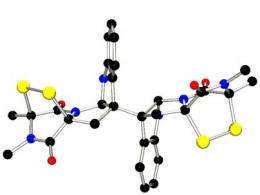
(PhysOrg.com) -- Ten years ago, William Fenical of the Scripps Institution of Oceanography isolated from an ocean-living fungus a compound that has since shown the ability to kill cancer cells in the lab. Now, for the first time, MIT chemists have synthesized the compound, an advance that could open the door to new drug treatments for cancer.
The compound, known as (+)-11,11'-Dideoxyverticillin A, is one of the most structurally complex members of a family of naturally occurring alkaloids.
Mohammad Movassaghi, associate professor of chemistry, graduate student Justin Kim and former postdoctoral associate James Ashenhurst reported the synthesis in the April 10 issue of Science.
Their 11-step synthesis, which starts with commercially available amino acids, provides ample quantities of the natural alkaloids and gives access to a wide range of related compounds, enabling thorough biological evaluation of these types of alkaloids as anticancer agents.
"If you want to only rely on the natural substance, you often have to go back to the natural source and extract more material for further study. This is certainly OK if getting to the natural source is easy and if the extraction yield is acceptable," said Movassaghi. "However, with a chemical synthesis you can rely on commercially available starting material, scale up the synthesis as needed, and make designed derivatives of the compound of interest."
Movassaghi said his team was drawn to the compound not just for its anti-cancer potential but also for its fascinating chemical structure. The (+)-11,11'-Dideoxyverticillin A molecule has 10 rings and eight stereogenic centers, or carbon atoms that have four different chemical groups attached to them.
"Because of the interesting structures, these compounds provide an ideal arena for exploring and developing new chemistry," said Movassaghi. "As you try to make the molecule, you become aware of its chemistry and oftentimes it's very informative in terms of it's possible mode of action."
When carbon atoms have four different groups attached to them, they can take on two possible arrangements, which are mirror images of each other. Producing the correct arrangement for all stereocenters was particularly challenging, said Movassaghi.
As large chemical structures are attached to each carbon, it also becomes more difficult to perform additional reactions at the same carbon atom, because the extra bulk makes the carbon less accessible.
Movassaghi says that while each step of the synthesis was difficult to figure out, the hardest task was designing the overall order of the synthesis. The molecule has several bonds that are very sensitive to oxidation or cleavage, so each reaction must occur in a precise order that will not expose those bonds to degradation.
"Justin and James had the solutions to each of the independent steps much earlier, but the major challenge was recognizing what would be the optimal sequence for each of these events to occur," said Movassaghi.
Now that the chemical synthesis has been demonstrated, researchers can tinker with it to produce similar compounds that may also have potential pharmacological activity.
The natural function of (+)-11,11'-Dideoxyverticillin A is not known, but it is likely to be involved in either natural defense or signaling mechanisms -- "chemical warfare at the microbial level," as Movassaghi describes it.
In other words, a colony of fungus might secrete the substances, toxic to competing species, to prevent invaders from stealing the same food and other resources.
"While the natural source may use this compound for defense or signaling, other scientists have shown this compound as having potential for treatment of cancer due to its antiangiogenic activity and efficacy against human breast cancer cell lines," Movassaghi said.
Movassaghi is an Alfred P. Sloan Research Fellow and a Beckman Young Investigator. The research was supported in part by non-restricted funds from Amgen, AstraZeneca, Boehringer Ingelheim, GlaxoSmithKline, Merck and Lilly.
Provided by Massachusetts Institute of Technology (news : web)


