Oddball stars discovered in new Hubble images
April 27, 2009 Oddball stars discovered in new Hubble images

Enlarge

Photo courtesy of Jay Anderson / Space Telescope Science Institute

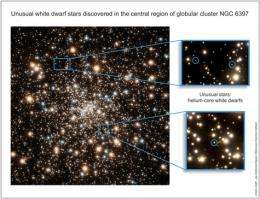
(PhysOrg.com) -- Professor Adrienne Cool has discovered 24 unusual stars in an ancient star cluster in the Milky Way. Made of helium rather than the usual carbon and oxygen, these white dwarf stars appear as faint, pale blue dots as spotted in new Hubble telescope images.

In a new study, Cool and former SF State graduate student Rachel Strickler suggest that these stars are coupled with close companion stars, which may explain how they came to be formed and why they are made of helium.

"Helium-core have only about half the mass of typical white dwarfs, but they are found concentrated in the center of the star cluster" said Cool, professor of physics and astronomy. "With such low masses, the helium-core white dwarfs ought to be floating all around the cluster, according to theory. The fact that we find them only in the central regions suggests that they have heavy companions -- partner that anchor them to the cluster center."

Cool and her collaborators suggest that these helium-core white dwarfs have had their lives cut short by the partner star, which has interfered with their normal development and stopped the star from fully maturing.

Cool and Strickler, now a doctoral student at University of California, Santa Cruz, co-authored the study with collaborators from the Space Telescope Science Institute, Indiana University and the Max Planck Institute in Germany. It will be published in the July 1, 2009, issue of The .

Provided by San Francisco State University (news : web)


print this article email this article download pdf blog this article bookmark this article     Stumble it Digg this share on Facebook retweet share on Reddit add to delicious
Rate this story - 4.3 /5 (22 votes)

Rank Filter

Move the slider to adjust rank threshold, so that you can hide some of the comments.


Display comments: newest first

  • LuckyBrandon - Apr 27, 2009
    • Rank: 3.7 / 5 (3)
    dont you just hate the way they change the article title and repost it as if its new news....
  • brant - Apr 27, 2009
    • Rank: 1.8 / 5 (5)
    How about solar theory is wrong?
  • superhuman - Apr 27, 2009
    • Rank: 4.5 / 5 (4)
    With such low masses, the helium-core white dwarfs ought to be floating all around the cluster, according to theory. The fact that we find them only in the central regions suggests that they have heavy companions -- partner stars that anchor them to the cluster center.


    Seriously this is getting ridiculous - when theories don't agree with data they need to be questioned, yet it seems many in physics are unable to do it and will just keep adding more and more invisible stuff - dark matter, dark energy, and now dark companion stars.

    There is one theme common to all those articles about cosmology - our models completely fail when it comes to explaining the Universe. To postulate that 95% of all energy content of the Universe in made of some exotic invisible matter and energy is just absurd. It means you have to invent 19 additional universes to explain the one we can observe. If this is not a proof that on cosmic scales our theories are blatantly wrong then what is?

    Realizing what we don't know is just as important in science as realizing what we do know, and for progress it might even be more important. Pretending that our models are fine when they are contradicted by data is stupid, it is hurting the progress and damaging the reputation of science, it brings science dangerously close to religion since falsifiability is the only thing which sets those two apart.

    Our physics is as applicable to cosmology as Newtonian physics is to relativistic motion.
  • earls - Apr 27, 2009
    • Rank: 3 / 5 (2)
    Yes, quite the conundrums we face when we only have one force at our disposal.
  • retro - Apr 28, 2009
    • Rank: 4.5 / 5 (2)
    One fundamental problem may be that events described by physical theories are framed in terms of an ideal, abstract, space-- mathematical space, which is generally differentiable, ordered, etc whereas events in the real world take place in a non-abstract physical space that might have properties not found in the abstract, mathematical, formal, spaces used for calculations. I really know of no way to get around that.
  • wiyosaya - Apr 28, 2009
    • Rank: 1 / 5 (1)
    With such low masses, the helium-core white dwarfs ought to be floating all around the cluster, according to theory. The fact that we find them only in the central regions suggests that they have heavy companions -- partner stars that anchor them to the cluster center.


    Seriously this is getting ridiculous - when theories don't agree with data they need to be questioned, yet it seems many in physics are unable to do it and will just keep adding more and more invisible stuff - dark matter, dark energy, and now dark companion stars.

    There is one theme common to all those articles about cosmology - our models completely fail when it comes to explaining the Universe. To postulate that 95% of all energy content of the Universe in made of some exotic invisible matter and energy is just absurd. It means you have to invent 19 additional universes to explain the one we can observe. If this is not a proof that on cosmic scales our theories are blatantly wrong then what is?

    Realizing what we don't know is just as important in science as realizing what we do know, and for progress it might even be more important. Pretending that our models are fine when they are contradicted by data is stupid, it is hurting the progress and damaging the reputation of science, it brings science dangerously close to religion since falsifiability is the only thing which sets those two apart.

    Our physics is as applicable to cosmology as Newtonian physics is to relativistic motion.


    Gotta admit that I had the same reaction to that statement. The article cites no evidence to support the astronomer's conclusions, however, the astronomer would rather hang on to theory - perhaps avoiding ostracization - rather than commit a "sin" against "accepted" and therefore always correct "science."

    It is unfortunate, at best, criminal, at worst, that there are scientists out there who are incapable of questioning whether theory is actually correct when data does not necessarily validate theory. Yet that is the "easy" way out. To rethink theory _may_ be more complicated, but maybe not.

    Perhaps the collegiate system should get rid of grading on curves. I live in an area that has a top 20 in the US university. This school grades on a curve. Basically, if everyone gets a 0 on an exam for a class, then everyone passes that exam. Yes, it is that bad as I experienced it first-hand and have heard similar anecdotes from other students of the same university. But, we cannot have all those parents complaining that their children are not getting passing grades now can we?

    I would love to see the Obama administration take on this side of "hokey" science, but I am not optimistic that this will happen.

    Too bad the astronomer is, apparently, incapable of thinking of other reasons why the stars are clustered in the center of the region. Must be a "scientist" in name only.
  • Merkk - Apr 28, 2009
    • Rank: 1 / 5 (1)
    I propose that the universe is made up of 12 different materials only 5 of which can be observed at any one time. The most exotic of what I like to call superduperdark energy. My only basis for this theory is the existance of another proposed material called baloney which apparently can only be detected through reports such as the one found above.

    The great news about my theory is that it fits in perfectly with the current model.

    Now may I please have 143.68 million dollars to further study this phenomenon?
  • yyz - Apr 28, 2009
    • Rank: not rated yet
    Here%u2019s the arXiv.org link to the preprint: http://arxiv.org/abs/0904.3496 . The authors state that this is 'the first extended sequence of Helium White Dwarfs found in a globular cluster' They also conclude that the Helium Dwarfs near the center of post core-collapse cluster require 'heavy White Dwarf companions' to occupy their present position in NGC 6397.
  • yyz - Apr 29, 2009
    • Rank: not rated yet
    Astronomers with a (hidden) agenda? Astrophysicists conspiring to hide the 'truth'? It all sounds like something out of the 'DaVinci Code'. X-Files fodder. I would guess that the paper this article is based on is just propaganda from scientists conspiring to hide the 'truth' from some of the people posting here (who in all likelihood have not even read the paper). Or would that be a waste of time, because these researchers are all 'in on it'. I've not seen one post referring to an explanation for these Helium Dwarf stars being found in high concentration near the center of the post core-collapse globular cluster NGC 6397. This cluster also has an an unusual concentration of millisecond pulsars near its core. Obviously this strange globular cluster poses many questions and offers some clues as to how it ended up as we find it. @Oliver K. Manuel: I would be interested in any published work directly relating your theories to the globular cluster NGC 6397 and the distribution of Helium Dwarfs near its center.
  • denijane - Apr 29, 2009
    • Rank: 1 / 5 (1)
    When did astronomers become scientists? :)
    No offence, but people whose only significant act is to denominate planets are not to be expected to question the easy theories.

    The funniest thing is that when you read articles in arxiv, you see the same 15 people in the most cited ones and they always tell you-this doesn't fit the theory and think of thousand ways to modify the theory to fit. When the theory is obviously wrong. And when this non-fitting behaviour repeat in 50% of the cases. (like in GRBs).
  • yyz - Apr 29, 2009
    • Rank: 4.5 / 5 (2)
    How do you explain papers at the arXiv site dealing with MOND? I've seen scores of papers posted on MOND, yet this is surely not a mainstream idea by any means. Are peer reviewers also in league with MOND proponents as well? And what theory do you have to offer to explain whatever it is your going on about? This 'peer conspiracy' theory is hogwash, not just at arXiv, but other peer-reviewed venues, like Nature & Science magazine.
  • lengould100 - May 01, 2009
    • Rank: not rated yet
    Just as you can ask for evidence to support a scientific theory, I can ask for evidence to support your conspiracy theory. Evidence please?
  • LuckyBrandon - May 01, 2009
    • Rank: not rated yet
    you mean someone actually ranked me a one when this is the 3rd article with a new title with the EXACT SAME COMMENT...that shoulda got a 5...lol
  • jeffsaunders - Jun 05, 2009
    • Rank: not rated yet
    I have a theory that can put helium stars in these globular clusters in different location without requiring them to have heavy companions.

    I am sure others can too - it fits neatly with universe construction and does not require a see of anti-matter to exist in intergalactic space.

    Also does not require MOND although I can see how MOND would appear correct from the same forces at work. ALso does not require spooky force acting at a distance or faster than light gravitons.

    The entire process is quite complicated to explain here but is simple to visualise to people with ability to think for themselves and that do not require that everything must fit into current square hole.

    Simple put gravity is not inherent quality of matter but is merely a reaction of matter to background radiationof universe which in turn is radiation from stars from extreme distances.

    As we all know light loses energy as it travels and interacts with matter on those travels hence the red shift of out very own sun, which by the way is a well known and documented fact. Light loses energy and this is observed in longer wavelengths the longer the wavelength is the more the wave penetrates matter before reacting with it.

    Gamma rays react very badly with surface of matter and blast right into matter because the react with every little bit. Longer wavelengths like light react by raising temperature of matter. Still Longer wavelengths like radio enter matter and heat it little but tend to push on matter. Longer still wavelengths penetrate further and have greater push.

    Gravity is a push of long and very long wavelength photons. Now we also have idea that if you are inside a high mass sphere you will not have much gravity effect i.e. inside a hollow asteroid you may be weightless at the center.

    Gravity is the evident force of the shadow of matter impinged upon by long wavelength photons. Hence a planet orbiting the sun appears to be affected by gravity of the sun at speeds greater then the speed of light. This is optical effect only.

    The same hollow sphere effect causes stars in a galaxy to rotate at different velocity than they would if each star was the source of its own gravity - not the case.

    So MOND is no longer needed to explain gravity anomaly and also simultaneously the problem of these helium stars is explained in a way we can all understand easily.

    The universal background radiation does not penetrate as much through these areas of high density stars so therefore gravity (as we measure it) is somewhat lower inside these areas and hence helium does not float as high as it otherwise would.

    See it is all quite simple really and explains so much.

April 27, 2009 all stories

Comments: 14

4.3 /5 (22 votes)
  • Stumble this up

  • Digg this

  • share this

  • hide
  • Related Stories

  • Largest collection of anomalous white dwarfs observed by Hubble
    created Apr 23, 2009 | popularity not rated yet | comments 0
  • Astronomers discover how white dwarf stars get their 'kicks'
    created Dec 04, 2007 | popularity not rated yet | comments 0
  • Astronomers Find Origin Of Extreme-Helium Stars
    created Mar 20, 2006 | popularity not rated yet | comments 0
  • Hubble Sees Faintest Stars in a Globular Cluster
    created Aug 17, 2006 | popularity not rated yet | comments 0
  • New type of pulsating white dwarf star discovered
    created May 01, 2008 | popularity not rated yet | comments 0


  • hide
  • Relevant PhysicsForums posts

  • The shape of our solar system's orbits.
    created Nov 07, 2009
  • Above or Below the Line of Nodes
    created Nov 07, 2009
  • Supernova vs. Nova?
    created Nov 07, 2009
  • Supernova's Gamma Rays and Comets
    created Nov 06, 2009
  • More from Physics Forums - General Astronomy

Other News

Deep creep means milder, more frequent earthquakes along Southern California's San Jacinto fault

Deep creep means milder, more frequent earthquakes along Southern California's San Jacinto fault

Space & Earth / Earth Sciences

created 13 hours ago | popularity 4.7 / 5 (3) | comments 0

With an average of four mini-earthquakes per day, Southern California's San Jacinto fault constantly adjusts to make it a less likely candidate for a major earthquake than its quiet neighbor to the east, the ...


Success in 'space elevator' competition (AP)

Success in 'space elevator' competition (Update 3)

Space & Earth / Space Exploration

created Nov 05, 2009 | popularity 4.3 / 5 (33) | comments 50

(AP) -- A robot powered by a ground-based laser beam climbed a long cable dangling from a helicopter on Wednesday to qualify for prize money in a $2 million competition to test the potential reality of the ...


In a Galaxy Far, Far Away...

In a Galaxy Far, Far Away...

Space & Earth / Astronomy

created Nov 06, 2009 | popularity 4.8 / 5 (5) | comments 17

(PhysOrg.com) -- Astronomers have published the discovery of the farthest known object in the cosmos: a star that exploded when the universe was only 630 million years old -- only 4.6% of its current age. ...


'Dropouts' pinpoint earliest galaxies

'Dropouts' pinpoint earliest galaxies

Space & Earth / Astronomy

created Nov 06, 2009 | popularity 4.2 / 5 (10) | comments 13

Astronomers, conducting the broadest survey to date of galaxies from about 800 million years after the Big Bang, have found 22 early galaxies and confirmed the age of one by its characteristic hydrogen signature ...


Space hotel taking bookings for 2012 opening

Space hotel taking bookings for 2012 opening

Space & Earth / Space Exploration

created Nov 05, 2009 | popularity 4.4 / 5 (21) | comments 11

(PhysOrg.com) -- The first orbiting space hotel is on track to open for its first customers in 2012, but hurry, as bookings are filling fast.