Icebergs break away from Antarctic iceshelf
April 28, 2009 Satellite imagery shows fragile Wilkins Ice Shelf destabilised

Enlarge

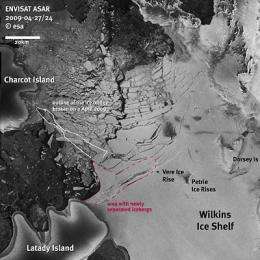
The figure displays the Envisat Advanced Synthetic Aperture Radar (ASAR) image from 27 April 2009 superimposed on an image from 24 April 2009. The margins of the collapsed ice bridge that formerly connected Charcot and Latady Islands are outlined in white. The demise of the ice bridge led to a destabilisation of the northern ice front of the Wilkins Ice Shelf, where the first icebergs calved off on 20 April 2009 (area denoted in red). Credit: ESA (Annotations by A. Humbert, Münster University)

(PhysOrg.com) -- Satellite images show that icebergs have begun to calve from the northern front of the Wilkins Ice Shelf - indicating that the huge shelf has become unstable. This follows the collapse three weeks ago of the ice bridge that had previously linked the Antarctic mainland to Charcot Island.

The ice bridge, which effectively formed a barrier pinning back the northern ice front of the central Wilkins Ice Shelf, collapsed on 5 April removing about 330 sq km of ice. As a consequence of the collapse, the rifts, which had already featured along the northern ice front, widened and new cracks formed as the ice adjusted in the days that followed.

Dr Angelika Humbert from the Institute of Geophysics, Münster University and Dr Matthias Braun from the Center for Remote Sensing, University of Bonn have been monitoring the ice shelf using a combination of radar images from ESA's Envisat satellite and the German Aerospace Centre's TerraSAR-X satellite.

On 24 April, the satellite data showed that the first icebergs had started to break away from the fragile ice shelf. A very rough estimate suggests that, so far, about 700 sq km of ice has been lost from the Wilkins Ice Shelf.

In contrast to the ice bridge, which shattered very quickly, it is expected that the discharge of ice will continue for some weeks. The icebergs are calving as a result of fracture zones that have formed over the last 15 years and which turned Wilkins into a fragile and vulnerable ice shelf.
Map showing the Wilkins Ice Shelf in Antarctica
Enlarge

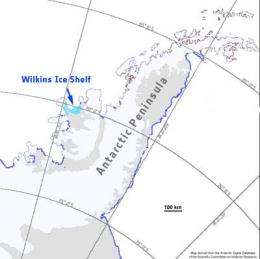
Map showing the Wilkins Ice Shelf in Antarctica. Credits: ESA

"The retreat of Wilkins Ice Shelf is the latest and the largest of its kind. Eight separate ice shelves along the Antarctic Peninsula have shown signs of retreat over the last few decades. There is little doubt that these changes are the result of atmospheric warming on the Antarctic Peninsula, which has been the most rapid in the Southern Hemisphere," explained David Vaughan from the British Antarctic Survey.

"The changes to Wilkins Ice Shelf provide a fabulous natural laboratory that will allow us to understand how ice shelves respond to climate change and what the future will hold for the rest of Antarctica," Vaughan commented. "The quality and frequency of images acquired by ESA satellites mean that the break-up of Wilkins Ice Shelf can be analysed far more effectively than any previous event. For the first time, I think, we can really begin to see the processes that have brought about the demise of the ice shelf."

However, it is still unclear how the situation will evolve. Humbert noted that, "We are not sure if a new stable ice front will now form between Latady Island, Petrie Ice Rises and Dorsey Island. If the connection to Latady Island is lost, the projected loss of 3370 sq km of ice might be greater - though we have no indication that this will happen in the near future."

The combination of high resolution TerraSAR-X images and the more frequently acquired Envisat images, increases the understanding of ice shelf break-up more than ever before.

ESA's Webcam from Space is available to the public and features the latest Envisat images, documenting the break-up of Antarctica's Wilkins Ice Shelf.

Source: European Space Agency


print this article email this article download pdf blog this article bookmark this article     Stumble it Digg this share on Facebook retweet share on Reddit add to delicious
Rate this story - 3.3 /5 (16 votes)

Rank Filter

Move the slider to adjust rank threshold, so that you can hide some of the comments.


Display comments: newest first

  • arcticireland - Apr 28, 2009
    • Rank: 4.2 / 5 (5)
    "Ice shelves in general have episodic carvings and there can be large icebergs breaking off -- I'm talking 100km or 200km long -- every 10 or 20 or 50 years".Dr.Ian Allison,Australian Antarctic Division.

    East Antarctica is four times the size of west Antarctica and parts of it are cooling. The Scientific Committee on Antarctic Research report prepared for last week's meeting of Antarctic Treaty nations in Washington noted the South Pole had shown "significant cooling in recent decades".
  • googleplex - Apr 28, 2009
    • Rank: 2.9 / 5 (7)
    Yep Antartic is getting colder and the Arctic is getting warmer. I read elsewhere that the Antarctic ozone hole negated the global warming. However since the ozone hole has been repaired the cooling period is likely to end.

    I also find it interesting that the Winter ice has increase in the Arctic. Whereas the Summer ice has decreased.

    One under reported issue is that as permafrost melts for the first time it releases potentially vast amounts of green house gases. To me this is a great example of how chaotic the global warming issue is.
  • Velanarris - Apr 28, 2009
    • Rank: 4.2 / 5 (5)
    "There is little doubt that these changes are the result of atmospheric warming on the Antarctic Peninsula, which has been the most rapid in the Southern Hemisphere," explained David Vaughan from the British Antarctic Survey (BAS).
    That's blatantly false. There is a lot of research pointing to tectonic activity and even more pointing towards shifting ocean currents carrying warmer water to the Western Antarctic.
  • mikiwud - Apr 29, 2009
    • Rank: 5 / 5 (2)
    These ice shelves are not melting, they are breaking up. Probably through wind, currents and tidal forces. Also this "latest" break up has been the latest news for years.

    http://www.appins...helf.htm

    Reports of the break up go back to at least 1999, just forgotten until regurgitated the next year.

    http://wattsupwit...ore-7352
  • arcticireland - Apr 30, 2009
    • Rank: 5 / 5 (2)
    These ice shelves are not melting, they are breaking up. Probably through wind, currents and tidal forces. Also this "latest" break up has been the latest news for years.


    Thats very true,anyone remember the Titanic ?
  • GrayMouser - May 01, 2009
    • Rank: 5 / 5 (1)
    Yep Antartic is getting colder and the Arctic is getting warmer. I read elsewhere that the Antarctic ozone hole negated the global warming. However since the ozone hole has been repaired the cooling period is likely to end.

    Who told you that the ozone hole has been repaired? Right now its expanding.


    I also find it interesting that the Winter ice has increase in the Arctic. Whereas the Summer ice has decreased.

    One under reported issue is that as permafrost melts for the first time it releases potentially vast amounts of green house gases. To me this is a great example of how chaotic the global warming issue is.

    It gets better, the ice in the Arctic is thinker than expected. http://wattsupwit...sdicken/

April 28, 2009 all stories

Comments: 6

3.3 /5 (16 votes)
  • Stumble this up

  • Digg this

  • share this

  • hide
  • Related Stories

  • 'Webcam' from Space: Envisat observing Wilkins Ice Shelf
    created Dec 12, 2008 | popularity not rated yet | comments 0
  • Ice Bridge Supporting Wilkins Ice Shelf Collapses
    created Apr 08, 2009 | popularity not rated yet | comments 0
  • Antarctic ice shelf 'hangs by a thread'
    created Mar 25, 2008 | popularity not rated yet | comments 0
  • Wilkins Ice Shelf under threat
    created Nov 28, 2008 | popularity not rated yet | comments 0
  • Even the Antarctic winter cannot protect Wilkins Ice Shelf
    created Jun 13, 2008 | popularity not rated yet | comments 0


  • hide
  • Relevant PhysicsForums posts

  • cycles
    created 14 hours ago
  • The Origin of the term 'fossil' fuels
    created Nov 05, 2009
  • co2
    created Nov 03, 2009
  • Early Earths Sulfidic Ocean Conditions
    created Oct 30, 2009
  • More from Physics Forums - Earth

Other News

Deep creep means milder, more frequent earthquakes along Southern California's San Jacinto fault

Deep creep means milder, more frequent earthquakes along Southern California's San Jacinto fault

Space & Earth / Earth Sciences

created 13 hours ago | popularity 4.7 / 5 (3) | comments 0

With an average of four mini-earthquakes per day, Southern California's San Jacinto fault constantly adjusts to make it a less likely candidate for a major earthquake than its quiet neighbor to the east, the ...


Success in 'space elevator' competition (AP)

Success in 'space elevator' competition (Update 3)

Space & Earth / Space Exploration

created Nov 05, 2009 | popularity 4.3 / 5 (33) | comments 50

(AP) -- A robot powered by a ground-based laser beam climbed a long cable dangling from a helicopter on Wednesday to qualify for prize money in a $2 million competition to test the potential reality of the ...


In a Galaxy Far, Far Away...

In a Galaxy Far, Far Away...

Space & Earth / Astronomy

created Nov 06, 2009 | popularity 4.8 / 5 (5) | comments 17

(PhysOrg.com) -- Astronomers have published the discovery of the farthest known object in the cosmos: a star that exploded when the universe was only 630 million years old -- only 4.6% of its current age. ...


'Dropouts' pinpoint earliest galaxies

'Dropouts' pinpoint earliest galaxies

Space & Earth / Astronomy

created Nov 06, 2009 | popularity 4.2 / 5 (10) | comments 13

Astronomers, conducting the broadest survey to date of galaxies from about 800 million years after the Big Bang, have found 22 early galaxies and confirmed the age of one by its characteristic hydrogen signature ...


Space hotel taking bookings for 2012 opening

Space hotel taking bookings for 2012 opening

Space & Earth / Space Exploration

created Nov 05, 2009 | popularity 4.4 / 5 (21) | comments 11

(PhysOrg.com) -- The first orbiting space hotel is on track to open for its first customers in 2012, but hurry, as bookings are filling fast.