We owe it all to comets
Comets have always fascinated us. A mysterious appearance could symbolize God's displeasure or mean a sure failure in battle, at least for one side. Now Tel Aviv University justifies our fascination -- comets might have provided the elements for the emergence of life on our planet.
While investigating the chemical make-up of comets, Prof. Akiva Bar-Nun of the Department of Geophysics and Planetary Sciences at Tel Aviv University found they were the source of missing ingredients needed for life in Earth's ancient primordial soup. "When comets slammed into the Earth through the atmosphere about four billion years ago, they delivered a payload of organic materials to the young Earth, adding materials that combined with Earth's own large reservoir of organics and led to the emergence of life," says Prof. Bar-Nun.
It was the chemical composition of comets, Prof. Bar-Nun believes, that allowed them to kickstart life. He has published his theory widely in scientific journals, including the journal Icarus.
A Pinch of Argon, A Dash of Xenon
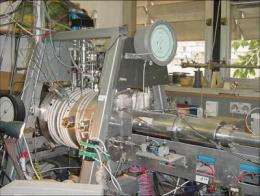
Using a one-of-a-kind machine built at Tel Aviv University, researchers were able to simulate comet ice, and found that comets contain ingredients necessary for providing the basic nutrients of life.
Specifically, Prof. Bar-Nun looked at the noble gases Argon, Krypton and Xenon, because they do not interact with any other elements and are not destroyed by Earth's oxygen. These elements have maintained stable proportions in the Earth's atmosphere throughout the lifetime of the planet, he explains.
"Now if we look at these elements in the atmosphere of the Earth and in meteorites, we see that neither is identical to the ratio in the sun's composition. Moreover, the ratios in the atmosphere are vastly different than the ratios in meteorites which make up the bulk of the Earth. So we need another source of noble gases which, when added to these meteorites or asteroid influx, could change the ratio. And this came from comets."
Solving the Otherworldly Puzzle
Comets are essentially large chunks of ice, whose temperature ranges from -200 to -250 degrees centigrade. Formed in the early days of the solar system far away from the sun, water vapor condensed directly into ice, making little grains. These grains came together to form the comets, which are less than 2/3 of a mile in diameter, explains Prof. Bar-Nun.
During the comets' formation, the porous ice trapped gases and organic chemicals that were present in outer space. "The pattern of trapping of noble gases in the ice gives a certain ratio of Argon to Krypton to Xenon, and this ratio ― together with the ratio of gases that come from rocky bodies ― gives us the ratio that we observe in the atmosphere of the Earth."
Thus, the arrival on Earth of comets and asteroids led to the necessary ratio of materials for organic life, "which eventually were dissolved in the ocean and started the long process leading to the emergence of life on Earth," says Prof. Bar-Nun.
Asteroid Showers and Thunderstorms
The story started between 4.6 and 3.8 billion years ago, when both the moon and the Earth were bombarded by a flux of asteroids and comets. "On the Earth, most of the craters were obliterated by continental movement and by weathering winds and water erosion. On the moon, they remained as they were," says Prof. Bar-Nun, who adds that no life could thrive during this period of bombardment.
But the Earth recovered, and three to four hundred million years later, fragile forms of life emerged after the comet-delivered elements precipitated into the ocean. "There was another chemical development of these molecules in water, which became more and more complex," says Prof. Bar-Nun, leading to the origin of life on Earth.
Source: Tel Aviv University (news : web)


