Avian Flu Research Sheds Light on Swine Flu Outbreak (w/Podcast)

April 28, 2009 By Gwyneth Dickey
Avian Flu Research Sheds Light on Swine Flu Outbreak (w/Podcast)

Enlarge

This graphic shows why the Type A virus can't be eradicated.

(PhysOrg.com) -- A new study by University of Maryland researchers suggests that the potential for an avian influenza virus to cause a human flu pandemic is greater than previously thought. Results also illustrate how the current swine flu outbreak likely came about.

As of now, viruses can infect humans who have contact with birds, but these viruses tend not to transmit easily between humans. However, in research recently published in the , Associate Professor Daniel Perez from the University of Maryland showed that after reassortment with a human influenza virus, a process that usually takes place in intermediary species like pigs, an avian flu virus requires relatively few mutations to spread rapidly between mammals by respiratory droplets.

"This is similar to the method by which the current swine influenza strain likely formed," said Perez, program director of the University of Maryland-based Prevention and Control of Avian Influenza Coordinated Agricultural Project, AICAP. "The virus formed when avian, swine, and human-like viruses combined in a pig to make a new virus. After mutating to be able to spread by respiratory droplets and infect humans, it is now spreading between humans by sneezing and coughing."

This video is not supported by your browser at this time.

Prof. Perez talks about the H9N2 Virus.

In his study, Perez used the avian H9N2 influenza virus, one that is on the list of candidates for human pandemic potential. Using reverse genetics, a technique whereby individual genes from viruses are separated, selected, and put back together, Perez and his team created a hybrid human-avian virus. Their research hybrid has internal human flu genes and surface avian flu genes from the H9N2 virus. Though it comes from a different strain of avian flu than the one that contributed to the hybrid virus now causing the swine , Perez's research virus is similar in origin to the swine flu virus, in that both involved a combination of avian and human influenza viruses.

Perez infected ferrets (considered a good model for human influenza transmission) with the virus he created, and allowed the virus to mutate in the species. Before long, healthy ferrets that shared air space but not physical space with the infected ferret had the virus, showing that the virus had mutated to spread by respiratory droplets.

When the genetic sequences of the mutant virus and original hybrid virus were compared, the only differences were five amino acid mutations, three on the surface, and two internally. Two of the surface mutations were determined to be solely responsible for supporting respiratory droplet transmission. Because so few mutations were necessary to make the hybrid H9N2 transmissible this way, they concluded that after an animal-human hybrid influenza virus forms in nature, a human pandemic of this virus is potentially just a few mutations away.
Avian Flu Research Sheds Light on Swine Flu Outbreak (w/Podcast)
Enlarge

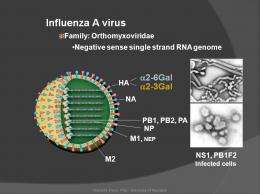
The Influenza A Virus.

"We do not know if the mutations we saw in the lab are the same that have made the H1N1 swine flu transmissible by respiratory droplets," Perez said. "We will be doing more research on the current swine flu strain to study its specific genetic mutations."

Perez found that one of the two of the genetic mutations in his lab strain that enabled respiratory transmission between mammals was on the tip of the HA surface protein, one of the sites where human antibodies created in response to current vaccines would bind.

"Because the binding site of the mutant virus is different from the virus upon which the vaccine is modeled, it may mean that current vaccine stocks would not be as effective against the H9N2 mutant strain as previously anticipated," said Perez. "We should keep this in mind when designing vaccines for an avian flu pandemic in humans."

However, scientists cannot predict what the actual mutations will look like if and when they occur in nature, or even which strain of avian influenza will mutate to infect mammals.

"This is just the tip of the iceberg," said Perez. "Many more studies have to be done to see which combinations of mutations cause this type of transmission before we can design the appropriate vaccines."

Perez will be talking this week with the NIH and the CDC to discuss his team's role in researching the current virus strain. Perez will likely do studies related to vaccine development, virus transmission between humans and animals, and the pathogenesis of the virus.

A virus vaccine is derived from the virus itself. The vaccine consists of virus components or killed viruses that mimic the presence of the virus without causing disease. These prime the body's immune system to recognize and fight against the virus. The immune system produces antibodies against the vaccine that remain in the system until they are needed. If that virus, or in some cases a closely similar one is later introduced into the system, those antibodies attach to viral particles and remove them before they have time to replicate, preventing or lessening symptoms of the virus.

The immune system also retains antibodies to a virus after being infected with it, so humans have general immunity to human strains of avian influenza strains. But humans do not generally have immunity to avian flu strains because they have not been infected by them before. The surface proteins are sufficiently different to escape the human immune response. Avian flu strains are therefore more dangerous for humans because the human immune system cannot recognize the or protect against it.

Provided by University of Maryland (news : web)

3.5 /5 (4 votes)  

Filter


Move the slider to adjust rank threshold, so that you can hide some of the comments.


Display comments: newest first

Thadieus
Apr 28, 2009

Rank: 1 / 5 (2)
Many people react with incredulity when the assertion is made that the so-called swine flu outbreak in Mexico may be manufactured crisis. And yet history is replete with examples of government using biological and chemical agents for political purpose.

As a primary example, consider the CIA%u2019s secret war against Cuba and Fidel Castro.


The CIA used chemical agents and toxins then stockpiled at Fort Detrick against Cuba and Fidel Castro.

In 1975, the Church Committee revealed a CIA memorandum listing deadly chemical agents and toxins then stockpiled at Fort Detrick. %u201CThese included anthrax, encephalitis, tuberculosis, lethal snake venom, shellfish toxin, and half a dozen lethal food poisons, some of which, the committee learned, had been shipped in the early 1960s to Congo and to Cuba in unsuccessful CIA attempts to assassinate Patrice Lumumba and Fidel Castro,%u201D write Ellen Ray and William H. Schaap (Bioterror: Manufacturing Wars the American Way, Ocean Press, 2003, p. vii).

Schaap cites the work of Dr. Marc Lappé (Chemical and Biological Warfare: The Science of Public Death, Student Research Facility for East Bay Women for Peace and Science Students for Social Responsibility, 1969), who claims that the U.S. Army had a biological warfare agent prepared for use against Cuba at the time of the Missile Crisis in 1962, mostly likely Q fever (Coxiella burnetii, a bacterium that affects both humans and animals). In 1977, a Washington Post report confirmed that during this time the CIA maintained an %u201Canticrop warfare%u201D program.

In regard to swine flu, the San Francisco Chronicle reported on January 10, 1977, that CIA %u201Coperatives linked to anti-Castro terrorists introduced African swine fever virus into Cuba in 1971.%u201D The outbreak, the first time the disease hit the Western Hemisphere, was labeled the %u201Cmost alarming event%u201D of 1971 by the United Nations Food and Agricultural Organization. Cuba reacted to outbreak by slaughtering 500,000 pigs. An intelligence source told the newspaper %u201Cthat early in 1971 he was given the virus in a sealed, unmarked container at Ft. Gulick, an Army base in the Panama Canal Zone. The CIA also operates a paramilitary training center for career personnel and mercenaries at Ft. Gulick.%u201D The source said he was given instructions to turn the container with the virus over to members of an anti-Castro group.


A d v e r t i s e m e n t

In 1980, described as %u201Cthe year of the plagues%u201D by Schaap, %u201CCuba was beset with disasters. Another African swine fever epidemic hit; the tobacco crop was decimated by blue mold; and the sugarcane crops were hit with a particularly damaging rust disease.%u201D

By 1981, the Cuban population was targeted with hemorrhagic dengue fever, a devastating disease transmitted by mosquitoes. %u201CFrom May to October 1981 there were well over 300,000 reported cases, with 158 fatalities, 101 involving children under 15. At the peak of the epidemic, in early July, more than 10,000 cases per day were being reported. More than a third of the reported victims required hospitalization. By mid-October, after a massive campaign to eradicate Aedes aegypti [mosquito], the epidemic was over,%u201D writes Schaap. %u201CThe history of the secret war against Cuba and the virulence of this dengue epidemic were enough to generate serious suspicions that the United States had a hand in the dengue epidemic of 1981. But there is much more support for those suspicions than a healthy distrust of U.S. intentions regarding Cuba.%u201D

After interviewing officials from the Pan American Health Organization and of the Cuban Ministry of Public Health, Schaap states that he believes the %u201Cepidemic was artificially induced.%u201D

The epidemic began with the simultaneous discovery in May 1981 of three cases of hemorrhagic dengue caused by a type 2 virus. The cases arose in three widely separated parts of Cuba: Cienfuegos, Camagiiey, and Havana. It is extremely unusual that such an epidemic would commence in three different localities at once. None of the initial victims had ever traveled out of the country; for that matter, none of them had recently been away from home. None had had recent contact with international travelers. Moreover, a study of persons arriving in Cuba in the month of May from known dengue areas found only a dozen such passengers (from Vietnam and Laos), all of whom were checked by the Institute of Tropical Medicine and found free of the disease. Somehow, infected mosquitoes had appeared in three provinces of Cuba at the same time. Somehow, the fever spread at an astonishing rate. There appears to be no other explanation but the artificial introduction of infected mosquitoes.

Researchers believe the Mexican swine flu outbreak may also be %u201Cartificially induced.%u201D First, the Mexican outbreak occurred outside of the normal flu season (influenza usually obeys a regularly re-occurring time period %u2013 in temperate climate zones, the flu season will typically begin in the late fall and peak in mid- to late winter, while in tropical zones flu seasons appear to be less pronounced, with year-round isolation of the virus). Second, the genetic makeup of the fast-spreading H1N1 strain of influenza %u2014 including genetic elements from bird flu, swine flu and human flu covering three continents %u2014 appears to be man-made.

%u201CWhat seems suspicious to me is the hybrid origin of the viral fragments found in H1N1 influenza,%u201D writes Mike Adams. These viral fragments include human influenza, bird flu from North America, and swine flu from Europe and Asia.

This is rather astonishing to realize, because for this to have been a natural combination of viral fragments, it means an infected bird from North America would have had to infect pigs in Europe, then be re-infected by those some pigs with an unlikely cross-species mutation that allowed the bird to carry it again, then that bird would have had to fly to Asia and infected pigs there, and those Asian pigs then mutated the virus once again (while preserving the European swine and bird flu elements) to become human transmittable, and then a human would have had to catch that virus from the Asian pigs %u2014 in Mexico! %u2014 and spread it to others.

At present, there is little evidence the virus was created in a U.S. lab and deliberately unleashed on an unsuspecting Mexican public. However, there is plenty of evidence the U.S. military and the CIA have used biological agents in the past, including %u201Ctests%u201D on the American people.

%u201CMore than 200 experiments were carried out in U.S. rural areas to test the spread of non-lethal germs,%u201D writes Joe Allen. %u201CThese tests were also carried out in San Francisco in 1950 and in New York in 1966. While the cover for these tests was to study a %u2018defense%u2019 against biochemical warfare, U.S. war planners wanted this knowledge for offensive use against an enemy population,%u201D for instance livestock and people in Cuba, as mentioned above.

At the height of Cold War insanity, the U.S. government gave a free hand for its scientists to experiment on anything that could possibly further its military prowess. The CIA experimented with LSD for %u201Cmind control.%u201D At Fort Detrick, scientists studied the possibility of spreading yellow fever and plague with insects. Anti-crop bombs were built for the United States Air Force to be used in the Third World.

It appears this insanity did not stop with the Cold War. Last week, the Frederick News Post reported Army criminal investigators are looking into the possibility that disease samples are missing from biolabs at Fort Detrick.

Finally, investigative journalist Wayne Madsen has reported that %u201Ca top scientist for the United Nations, who has examined the outbreak of the deadly Ebola virus in Africa, as well as HIV/AIDS victims, [and] concluded that H1N1 possesses certain transmission %u2018vectors%u2019 that suggest that the new flu strain has been genetically-manufactured as a military biological warfare weapon. The UN expert believes that Ebola, HIV/AIDS, and the current A-H1N1 swine flu virus are biological warfare agents.%u201D

Again, at this time, there is no definitive evidence indicating the Mexican virus is a bioweapon. However, there is plenty of factual evidence pointing to the fact the U.S. government (and other governments) have developed biological weapons and have used them against target populations.
John_balls
Apr 28, 2009

Rank: 5 / 5 (1)
Get the fk out of here you moron
Thadieus
Apr 28, 2009

Rank: 1 / 5 (2)
nice language jerk. Shows me that you have no real response.
Soylent
Apr 29, 2009

Rank: not rated yet
nice language jerk. Shows me that you have no real response.


Offtopic, multi-page spam does not deserve a more considered response. STFU
MadLintElf
Apr 29, 2009

Rank: not rated yet
Don't flood the thread with a messages like this, make your point and post a link to a web page and give us a break please.

Thank you.
Rank 3.5 /5 (4 votes)
Related Stories
Relevant PhysicsForums posts
  • Is Everyday Technology Killing Us?
    createdFeb 08, 2012
  • Exercise and weight loss
    createdFeb 08, 2012
  • Why do we have head aches? Our brains can't feel anything.
    createdFeb 07, 2012
  • "The end of diseases" by David Agus, interview from Daily Show with Jon Stewart
    createdFeb 04, 2012
  • Oncolytic adenovirus
    createdFeb 04, 2012
  • Nutrition label stuffs and diets
    createdFeb 02, 2012
  • More from Physics Forums - Medical Sciences

More news stories

Complex wiring of the nervous system may rely on a just a handful of genes and proteins

Researchers at the Salk Institute have discovered a startling feature of early brain development that helps to explain how complex neuron wiring patterns are programmed using just a handful of critical genes. ...

Medicine & Health / Research

created 7 hours ago | popularity 4.9 / 5 (9) | comments 0 | with audio podcast

Both maternal and paternal age linked to autism

Older maternal and paternal age are jointly associated with having a child with autism, according to a recently published study led by researchers at The University of Texas Health Science Center at Houston (UTHealth).

Medicine & Health / Psychology & Psychiatry

created 12 hours ago | popularity 4.3 / 5 (3) | comments 0 | with audio podcast

New understanding of DNA repair could eventually lead to cancer therapy

A research group in the Faculty of Medicine & Dentistry at the University of Alberta is hoping its latest discovery could one day be used to develop new therapies that target certain types of cancers.

Medicine & Health / Cancer

created 11 hours ago | popularity 4.8 / 5 (5) | comments 0 | with audio podcast

Curry spice component may help slow prostate tumor growth

Curcumin, an active component of the Indian curry spice turmeric, may help slow down tumor growth in castration-resistant prostate cancer patients on androgen deprivation therapy (ADT), a study from researchers ...

Medicine & Health / Cancer

created 13 hours ago | popularity 4.4 / 5 (8) | comments 0 | with audio podcast

Team isolates nerve cells involved in storing long term memory and gene proteins associated with them

(Medical Xpress) -- A research team in Taiwan has succeeded in isolating two nerve cells in fruit fly brains that are believed to be the major players in allowing for the formation of long term memories. Furthermore, ...

Medicine & Health / Neuroscience

created 14 hours ago | popularity 5 / 5 (4) | comments 1 | with audio podcast report


Anonymous knocks CIA website offline (Update)

The website of the Central Intelligence Agency was inaccessible on Friday after the hacker group Anonymous claimed to have knocked it offline.

Google users warned of threat to smartphone wallets

Users of Google smartphone wallets were being warned on Friday that there is a way to crack pass codes intended to thwart thieves from going on illicit shopping sprees.

New error-correcting codes guarantee the fastest possible rate of data transmission

Error-correcting codes are one of the triumphs of the digital age. They’re a way of encoding information so that it can be transmitted across a communication channel — such as an optical fiber o ...

Humans may have helped the decline of African rainforests 3000 years ago

(PhysOrg.com) -- Large areas of rainforests in Central Africa mysteriously disappeared over three thousand years ago, to be replaced by savannas. The prevailing theory has been that the cause was a change ...

The power of estrogen -- male snakes attract other males

A new study has shown that boosting the estrogen levels of male garter snakes causes them to secrete the same pheromones that females use to attract suitors, and turned the males into just about the sexiest ...

New power source discovered

(PhysOrg.com) -- Researchers at the Massachusetts Institute of Technology (MIT) and RMIT University have made a breakthrough in energy storage and power generation.