Some Short-term Memories Die Suddenly, No Fading
April 28, 2009 Some short-term memories die suddenly, no fading

Enlarge

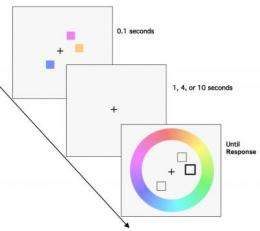
People who viewed these colored squares for a tenth of a second could usually accurately match the color they’d seen to a point on the color wheel after 1 and 4 second intervals. At 10 seconds, some people still made accurate matches, while most made random guesses. The results indicate that short-term visual memory remains precise until it suddenly dies. Credit: Steve Luck/UC Davis

(PhysOrg.com) -- The human brain stores some kinds of memories for a lifetime. But when our eyes are open and looking at things, our gray matter also creates temporary memories that help us process complex tasks during the few seconds these visual memories exist. For decades, scientists have held that such short-term memories don’t suddenly disappear, but grow gradually more imprecise over the course of several seconds.

Now researchers at the University of California, Davis, have found just the opposite. Their subjects retained temporary memories of an object’s color or shape for at least four seconds. After that, the memories began to wink out like streetlights at daybreak, remaining quite accurate until they suddenly disappeared.

To test the accuracy of short-term visual , Weiwei Zhang, a postdoctoral scholar, and Steve Luck, a professor of psychology, both at the UC Davis Center for Mind and Brain, devised a pair of tests, both of which could separately measure two things: the accuracy of a short-term memory and the probability that the memory still existed. Each test was given to 12 adults.

In the first test, three squares — each with a different color fill — flashed for a tenth of a second on a computer screen. After an interval of one, four or 10 seconds a wheel showing the entire spectrum of colors appeared on the screen. The three squares also reappeared, only now they were colorless and one of them was highlighted. Subjects were asked to recall the color of the highlighted square and click on the area of the wheel that most closely matched it. Each subject repeated this test 150 times for each of the three memory retention intervals.

When subjects retained a memory of the color, they clicked very close to it on the wheel — the distance between the click and the actual color indicating the accuracy of the memory. When color had disappeared from memory, however, subjects clicked at random on the wheel.

The second test was similar to the first, but used shapes instead of colors.

Published in the April issue of the journal Psychological Science, the study found that subjects “either had the memory or didn’t have the memory,” Luck said, “and the probability of having it decreased between four and ten seconds. The memories did not gradually fade away.”

The finding provides insight into the underlying mechanisms behind memory formation and retention. “The memories are not like flashlights that get progressively weaker as the battery runs low,” Luck said. “They are more like a laptop computer that continues working at the same speed until it suddenly shuts down.” This could be important in everyday life, he explained, because it would provide a mechanism to help us avoid the confusion that might arise if we tried to make decisions on the basis of weak, inaccurate memories.

Zhang and Luck are currently incorporating these findings into a study of short-term memory dysfunction in people with schizophrenia.

The research was supported by a grant from the National Institute of Mental Health.

Provided by UC Davis (news : web)


print this article email this article download pdf blog this article bookmark this article     Stumble it Digg this share on Facebook retweet share on Reddit add to delicious
Rate this story - 5 /5 (2 votes)


April 28, 2009 all stories

Comments: 0

5 /5 (2 votes)
  • Stumble this up

  • Digg this

  • share this

  • hide
  • Related Stories

  • Working memory has limited 'slots'
    created Apr 03, 2008 | popularity not rated yet | comments 0
  • Sense and sensibility in short-term memory
    created Feb 20, 2007 | popularity not rated yet | comments 0
  • Unlocking the mysteries of memory
    created Dec 04, 2008 | popularity not rated yet | comments 0
  • Short-term memory ability may predict IQ
    created Jul 12, 2007 | popularity not rated yet | comments 0
  • Study indicates how we maintain visual details in short-term memory
    created Feb 20, 2009 | popularity not rated yet | comments 0


  • hide
  • Relevant PhysicsForums posts

  • Improving the brain through chemistry
    created Nov 07, 2009
  • Sleep / REM Sleep and homeostasis
    created Nov 07, 2009
  • The Biceps Reflex
    created Nov 05, 2009
  • Consequenses of striking a Vein and an artery?
    created Nov 05, 2009
  • More from Physics Forums - Medical Sciences

Other News

Young tennis players who play only 1 sport are more prone to injuries

Young tennis players who play only one sport are more prone to injuries

Medicine & Health / Health

created 5 minutes ago | popularity not rated yet | comments 0

Gifted young athletes are under increasing pressure to play only one sport year round.


Scientists uncover new key to the puzzle of hormone therapy and breast cancer

Scientists uncover new key to the puzzle of hormone therapy and breast cancer

Medicine & Health / Cancer

created 5 minutes ago | popularity not rated yet | comments 0

The use of postmenopausal hormone therapy has decreased over time in the United States, which researchers suggest may play a key role in the declining rate of atypical ductal hyperplasia, a known risk factor ...


Lawmaker wants probe of E. coli and school lunches

Medicine & Health / Diseases

created 24 minutes ago | popularity not rated yet | comments 0

(AP) -- The chairman of the House Education and Labor Committee wants an investigation into the risk of deadly E. coli getting into school lunches.


House passes health care bill on close vote (AP)

Landmark health bill passes House on close vote

Medicine & Health / Health

created 23 hours ago | popularity 3.8 / 5 (10) | comments 3

(AP) -- The Democratic-controlled House narrowly passed far-reaching health care legislation, handing President Barack Obama a hard-won victory on his chief domestic priority though the road ahead in the ...


Developmental delay could stem from nicotinic receptor deletion

Medicine & Health / Genetics

created 15 hours ago | popularity 4.5 / 5 (2) | comments 0

The loss of a gene through deletion of genetic material on chromosome 15 is associated with significant abnormalities in learning and behavior, said a consortium of researchers led by Baylor College of Medicine in a report ...