Companies mine Web clues for signs of pandemics
(AP) -- Weeks before the Centers for Disease Control and Prevention and the World Health Organization alerted the public to a growing number of swine flu cases, a startup based in Seattle's suburbs already had a hunch something was up.
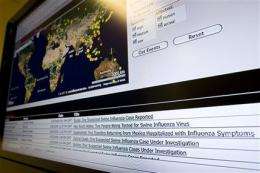
Veratect Inc., a 2-year-old company with fewer than 50 employees, combines computer algorithms with human analysts to monitor online and off-line sources for hints of disease outbreaks and civil unrest worldwide. It tracks thousands of "events" each month - an odd case of respiratory illness, or a run on over-the-counter medicines, for example - then ranks them for severity and posts them on a subscription-only Web portal for clients who want early warnings.
The idea fueling Veratect and similar companies is that blogs, online chat rooms, Twitter feeds and news media and government Web sites are full of data that public health agencies could use to respond faster to problems like outbreaks of swine flu.
Veratect attracted attention in recent days by publicly posting a timeline of the outbreak and publishing short reports on Twitter, where more than 4,000 people signed up to receive updates.
But skeptics question whether these companies can reliably detect meaningful signals from all the noise online or whether they are mainly good at spotting patterns in hindsight. Complicating the picture, the companies are reluctant to disclose their sources and methods.
Veratect's chief executive, Robert Hart, says the company alerted clients to a potentially severe outbreak before the general public learned of swine flu. Veratect's computer systems, which troll the Web for reports that seem out of the ordinary, unearthed clues, and a team of about 30 analysts, many of them multilingual holders of public health degrees, chased down the ones that seemed most alarming.
Veratect says it posted a report to clients on April 6 describing an unusual number of respiratory illnesses in the Mexican state of Veracruz, then sent an e-mail on April 16 to the Centers for Disease Control pointing to an outbreak of atypical pneumonia in Oaxaca state, after officials there issued an alert.
A key clue came in Mexican media reports on April 6 indicating a Veracruz community called La Gloria - now considered a swine flu hot spot - was starting to point fingers. Local residents blamed waste from a nearby pig breeding farm for the respiratory illness, while health officials pinned it on a fly.
"Playing the blame game is one of those indicators" that something unusual is going on, said Dr. James Wilson, Veratect's chief scientist. When the company posted the La Gloria information, it treated the incident as a matter of "moderate severity."
To be sure, not everything Veratect turned up was related to the outbreak. Veratect told its clients of a Canadian lawyer hospitalized in late March after a trip to Mexico, but on Tuesday the company said he has since tested negative for swine flu.
Even with the flaws, clients like World Vision, the large Christian humanitarian organization based in Federal Way, Wash., pay Veratect for its intelligence.
Recently, World Vision shifted resources - water purification tablets and education staffers - to areas Veratect thinks might see cholera outbreaks, said Brian Carlson, the head of technology for World Vision's global relief efforts.
A 10-year-old Veratect rival, Annapolis, Md.-based iJet Intelligent Risk Systems, also tracks Web reports and uses analysts to interpret the data. Marty Pfinsgraff, iJet's chief operating officer, said it monitors emerging health risks, civil unrest and issues such as telecommunications outages. He said iJet advised clients to cancel unnecessary travel to Mexico and to activate pandemic plans last Friday, before health officials weighed in. Pfinsgraff said the CDC is among iJet's paying clients.
Other efforts focus more narrowly on disease. ProMed, a system designed by the Federation of American Scientists, lets human, animal and plant specialists share infectious disease information. A site called HealthMap compiles data from ProMed, the CDC, the World Health Organization and other sources. A volunteer-built site called FluWiki has tracked bird flu since 2005, and last year Google Inc. launched Flu Trends, which gauges U.S. flu conditions based on increases in flu-themed Web searches.
Specialists in disease outbreaks acknowledge that unscientific, community-level information can be valuable. For example, when a parasite slipped through Milwaukee's water treatment system in 1993, the first sign of trouble came in reports to city health officials that drugstores were selling out of diarrhea medicines.
But some public health experts say it's not possible to draw firm conclusions from online tools or reports from companies like Veratect.
"They are considered interesting, unofficial, instructive, imaginative, and then I would go back and emphasize unofficial," said Dr. William Schaffner, a public health expert at Vanderbilt University and a spokesman for the Infectious Disease Society of America.
Dr. Scott Dowell, who heads the CDC's international swine flu team, said the agency looks at reports from Veratect and other companies in the course of monitoring outbreaks around the world. Veratect is often useful, Dowell said, and can be very sensitive to emerging threats.
"It also generates a lot of noise," he said.
Others add that it's risky to act on early signals. Without positive lab tests, reports of new cases are unreliable, in part because mystery illnesses prompt uninfected people to think they have the symptoms.
Even now, when some of Veratect's findings appear to be bearing fruit, the focus on La Gloria as a disease epicenter may turn out to be off-base.
Dr. Philip Brachman, an Emory University professor who for years led the CDC's Epidemic Intelligence Service, said the scapegoating of the pig farm Veratect detected might stem from an existing local grudge.
"The town probably doesn't like the pig farm," Brachman said, "because of the odor."
---
AP Medical Writers Mike Stobbe in Atlanta and Marilynn Marchione in Chicago contributed to this report.
©2009 The Associated Press. All rights reserved. This material may not be published, broadcast, rewritten or redistributed.


