S.Korea lifts ban on stem cell research
April 29, 2009 South Korea plans to build the world's largest stem cell research and treatment centre in Seoul by 2013

Enlarge

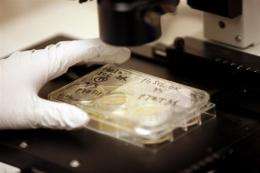
A scientist looks at a colony of embryonic stem cells. South Korea has conditionally lifted a ban on stem cell research using human eggs, three years after outlawing the practice because a scientist was found to have faked his work.

South Korea on Wednesday conditionally lifted a ban on stem cell research using human eggs, three years after outlawing the practice because a scientist was found to have faked his work.

The national committee on bioethics said it agreed to approve a new research project provided its scientists met certain conditions.

A team from Seoul's Cha General Hospital had sought approval for its stem cell project using aborted human eggs to develop cures for grave human diseases.

The committee gave it the go-ahead on four conditions.

The hospital must secure fresh written consent from egg donors, focus on lab animals to minimise the use of such eggs and set up an internal screening body to check for possible abuse.

It should also remove references from the project title that could give people false hope. The title mentions " which can cure diseases such as Parkinson's."

"This research that we have conditionally approved today is really just the very first step towards a new academic study," bioethics committee chief Roh Jae-Kyung told reporters.

"Though we hope this will eventually become a ray of hope for those patients with an incurable disease, we want you to refrain from premature or excessive expectations."

The committee banned research using human eggs in 2006 after Hwang Woo-Suk's claims that he created the first human through cloning were ruled to be bogus.

South Korean scientists had urged the government to relax its ban, especially after US President this year lifted a ban on federal funding for such research.

The hospital's leading researcher, Chung Hyung-Min, welcomed the committee's decision and said he would try to meet its conditions.

"The decision will help reactivate stem cell research in ," Chung said.

"Stem cell research has been done by scientists in Britain and other countries. But there has been no successful case yet, using human eggs," he said.

Lee said the hospital would build the world's largest stem cell research and treatment centre in southern Seoul by 2013.

The bioethics committee has rejected a similar request from Hwang, who is now engaged in animal cloning but wants to begin a new embryonic stem cell research project using eggs from aborted foetuses.

Hwang, still on trial for fraud, embezzlement, ethical breaches and other charges, has insisted in court that he could prove he created the first cloned human stem cells.

(c) 2009 AFP


Rate this story - not rated yet


April 29, 2009 all stories

Comments: 0

not rated yet

  • hide
  • Related Stories

  • Disgraced Scientist to Resume Research
    created Jun 28, 2006 | popularity not rated yet | comments 0
  • Briefs: Korean scientist's research license voided
    created Mar 16, 2006 | popularity not rated yet | comments 0
  • Japan to learn cloning skills from S.Korea
    created Jul 19, 2005 | popularity not rated yet | comments 0
  • British panel to debate hybrid embryo fate
    created Jan 10, 2007 | popularity not rated yet | comments 0
  • In Brief: Egg donors sue S. Korean hospitals
    created Apr 22, 2006 | popularity not rated yet | comments 0


  • hide
  • Relevant PhysicsForums posts

Other News

giant oarfish

Bizarre giant oarfish filmed (w/ Video)

Biology / Plants & Animals

created 3 hours ago | popularity 4.3 / 5 (4) | comments 0 | with audio podcast report

(PhysOrg.com) -- A rare giant oarfish, probably the largest bony fish in the ocean, has been filmed off the Gulf of Mexico. This is possibly the first time the fish has been observed in its natural environment.


Scientists crash test DNA's replication machinery

Biology / Cell & Microbiology

created 2 hours ago | popularity 5 / 5 (2) | comments 0 | with audio podcast

(PhysOrg.com) -- Important molecular machines routinely crash into one another while plying their trades on DNA. New research shows that the enzymes that copy DNA before cell division, called replisomes, are the kings of ...


Benefits of badger culling not long lasting for reducing cattle TB, says study

Benefits of badger culling not long lasting for reducing cattle TB, says study

Biology / Ecology

created 2 hours ago | popularity not rated yet | comments 0

(PhysOrg.com) -- Badger culling is unlikely to be a cost-effective way of helping control cattle TB in Britain, according to research published today in PLoS ONE.


Great tits: birds with character

Great tits: birds with character

Biology / Plants & Animals

created 16 hours ago | popularity 5 / 5 (3) | comments 3 | with audio podcast

(PhysOrg.com) -- In humans and animals alike, individuals differ in sets of traits that we usually refer to as personality. An important part of the individual difference in personality is due to variation ...


Scientists release Key Largo wood rats in first test of restocking experiment

Biology / Ecology

created 3 hours ago | popularity not rated yet | comments 0

The seven pioneers spent the week preparing for their upcoming ordeal in North Key Largo, sampling berries and other local fare, redecorating homes with sticks, leaves and whatever else they got their little paws on, and ...