Watching solar activity muddle Earth's magnetic field
April 29, 2009 Watching solar activity muddle Earth's magnetic field

Enlarge

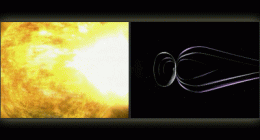
Effect of extreme solar activity on Earth's magnetosphere. Click Enlarge for animation.

(PhysOrg.com) -- Scientists have found that extreme solar activity drastically compresses the magnetosphere and modifies the composition of ions in near-Earth space. They are now looking to model how these changes affect orbiting satellites, including the GPS system.

The results were obtained from coordinated in-situ measurements performed by ESA’s four Cluster satellites along with the two Chinese/ESA Double Star satellites.

Under normal solar conditions, GPS satellites orbit within the magnetosphere—the protective magnetic bubble carved out by Earth’s magnetic field. But when solar activity increases, the picture changes significantly: compressed and particles become energized, exposing satellites to higher doses of radiation that can perturb signal reception.

Such increased affects all satellites, not only the GPS system. This is why monitoring and forecasting its impact on near-Earth space is becoming increasingly critical to safeguarding daily life on Earth. One way to do this is by studying the physics of near-Earth space and observing the impact of such activity in time.
Watching solar activity muddle Earth's magnetic field
Enlarge

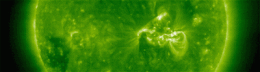
High-energy (X-3) solar flare on 13 December 2006. Credits: ESA/NASA/SOHO. Click Enlarge for animation.

During two extreme solar explosions, or , on 21 January 2005 and 13 December 2006, the Cluster constellation and the two Double Star satellites were favourably positioned to observe the events at a large scale. The satellites carried out coordinated measurements of the response of the magnetosphere to these events.

During both events, the velocity of positively charged particles in the solar wind was found to be higher than 900 km/s, more than twice their normal speed. In addition, the density of charged particles around Earth was recorded as five times higher than normal. The measurements taken in January 2005 also showed a drastic change in ion composition.

These factors together caused the magnetosphere to be compressed. Data show that the ‘nose’ of the dayside magnetopause (the outer boundary of the magnetosphere), usually located about 60 000 km from Earth, was only 25 000 km away.

The second explosion in December 2006 released extremely powerful high-energy X-rays followed by a huge amount of mass from the solar atmosphere (called a coronal mass ejection). During the event, GPS signal reception on ground was lost.

Typical nose-like ion structures in near-Earth space were washed out as energetic particles were injected into the magnetosphere. These nose-like structures, that had formed earlier in the ‘ring current’ in the equatorial region near Earth, were detected simultaneously on opposite sides of Earth. Measurements of the ring current showed that its strength had increased.
Double Star mission in orbit
Enlarge

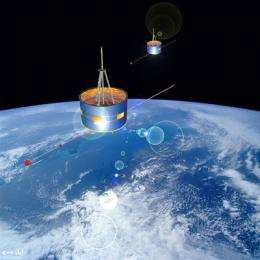
An artist's impression of the Double Star mission in orbit. Credits: ESA

About five hours after the coronal mass ejection hit Earth’s magnetosphere, a Double Star observed penetrating solar energetic particles on the night side. These particles are hazardous to astronauts as well as satellites.

“With these detailed observations, we’ll be able to plug in data and better estimate what happens to the inner magnetosphere and near-Earth space during such explosions on the Sun”, said Iannis Dandouras, lead author of the results published recently, and Principal Investigator of the Cluster Ion Spectrometer.

“Looking at such a large-scale physical phenomena with a single satellite is akin to predicting the impact of a tsunami with a single buoy,” added Matt Taylor, ESA’s Project Scientist for Cluster and Double Star. “With Cluster and Double Star we have monitored both sides of Earth simultaneously, and obtained valuable in-situ data.”

More information: These results appear in Dandouras, I.S., Rčme, H., Cao, J. & Escoubet, P. (2009). Magnetosphere response to the 2005 and 2006 extreme solar events as observed by the Cluster and Double Star spacecraft. Advances in Space Research. Vol.43,618-623.

Provided by European Space Agency (news : web)


print this article email this article download pdf blog this article bookmark this article     Stumble it Digg this share on Facebook retweet share on Reddit add to delicious
Rate this story - 4.5 /5 (2 votes)

Rank Filter

Move the slider to adjust rank threshold, so that you can hide some of the comments.


Display comments: newest first

  • Mercury_01 - Apr 29, 2009
    • Rank: not rated yet
    That was an awesome animation. This stuff scares the living buhjeezuz out of me. bloody hell.
  • omatumr - Apr 29, 2009
    • Rank: not rated yet
    Thanks for additional evidence that the Sun and the Earth are intimately connected - magnetically, gravitationally and electrically.

    Earth and the Sun are mistakenly perceived as separate entities because visible light from the photosphere produces the illusion of a solar surface between the Earth and the Sun.

    However the Earth and the other planets glide through the outer layer of the Sun - the heliosphere - and are almost instantly affected by heliospheric disturbances.

    The observations were made in 2005 and 2006, when surface solar activity was much higher than now.

    These results further weaken the idea that the Sun can only cause changes in our climate by changes in solar irradiance.

    With kind results,
    Oliver K. Manuel
    http://www.omatumr.com
  • am_Unition - Apr 30, 2009
    • Rank: not rated yet
    Radiation Storm Belt Probe launches in 2011.

    Problem is, there isn't going to be any geomagnetic storming if the solar cycle never kicks up again.
  • Mercury_01 - Apr 30, 2009
    • Rank: not rated yet
    oh, it will.

April 29, 2009 all stories

Comments: 4

4.5 /5 (2 votes)
  • Stumble this up

  • Digg this

  • share this

  • hide
  • Related Stories

  • Double Star TC-1 completes its mission
    created Oct 16, 2007 | popularity not rated yet | comments 0
  • Killer electrons in space are now less mysterious
    created Jul 26, 2007 | popularity not rated yet | comments 0
  • Cluster spacecraft reach greatest separation at fifth anniversary
    created Jul 14, 2005 | popularity not rated yet | comments 0
  • Spacecrafts witness a new facet of Earth's magnetic behaviour
    created Mar 30, 2006 | popularity not rated yet | comments 0
  • Model Reveals How Plasma from Superstorms Affects Near-Earth Space
    created May 29, 2008 | popularity not rated yet | comments 0


  • hide
  • Relevant PhysicsForums posts

  • The shape of our solar system's orbits.
    created Nov 07, 2009
  • Above or Below the Line of Nodes
    created Nov 07, 2009
  • Supernova vs. Nova?
    created Nov 07, 2009
  • Supernova's Gamma Rays and Comets
    created Nov 06, 2009
  • Our Moon
    created Nov 06, 2009
  • Question about a Carl Zeiss lens
    created Nov 05, 2009
  • More from Physics Forums - General Astronomy

Other News

Deep creep means milder, more frequent earthquakes along Southern California's San Jacinto fault

Deep creep means milder, more frequent earthquakes along Southern California's San Jacinto fault

Space & Earth / Earth Sciences

created 13 hours ago | popularity 4.7 / 5 (3) | comments 0

With an average of four mini-earthquakes per day, Southern California's San Jacinto fault constantly adjusts to make it a less likely candidate for a major earthquake than its quiet neighbor to the east, the ...


Success in 'space elevator' competition (AP)

Success in 'space elevator' competition (Update 3)

Space & Earth / Space Exploration

created Nov 05, 2009 | popularity 4.3 / 5 (33) | comments 50

(AP) -- A robot powered by a ground-based laser beam climbed a long cable dangling from a helicopter on Wednesday to qualify for prize money in a $2 million competition to test the potential reality of the ...


In a Galaxy Far, Far Away...

In a Galaxy Far, Far Away...

Space & Earth / Astronomy

created Nov 06, 2009 | popularity 4.8 / 5 (5) | comments 17

(PhysOrg.com) -- Astronomers have published the discovery of the farthest known object in the cosmos: a star that exploded when the universe was only 630 million years old -- only 4.6% of its current age. ...


'Dropouts' pinpoint earliest galaxies

'Dropouts' pinpoint earliest galaxies

Space & Earth / Astronomy

created Nov 06, 2009 | popularity 4.2 / 5 (10) | comments 13

Astronomers, conducting the broadest survey to date of galaxies from about 800 million years after the Big Bang, have found 22 early galaxies and confirmed the age of one by its characteristic hydrogen signature ...


Space hotel taking bookings for 2012 opening

Space hotel taking bookings for 2012 opening

Space & Earth / Space Exploration

created Nov 05, 2009 | popularity 4.4 / 5 (21) | comments 11

(PhysOrg.com) -- The first orbiting space hotel is on track to open for its first customers in 2012, but hurry, as bookings are filling fast.