Rogue Black Holes May Roam the Milky Way
April 29, 2009
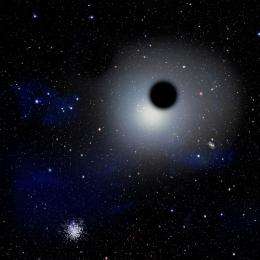
This artist's conception shows a rogue black hole floating near a globular star cluster on the outskirts of the Milky Way. New calculations by Ryan O'Leary and Avi Loeb suggest that hundreds of massive black holes, left over from the galaxy-building days of the early universe, may wander the Milky Way. Fortunately, the closest rogue black hole should reside thousands of light-years from Earth. Credit: David A. Aguilar (CfA)
(PhysOrg.com) -- It sounds like the plot of a sci-fi movie: rogue black holes roaming our galaxy, threatening to swallow anything that gets too close. In fact, new calculations by Ryan O'Leary and Avi Loeb (Harvard-Smithsonian Center for Astrophysics) suggest that hundreds of massive black holes, left over from the galaxy-building days of the early universe, may wander the Milky Way.
Good news, however: Earth is safe. The closest rogue black hole should reside thousands of light-years away. Astronomers are eager to locate them, though, for the clues they will provide to the formation of the Milky Way.
"These black holes are relics of the Milky Way's past," said Loeb. "You could say that we are archaeologists studying those relics to learn about our galaxy's history and the formation history of black holes in the early universe."
According to theory, rogue black holes originally lurked at the centers of tiny, low-mass galaxies. Over billions of years, those dwarf galaxies smashed together to form full-sized galaxies like the Milky Way.
Each time two proto-galaxies with central black holes collided, their black holes merged to form a single, "relic" black hole. During the merger, directional emission of gravitational radiation would cause the black hole to recoil. A typical kick would send the black hole speeding outward fast enough to escape its host dwarf galaxy, but not fast enough to leave the galactic neighborhood completely. As a result, such black holes would still be around today in the outer reaches of the Milky Way halo.
Hundreds of rogue black holes should be traveling the Milky Way's outskirts, each containing the mass of 1,000 to 100,000 suns. They would be difficult to spot on their own because a black hole is visible only when it is swallowing, or accreting, matter.
One telltale sign could mark a rogue black hole: a surrounding cluster of stars yanked from the dwarf galaxy when the black hole escaped. Only the stars closest to the black hole would be tugged along, so the cluster would be very compact.
Due to the cluster's small size on the sky, appearing to be a single star, astronomers would have to look for more subtle clues to its existence and origin. For example, its spectrum would show that multiple stars were present, together producing broad spectral lines. The stars in the cluster would be moving rapidly, their paths influenced by the gravity of the black hole.
"The surrounding star cluster acts much like a lighthouse that pinpoints a dangerous reef," explained O'Leary. "Without the shining stars to guide our way, the black holes would be all but impossible to find."
The number of rogue black holes in our galaxy depends on how many of the proto-galactic building blocks contained black holes at their cores, and how those proto-galaxies merged to form the Milky Way. Finding and studying them will provide new clues about the history of our galaxy.
Locating the star cluster signposts may turn out to be relatively straightforward.
"Until now, astronomers were not searching for such a population of highly compact star clusters in the Milky Way's halo," said Loeb. "Now that we know what to expect, we can examine existing sky surveys for this new class of objects."
Loeb and O'Leary's journal paper will be published in the Monthly Notices of the Royal Astronomical Society and is available online at http://arxiv.org/abs/0809.4262 .
Provided by
-
How to find a black hole
Oct 20, 2005 |
not rated yet |
0
-
Huge Black Holes Stifle Star Formation
Aug 23, 2006 |
not rated yet |
0
-
Most Black Holes Might Come in Only Small and Large
Aug 20, 2008 |
not rated yet |
0
-
Galaxy may hold hundreds of rogue black holes
Jan 09, 2008 |
not rated yet |
0
-
Astronomers detect black hole in tiny 'dwarf' galaxy
Jan 07, 2007 |
not rated yet |
0
-
Engineers build first sub-10-nm carbon nanotube transistor
Feb 01, 2012 |
4.9 / 5 (33) |
30
-
Something old, something new: Evolution and the structural divergence of duplicate genes
Jan 31, 2012 |
4.6 / 5 (7) |
1
-
The hidden nanoworld of ice crystals: Revealing the dynamic behavior of quasi-liquid layers
Jan 30, 2012 |
5 / 5 (4) |
1
-
Stock market network reveals investor clustering
Jan 27, 2012 |
3.9 / 5 (23) |
8
-
Of microchemistry and molecules: Electronic microfluidic device synthesizes biocompatible probes
Jan 26, 2012 |
5 / 5 (2) |
0
-
Never ending outer space.....
23 hours ago
-
Neutron Star fragments?
Feb 11, 2012
-
stationary or not?
Feb 11, 2012
-
Scale of the Universe
Feb 10, 2012
-
Titan's lack of impact craters
Feb 09, 2012
-
Real pictures of black hole eating a star?
Feb 08, 2012
- More from Physics Forums - General Astronomy
More news stories
Salvage workers begin pumping fuel from Italian shipwreck
Salvage workers Sunday began pumping fuel from the shipwrecked Italian cruise liner Costa Concordia, a day ahead of schedule, officials said.
8 hours ago |
5 / 5 (1) |
0
Latin America mining boom clashes with conservation
Latin America is experiencing a mining boom as prices rise fuelled by a hike in global demand, but the region is also being hit by a wave of violent protests, strikes and rallies by environmentalists.
16 hours ago |
5 / 5 (1) |
1
Political leaders play key role in how worried Americans are by climate change: study
More than extreme weather events and the work of scientists, it is national political leaders who influence how much Americans worry about the threat of climate change, new research finds.
Feb 06, 2012 |
5 / 5 (7) |
73
NASA budget will axe Mars deal with Europe: scientists
US President Barack Obama's budget proposal to be submitted next week for 2013 will cut NASA's budget by 20 percent and eliminate a major partnership with Europe on Mars exploration, scientists said Thursday.
Space & Earth / Space Exploration
Feb 10, 2012 |
5 / 5 (3) |
58
Humans may have helped the decline of African rainforests 3000 years ago
(PhysOrg.com) -- Large areas of rainforests in Central Africa mysteriously disappeared over three thousand years ago, to be replaced by savannas. The prevailing theory has been that the cause was a change ...
Scientists discover molecular secrets of 2,000-year-old Chinese herbal remedy
For roughly two thousand years, Chinese herbalists have treated Malaria using a root extract, commonly known as Chang Shan, from a type of hydrangea that grows in Tibet and Nepal. More recent studies suggest that halofuginone, ...
New method to examine batteries -- MRI from the inside
There is an ever-increasing need for advanced batteries for portable electronics, such as phones, cameras, and music players, but also to power electric vehicles and to facilitate the distribution and storage of energy derived ...
Google might launch Drive for cloud storage soon
(PhysOrg.com) -- Google's next big move, according to the Wall Street Journal, is a cloud storage service called Drive. Hardly first to the plate, Google is simply catching up to introducing its cloud reposi ...
A mitosis mystery solved: How chromosomes align perfectly in a dividing cell
Although the process of mitotic cell division has been studied intensely for more than 50 years, Whitehead Institute researchers have only now solved the mystery of how cells correctly align their chromosomes during symmetric ...
Lab study raises questions over nano-particle impact
Tests involving chickens have raised questions about the impact on health from engineered nano-particles, the ultra-fine grains commonly used in drugs and processed foods, scientists said on Sunday.
Starve a virus, feed a cure? Findings show how some cells protect themselves against HIV
A protein that protects some of our immune cells from the most common and virulent form of HIV works by starving the virus of the molecular building blocks that it needs to replicate, according to research published online ...
Apr 29, 2009
Rank: 4 / 5 (2)
I wonder if we'll ever get a follow up regarding their observations.
Apr 29, 2009
Rank: 4 / 5 (1)
Apr 29, 2009
Rank: 5 / 5 (4)
I recall a previous article (I think it was also in PhysOrg) about NASA or ESA tracking a "rogue star" that was screaming through our galaxy at enormous speed relative to the nearby stars it was passing. I'm also an avid follower of the Einstein@Home project for gravity wave detection from BH and neutron stars.
I still wonder if a single BH or neutron star moving at large relative velocity through the galaxy would leave a detectable "wake" in the surrounding gravity field, independant of any gravity waves it may produce due to it's own rotation, and afford us a way to detect these things.
Apr 29, 2009
Rank: 5 / 5 (5)
Apr 29, 2009
Rank: 5 / 5 (3)
Apr 29, 2009
Rank: 4.3 / 5 (3)
Apr 29, 2009
Rank: 4 / 5 (3)
Apr 30, 2009
Rank: not rated yet
Still, it's amazing what people can come up when they think about black hole. But apart from creativity, there's still too much of a discussion whether we have observed a black hole at all, so although fun, there's not much point of discussion probable dark objects flying around our galaxy.
Apr 30, 2009
Rank: not rated yet
Apr 30, 2009
Rank: not rated yet
Realistically, I imagine it would be resource intensive (or else take incredible luck) to find one this way.
Simplistically, I would think you'd need a method of baselining all the background images of the surrounding sky and then a system to monitor the sky in all (or many, or a few?) directions looking for visible changes specifically due to lensing.
That's why I was thinking first about a method of direct detection of the BH itself from gravity waves (via LIGO or LISA, or similar).
Apr 30, 2009
Rank: not rated yet
They already have a common sense approach... Look for clusters of stars orbiting a non-luminous central point which itself is orbiting the galactic core.
May 01, 2009
Rank: not rated yet
Good point.
If the rogue BH was inside our galaxy rather than outside (closer to Earth and with closer objects behind it), how much more (or less) pronounced could the visible lensing effect be?
May 05, 2009
Rank: not rated yet
So I agree with barkster.
So the idea is great. Very good method although is real life other methods are preferred because they are easier and have better precision