Mites On Hissing Coackroach May Benefit Humans With Allergies
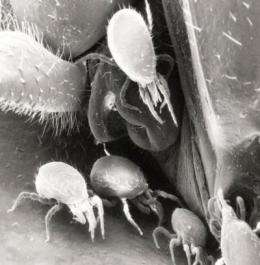
(PhysOrg.com) -- Tiny mites living on the surface of Madagascar hissing cockroaches help decrease the presence of a variety of molds on the cockroaches' bodies, potentially reducing allergic responses among humans who handle the popular insects, according to new research.
Scientists cultured and identified fungi on the cockroaches' body surfaces with and without mites and discovered that the presence of these mites reduced the molds by at least 50 percent.
Many of these same researchers reported a year ago that 14 different types of mold were present on and around this species of cockroach, including several fungi associated with allergies and others that can cause secondary infections if they enter the lungs or an open wound.
The mites eat saliva and organic debris that collects between the cockroaches' legs, eliminating material that would foster mold growth on the insects' bodies. The mites don't appear to actually eat any mold.
"We haven't proved yet that this helps the cockroaches, but reducing the fungi present on their surface is beneficial overall," said Joshua Benoit, a doctoral student in entomology at Ohio State University and a co-author of the study. "By suppressing the molds, the mites have a role in reducing allergic reactions to cockroaches."
The research is published in the current issue of the journal Symbiosis.
he Madagascar hissing cockroach, or Gromphadorhina portentosa, grows to between 2 and 3 inches long and 1 inch wide, and makes its characteristic hissing sound if it is squeezed or otherwise feels threatened. Its gentle nature, large size, odd sounds and low-maintenance care have made the species a popular educational tool and pet for years.
When Benoit and colleagues discovered the molds on cockroach surfaces in a previous study, they recommended that people wash their hands after handling the cockroaches and emphasized the need to keep the insects' cages clean. Because the mites do not completely eliminate fungi, the researchers continue to recommend that people sensitive to molds use care in handling Madagascar hissing cockroaches.
It turns out that not all colonies of Madagascar hissing cockroaches harbor the mites, a species called Gromphadorholaelaps schaeferi. Researchers do not know why that is. But the cockroaches that do harbor mites also harbor fewer molds on their bodies.
In the study, female cockroaches with mites had 64 percent fewer fungal colonies than those lacking mites. In males, the difference was 31 percent, and in nymphs, or younger and smaller cockroaches, there were 24 percent fewer fungi.
To ensure the mites were responsible for the reduction in fungi, the researchers tested colonies with and without mites, but also removed mites from colonies that originally had mites and added mites to cockroaches that didn't initially harbor any mites. In all cases, the presence of mites resulted in lower levels of mold.
The most commonly found mold species found on the body surfaces of young and adult Madagascar hissing cockroaches were Rhizopus, Penicillium, Mucor, Trichoderma and Alternaria, several of which are listed by the Centers for Disease Control and Prevention (CDC) as common indoor molds.
"The presence of the mites caused a reduction in all fungi on the surface, not just a select few kinds of fungus," said Jay Yoder, a professor of biology at Wittenberg University and lead author of the study.
About 20 to 25 mites live on each adult cockroach. The scientists experimented by adding more mites to the insects' surfaces, but found that more mites didn't result in a more significant reduction in molds.
"The number on each insect is based on the food available," Benoit said.
In captivity, Madagascar hissing cockroaches thrive on dog food and fruit. Benoit said they tend to slobber on themselves when they eat, leaving saliva and organic debris in crevices along the lower middle portions of their bodies for the mites to eat. The mites are in particular need of the moisture in the food - meaning they eat up water and nutrients that molds need to establish themselves and grow.
The mites also obtain moisture from spiracles through which the cockroaches breathe. The mites cannot live anywhere else but on the surface of the Madagascar hissing cockroach. Chemical cues from growing nymphs offer signals that a new host is large enough to house a colony of mites. When a host cockroach dies, the mites wander aimlessly on the carcass until they die, too.
Whether the mites offer any benefits to the cockroaches remains to be seen. But it has been established that they do no harm. "The mites on the cockroaches have no negative effect at all. They don't impede their development and don't cause any parasitism," Benoit said.
For now, the scientists describe the symbiotic relationship as commensalism rather than mutualism, meaning just one species clearly benefits and no damage is done to the other.
Source: The Ohio State University (news : web)


